Claiming What's Yours: A Complete MSME Guide to Assam's Industrial Incentive Stack
As marquee industrial incentive schemes like UNNATI 2024 are getting phased out, MSMEs looking to set up industries in Assam need to file for updated incentive and subsidy schemes. This report lays out the Aug 2026 landscape.
0 of 5 sections read
This guide, first published in March 2026, listed five schemes as stackable for Assam MSMEs.
Two of those five have since closed to new applicants. This update corrects the record.
Check your numbers first
Run your project’s numbers through the free Nitisagar Subsidy Calculator before reading further. It was rebuilt in August 2026 on the corrected IIPA 2019 basis this guide describes.
UNNATI 2024 registration window was extended from Mar 31 2026 to Sep 30, 2026.
But that extension is now largely meaningless. Visit the website today, and you will see this popup:
Registration of further applications on the UNNATI Portal has presently been stopped on account of applications exceeding the available funding for the Scheme against allocated to the States. The applications received are being reviewed and in the event of rejection of existing applications or availability of funds, the registration process may be resumed.
Registrations already breached the scheme’s Rs 11,543 Cr trigger. That is 115% of the Rs 10,037 Cr outlay, so applications stopped before the extended window closes.
NEIDS 2017 closed earlier still, on 31 March 2022, with no equivalent reopening mechanism in its notification.
Both schemes continue paying units that registered before they stopped, over multi-year disbursement windows. Neither accepts a fresh application today.
This report is a point-in-time snapshot, refreshed on the schedule at the top of the page. For the current status of every Assam and central scheme between updates, search the Policy Explorer.
FIGURE 1: SCHEME STATUS, AUGUST 2026
Sources: DPIIT UNNATI portal; Assam IIPA 2019 portal; scheme notifications cited throughout this guide.
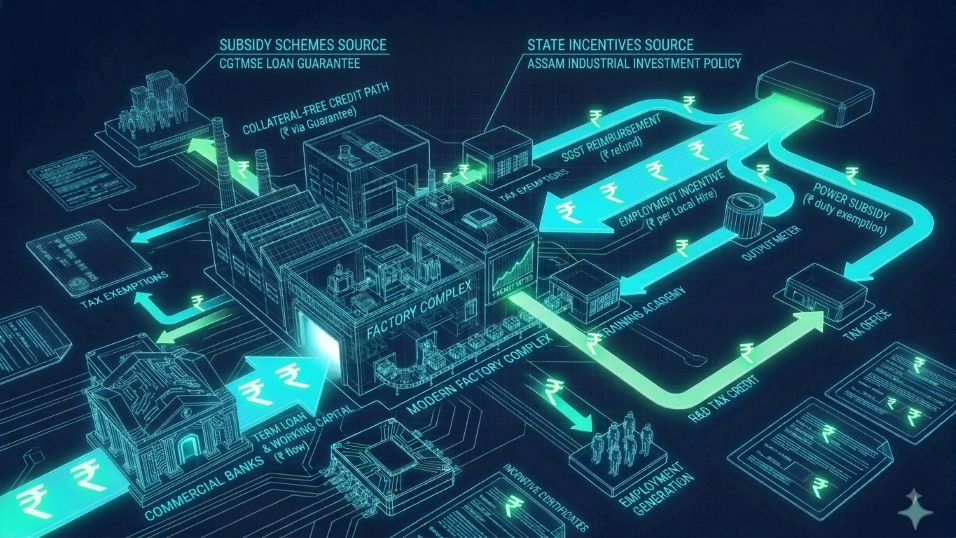
A new MSME investor in August 2026 can access three schemes:
- IIPA 2019 (AIDP): Assam’s state industrial policy, extended indefinitely since September 2024 with no fixed end date. This is now the default scheme.
- PMEGP: central margin-money subsidy for new micro units, administered through DIC offices.
- CGTMSE: central credit guarantee cover for collateral-free loans. Not a cash subsidy, but a financing enabler.
Assam MSME incentive schemes, status as of August 2026
| Scheme | Type | Max benefit |
|---|---|---|
| IIPA 2019 (AIDP): SGST Reimbursement 100% SGST reimbursed for 15 years, capped by enterprise size Open (default scheme) | State | 150-250% of Fixed Capital Investment |
| IIPA 2019 (AIDP): Other Incentives Nine capped lines covering power, stamp duty, working capital interest and more Open | State | 100% of FCI, aggregate cap |
| PMEGP Margin-money subsidy for new micro manufacturing and service units Open | Central | Linked to project cost |
| CGTMSE Collateral-free credit guarantee cover on MSME loans Open | Central | Financing enabler, not a cash subsidy |
| UNNATI 2024: Capital Investment Incentive (CII) 30% (Zone A) or 50% (Zone B) of eligible plant and machinery, for registered units only Presently stopped | Central | Rs 5-7.5 Cr, Rs 10 Cr where GST does not apply |
| UNNATI 2024: Capital Interest Subvention (CIS) 3% (Zone A) or 5% (Zone B) interest subvention for 7 years, for registered units only Presently stopped | Central | On loans up to Rs 250 Cr principal |
| UNNATI 2024: Manufacturing & Services Linked Incentive (MSLI) 100% of net GST for up to 10 years, for registered units only Presently stopped | Central | Linked to net GST paid |
| NEIDS: Transport Subsidy Freight-cost subsidy on goods dispatched out of NER, for registered units only Closed since 2022 | Central | Percentage of freight cost |
| Assam Electronics / Semiconductor Policy 2023 40% additional on central CAPEX support, plus land and power-tariff incentives Not MSME-accessible | State | Anchor-scale projects only |
Key principle, updated
IIPA 2019, PMEGP and CGTMSE draw from different budget heads. They are generally additive for a new applicant.
UNNATI and NEIDS now form a separate track, one only existing registrants can draw from. NEIDS is permanently closed.
UNNATI is presently stopped, and could resume if DPIIT’s funding position changes. Check the portal before assuming either way.
IIPA 2019, the live default scheme for a new applicant, has no district dimension at all.
The Assam government’s own IIPA 2019 portal segregates incentives by enterprise size instead: Micro, Small, Medium, Large or Mega, based mainly on plant and machinery investment.
What actually decides your IIPA 2019 incentive:
| Enterprise category | SGST cap, units outside parks | SGST cap, units in Govt-collaborated parks |
|---|---|---|
| Micro | 200% of Fixed Capital Investment | 250% of FCI |
| Small | 150% of FCI | 180% of FCI |
| Medium and Large | 150% of FCI | 150% of FCI |
| Mega (Rs 100 Cr+ FCI, or 200+ employees, custom negotiated) | up to 200% of FCI | Negotiated via AIIDC |
Every line runs for 15 years, 100% SGST reimbursed against tax actually paid.
Barak Valley Cements’ Rs 482 crore expansion is a working example at the large end. The unit secured 100% SGST reimbursement for 15 years under IIPA 2019, alongside power subsidy and stamp duty reimbursement, with no district classification involved.
At MSME scale, the IIPA 2019 Sub-Committee’s own meeting minutes record the same mechanics at a much smaller size.
M/S Unique Industries in Sonapur, Kamrup Metropolitan, was granted an Eligibility Certificate against a Fixed Capital Investment of roughly Rs 4.86 Cr. Its SGST reimbursement runs 15 years, up to a ceiling of roughly Rs 7.29 Cr, at the 150% of FCI rate.
If you are still registered under UNNATI
Existing UNNATI registrants remain on the two-zone structure: Zone A, the industrially advanced districts, at 30% Capital Investment Incentive, and Zone B, the industrially backward districts, at 50%.
The precise district-to-zone allocation appears in the DPIIT UNNATI gazette annexure. Only Kamrup Metropolitan can be confirmed as Zone A with confidence.
Every other district is provisional pending that annexure. Confirm your unit’s zone against the annexure, not against this guide, before filing a claim.
Applicants moving forward under IIPA 2019 do not need to check a district table at all.
The classification that matters is enterprise size, confirmed when you apply for the Eligibility Certificate.
One filing sequence used to cover every Assam MSME.
Now it depends on whether your unit registered under UNNATI or NEIDS before each scheme stopped taking new applications.
Track one: new applicant, filing today
- IIPA 2019 Eligibility Certificate: apply online within six months of commencing commercial production. This establishes the SGST reimbursement and the capped Other Incentives.
- PMEGP: file through your local DIC office before or alongside project setup. PMEGP is credit-linked, so timing depends on your bank sanction.
- CGTMSE: apply through your lending bank once the loan is sanctioned. This runs alongside the other two, not after them.
IIPA 2019, PMEGP and CGTMSE draw from different budget heads, so claiming one does not disqualify the others.
Track two: existing UNNATI or NEIDS registrant
If your unit registered before the relevant deadline, continue on the original schedule:
- UNNATI CII, CIS and MSLI: continue filing tranche claims against your existing registration. New registration is not possible while the DPIIT portal notice remains in effect.
- NEIDS Transport Subsidy: continue claiming freight subsidy if your unit registered before 31 March 2022.
- IIPA 2019: check with your DIC office whether your unit can also draw IIPA 2019 incentives alongside legacy UNNATI or NEIDS benefits. This has not been confirmed in every case, and should be verified before you assume it.
The stacking principle, updated
The old rule still holds for IIPA 2019, PMEGP and CGTMSE: central and state schemes are additive, since they draw from different budgetary heads.
It does not resurrect NEIDS, which is permanently closed to a new applicant. UNNATI is presently stopped rather than permanently closed. Check unnati.dpiit.gov.in before assuming a fresh application will be rejected.
Applications don’t fail at DIC review. They fail at Stage One, document submission.
The checklist many DIC offices hand out is incomplete.
For existing UNNATI registrants finalising a claim, the five documents most commonly missing:
1. EPF records for all employees Required for MSLI calculation. Most applicants omit this because UNNATI’s popular communication emphasises CII, the capex-linked incentive, and barely mentions MSLI.
Result: the CII claim goes through. The MSLI claim stalls, and is eventually rejected.
2. Capex invoice set, tax invoices, not pro-forma The scheme requires GST-registered tax invoices for all capital expenditure claimed. Pro-forma invoices are routinely submitted instead.
DIC officers sometimes let this pass at Stage One. The DPIIT verification team does not.
3. Investment date declaration, correctly dated The investment date must predate the application, not the unit’s GST registration date. An investment date that post-dates the application voids the claim.
4. Land ownership documentation matching the declared classification A 30-year lease is acceptable under UNNATI. An annual lease is not.
5. CA-certified project report with cost breakup The cost breakup must match the capex declared, line by line.
Discrepancies of even Rs 5 lakh trigger a re-verification request, typically resolved in 60 to 90 days.
Our techno-economic feasibility guide covers how to build a cost breakup that holds up to this scrutiny.
For a new applicant filing under IIPA 2019, the document set is different:
- Eligibility Certificate application, filed online within six months of commencing commercial production, not within six months of registration.
- Employment certificates confirming at least 80% Assam residents in managerial roles and 90% in non-managerial roles.
- Negative-list check against IIPA 2019’s Annexure-I, since certain manufacturing categories are excluded from eligibility.
- SGST payment records, since the reimbursement is claimed against SGST actually debited through the electronic cash ledger, not against a pre-approved lump sum.
- Land tenure and CA-certified cost breakup: the same standard that trips up UNNATI applicants trips up IIPA 2019 applicants too.
The fix
Have a CA review the full document set against the correct checklist before submission: UNNATI’s for a legacy claim, IIPA 2019’s for a new one. The DIC verification window is 30 days for both. A rejection here restarts the clock.
MSME promoters routinely present subsidy-linked project reports to banks, with projected incentive receipts treated as near-term cashflow.
That is not how disbursement works under either scheme, and banks know it.
UNNATI, for existing registrants: incentives disburse in tranches over 5-10 years, verified against production and employment milestones. The headline approval figure is the total committed over the full period, not the Year 1 disbursement.
A simplified timeline for a legacy UNNATI registrant’s Rs 5 Cr capex project in a Zone B district:
- Month 0-6: Application filed, DIC verification, DPIIT acknowledgement
- Month 6-12: First tranche eligibility verified against the production milestone
- Month 12: First disbursement, typically 20-25% of total CII
- Year 2-5: Subsequent tranches against employment and production milestones
- Year 5-10: Final tranches, for the 10-year schemes
IIPA 2019, for a new applicant: SGST reimbursement moves with your output, not with a milestone calendar. Here is the same Rs 5 Cr project ramping up over three years, run through both schemes:
| Year 1, 40% capacity | Year 2, 80% capacity | Year 3+, full capacity | |
|---|---|---|---|
| Revenue | Rs 2 Cr | Rs 4 Cr | Rs 6 Cr |
| Output SGST (9%) | Rs 18 lakh | Rs 36 lakh | Rs 54 lakh |
| Input tax credit | Rs 10 lakh | Rs 12 lakh | Rs 14 lakh |
| Net SGST paid, cash ledger | Rs 8 lakh | Rs 24 lakh | Rs 40 lakh |
| IIPA 2019 reimbursement | Rs 8 lakh | Rs 24 lakh | Rs 40 lakh a year |
| UNNATI CII (legacy, Zone B) | ~Rs 55 lakh | ~Rs 22 lakh | ~Rs 22 lakh a year, until Rs 2.5 Cr is paid out |
This table assumes all sales are intrastate, so output SGST applies to the full revenue figure. Any interstate sales would carry IGST instead, which IIPA 2019 does not reimburse.
It also assumes ITC is claimed at the rates shown. A different ITC position changes the net SGST paid, and therefore the reimbursement, line by line.
Same factory, same ramp-up, opposite behaviour.
UNNATI pays a fixed milestone tranche regardless of that year’s output, so it front-loads in Year 1 and flattens after. IIPA 2019 pays out whatever SGST you actually put through the cash ledger that year. It tracks revenue directly: low while you’re ramping up, higher once you’re at capacity.
For your bank proposal
Don’t model either as Year 1-2 operating cashflow. Treat UNNATI tranches as a long-term equity equivalent.
Treat IIPA 2019 reimbursement as a monthly reduction in tax outflow that scales with revenue, not a lump sum.
For a directional estimate, run your project through the free Nitisagar Subsidy Calculator.
It flags scheme-specific conditions for review, rather than guessing a number. Your actual SGST paid, loan terms, or consumption records aren’t something a six-input form can capture. For the land and DPR side of a new unit, see the factory setup playbook.
The moves that matter, before they cost you
Reports like this one are how we go deep on the shifts that decide which projects work in Northeast India. Every new report, briefing, and analysis in your inbox — original reporting, no syndicated fluff.
We'll map your project against IIPA 2019 and Assam's incentive stack, complimentary, no commitment.
Get a Free Pre-Assessment