Semiconductor Packaging Clusters in Asia
Penang Built It In 50 Years. Sanand Is Trying In 5. Here Is What Morigaon Still Needs.
0 of 7 sections read
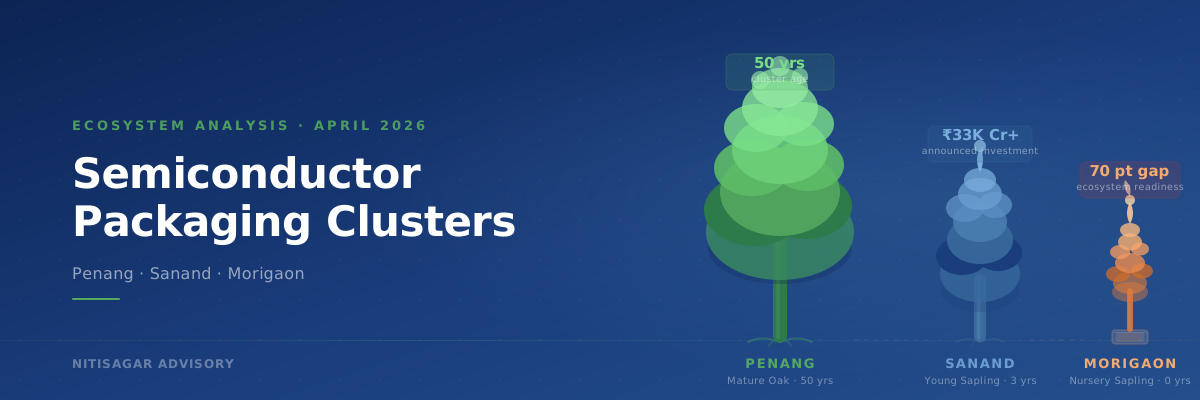
Three semiconductor packaging clusters in Asia represent distinct stages of ecosystem maturity. Penang (Malaysia) is fully established after 50 years of incremental development. Sanand (Gujarat) is scaling at policy-accelerated speed, with two anchor plants in commercial production as of April 2026. Morigaon (Assam) is a greenfield anchor (₹27,000 crore committed, 48 million chips per day of intended capacity) still waiting for its supporting ecosystem to arrive.
The core problem is not the anchor investment. The TSAT facility’s physical readiness is at approximately 90%. Ecosystem readiness (lead frame supply, bonding wire, precision engineering, trained workforce, logistics infrastructure) is at approximately 20%. That 70-point gap does not close by itself, and it does not close in time unless intervention is deliberate and sequenced.
This report maps what Penang built over five decades, what Sanand is racing to build now, and what the gap means for anyone planning investment or operations in Morigaon. The data is drawn from official PIB announcements, SEMI Southeast Asia research, InvestPenang, CSIS analysis (February 2026), and Carnegie Endowment (August 2025).
Penang’s semiconductor cluster did not happen because of a single big investment. It happened because a free trade zone established in 1970 attracted MNC anchors in the 1980s, which pulled in SME suppliers in the 1990s, which enabled IC design and advanced packaging services in the 2000s, which compounded into 50+ precision engineering firms, a dedicated automation cluster, and 5,000+ trained semiconductor professionals today.
The cluster contributes approximately 5% of global semiconductor assembly and testing output, with annual exports of USD 75 billion (2020) and USD 12.8 billion in FDI attracted in 2023. InvestPenang, 2024
Anchor MNCs: Then and Now
Penang’s eight founding MNCs, who entered between 1970 and the mid-1980s, established the process knowledge and workforce base that every subsequent wave built on. SEMI Malaysia
| Founding Company | Entry Era | Current Status in Penang |
|---|---|---|
| Intel | 1972 | Legacy assembly & test + design center; advanced packaging project paused (Feb 2025) |
| Hewlett-Packard (now Keysight / Agilent) | Early 1970s | Test & measurement operations |
| Robert Bosch | Early 1970s | Automotive semiconductor operations |
| AMD | Early 1970s | Design center presence |
| Litronix (now Osram Opto Semiconductors) | Early 1970s | Opto-semiconductor production |
| Hitachi (now Renesas Electronics) | Early 1970s | Semiconductor assembly |
| National Semiconductor | Early 1970s | Now part of Texas Instruments |
| Clarion | Early 1970s | Electronics manufacturing |
What the current anchor capacity looks like: The cluster has expanded far beyond its founding cohort. Today it hosts 350+ MNCs and 4,000 supporting SMEs accounting for roughly 80% of Malaysia’s national assembly and test capacity. Mordor Intelligence, 2025
| Current Major Anchor | Type | Recent Developments |
|---|---|---|
| ASE Technology (Taiwan) | World’s largest OSAT | Inaugurated 5th Penang plant Feb 2025, expanding to 3.4 million sq ft (tripled floor space); focus on AI and automotive packaging |
| Infineon Technologies (Germany) | IDM / Power semiconductor | EUR 2B SiC fab in Kulim; first phase of what will be the world’s largest 200mm SiC facility (2024) |
| AT&S (Austria) | Advanced substrates | EUR 1.7B substrate facility in Kulim opened January 2025, Southeast Asia’s first high-end AI substrate line |
| Micron Technology (USA) | Memory ATMP | Three Malaysia facilities (Muar 2010, Prai 2018, Batu Kawan 2020); produces NAND, compute DRAM, SSDs, DIMMs |
| Intel (USA) | IDM / Assembly & Test | Legacy assembly and test since 1972; design center operational; USD 7B advanced packaging expansion paused as of February 2025 |
| Analog Devices (USA) | IDM / Analog | Penang plant (est. 1994, 680,000 sq ft), being acquired by ASE, deal expected H1 2026 |
Local Malaysian OSAT and E&E Champions
A critical marker of ecosystem maturity is the depth of domestically-owned supply chain firms. Penang has a substantial local layer that most emerging clusters lack entirely.
| Company | Segment | Role in Ecosystem |
|---|---|---|
| Inari Amertron | OSAT | RF module testing; major local OSAT serving multiple Tier-1 customers |
| ViTrox | ATE / Inspection | Automated optical inspection (AOI) equipment; supplies semiconductor and PCB inspection globally |
| MPI (Malaysian Pacific Industries) | OSAT | Semiconductor packaging; long-standing local player |
| Unisem | OSAT | Assembly and test services; serves automotive and industrial segments |
| Globetronics | OSAT / Test | Package and test; also a technology partner to Kaynes Semicon India |
| Experior | IC Design | IC design and IC test design services for MNC clients globally; emerged in last 5 years |
| Oppstar Technology | IC Design | IC design services; publicly listed; emerged in last 5 years |
| Skyechip | IC Design | IC design and test design; serves global fabless clients |
Tier-1 Support Infrastructure
A. Precision Engineering and Automation: The Penang Automation Cluster (PAC)
The Penang Automation Cluster (PAC), established 2017, is a dedicated supply chain hub jointly operated by domestic industrial companies. It includes 50+ specialized metalworking firms offering:
- Precision metal fabrication for semiconductor tooling and fixtures
- Automation components: conveyor systems, robotic fixtures, machine frames
- Machine tool setup, calibration, and maintenance
- Test equipment integration and customization
- German dual vocational training pathways embedded in local polytechnics
PAC serves semiconductor, LED, medical device, and avionics sectors, cross-sector demand that keeps SME suppliers viable even during semiconductor downturns.
B. Electronics Manufacturing Services (EMS)
Multiple regional EMS providers offer PCB assembly, system integration, supply chain logistics, and quality assurance support. Their presence means OSAT plants can source board-level components and module integration locally rather than importing finished assemblies.
C. Automated Test Equipment (ATE) Services
Penang has a mature ATE support layer that Sanand and Morigaon lack entirely:
- IC design and IC test design services from companies including Experior, Oppstar Technology, and Skyechip (all emerged in last five years; serve global MNC clients)
- ATE integration and programming from local specialists
- Test program development (reducing time-to-qualification for new chip families)
- Maintenance, spare parts supply, and calibration services, eliminating the need to fly in technicians from Japan or the US for routine support
D. Silicon Design @5km+ Initiative
Launched December 2024, the Silicon Design @5km+ initiative geographically clusters IC design firms within 5 km of each other, providing shared EDA tool access (Synopsys, Cadence), collaborative R&D infrastructure, and co-location with packaging customers. This is the institutionalization of what happened organically in Taiwan and South Korea, and it does not exist in either Sanand or Morigaon.
Tier-2 Materials Supply
| Category | Status in Penang |
|---|---|
| Lead frames and bonding wire | Japanese suppliers (multiple manufacturers) with Malaysia production facilities or established local representatives; mature, multi-vendor supply with no single-source dependency |
| Encapsulation resins | Sourced globally; mixed and formulated locally; local technical service centers from major chemical MNCs |
| Solvents and cleaning compounds | Established chemical distributors with HAZMAT-compliant logistics; no restricted-corridor routing |
| Flux and solder materials | Full local distribution through established channels |
| Cleanroom consumables | Multiple local suppliers for HEPA filters, cleanroom garments, ESD packaging |
| Ultrapure water systems | Local vendors for DI water treatment and delivery; mature, well-understood technology in the cluster |
| Semiconductor logistics | ESD-compliant, temperature-controlled, HAZMAT-certified local providers, no equivalent in Northeast India |
Workforce and Institutional Support
| Category | Details |
|---|---|
| Skilled workforce | 5,000+ trained semiconductor professionals immediately available (InvestPenang) |
| University pipelines | Universiti Sains Malaysia (USM), MARA Institute of Technology; semiconductor-aligned engineering curricula |
| Technical training | State-run polytechnics with semiconductor curriculum; Penang CAT (Talent Attraction and Retention) Center |
| Industry coordination | SEMI Malaysia (standards, events, advocacy); InvestPenang (government investment promotion agency) |
| Certification pathways | ISO 9001, IATF 16949, cleanroom operations: mature, well-understood in the cluster |
Ecosystem Scale
| Metric | Value |
|---|---|
| MNCs present | 350+ |
| Supporting SMEs | 4,000+ |
| Annual exports (2020) | USD 75 billion |
| Global semiconductor assembly share | ~5% |
| Trained professionals available | 5,000+ |
| FDI attracted (2023) | USD 12.8 billion |
| Port distance | 30 km to deep-water port |
The Penang Benchmark
Penang is the cost and capability baseline for ATP operations in Asia. 30 km to deep-water port. 50 years of accumulated process knowledge. Named anchor companies across every category from memory to power semiconductors to substrates. A local OSAT industry (Inari, ViTrox, MPI, Unisem) that generates demand for SME suppliers independently of MNC capex cycles. Named IC design firms (Experior, Oppstar, Skyechip) producing revenue from global MNC clients. Every other cluster in this analysis is measured against this baseline.
What Penang built over 50 years, Sanand is attempting in under five. The Sanand GIDC cluster in Ahmedabad district has attracted three major OSAT/ATMP anchors in rapid succession, backstopped by Gujarat’s semiconductor policy (40% capital subsidy, up to 75% land subsidy for 200 acres) and ISM’s 50% capex subsidy. As of April 2026, two of three anchor plants are in commercial production.
Anchor Facilities (as of April 2026)
Micron Technology ATMP was inaugurated on February 28, 2026. Investment: ₹22,516 crore (~USD 2.75 billion). India’s first advanced memory packaging plant. Once fully ramped, the first phase will feature more than 500,000 sq ft of cleanroom space, one of the world’s largest single-floor assembly and test cleanrooms. Produces DDR5 DRAM (1-gamma node), enterprise SSDs, and GDDR AI memory. First delivery: DRAM module to Dell Technologies. Further customers: ASUS, Qualcomm. Target: 5,000 direct jobs; ~1,300 already employed at opening, ~700 of them new graduates from Gujarat and neighbouring states. MOU June 2023, groundbreaking September 2023, production February 2026: under 900 days from groundbreaking. TrendForce, March 2026
Kaynes Semicon OSAT was inaugurated on March 31, 2026. Investment: ₹3,300 crore (~USD 400 million). Kaynes Semicon is a subsidiary of Kaynes Technology India Ltd, with technology and supply chain partners including Globetronics (Malaysia), AOI (Japan), and Mitsui & Co. Capacity: ~6.3 million chips per day. Produces Intelligent Power Modules (IPMs): each integrating 17 chips: power MOSFETs, and IGBTs for automotive EV and industrial automation. First customer: Alpha and Omega Semiconductor (California). Additional customers in qualification: Fujitsu, Infineon, Enti. ~900 MCM modules shipped ahead of formal inauguration. IESA, March 2026
CG Semi OSAT began pilot production on August 28, 2025. Investment: ₹7,600 crore over 5 years across two facilities (G1 and G2). JV: CG Power (India, 92.3%), Renesas Electronics (Japan, 6.8%), Stars Microelectronics (Thailand, 0.9%). G1 pilot capacity: ~0.5 million units per day; full ramp target across G1+G2: 15 million units per day. Product range: legacy packages (QFN, QFP) through advanced packages (FC BGA, FC CSP). Renesas is the primary first customer for chip qualification. ISO 9001 + IATF 16949 certification in process. CG Semi / Renesas, 2024
| Anchor | Investment | Status (Apr 2026) | Daily Capacity | Products |
|---|---|---|---|---|
| Micron ATMP | ₹22,516 Cr / USD 2.75B | Commercial production ramping | Tens of millions of chips in 2026; hundreds of millions in 2027 | DDR5 DRAM, NAND, enterprise SSDs, GDDR |
| Kaynes Semicon OSAT | ₹3,300 Cr / USD 400M | Commercial production | ~6.3M chips/day | IPMs, power MOSFETs, IGBTs |
| CG Semi OSAT | ₹7,600 Cr (5-yr) | Pilot production (G1); G2 ramping | 0.5M/day now → 15M/day at full ramp | QFN, QFP, FC BGA, FC CSP |
Tier-1 Ecosystem: Actively Developing, Material Gaps Remain
Sanand benefits from one structural advantage Morigaon lacks: an existing auto OEM and ancillary industrial base that provides a seed layer of precision engineering capability. But even with that advantage, the Tier-1 ecosystem is significantly incomplete.
| Category | Sanand Status | Key Gap |
|---|---|---|
| Precision engineering cluster | 5–10 firms emerging from auto ancillary base | Below the 50+ needed to serve three anchor plants |
| EMS providers | 2–3 present | Limited integration capability |
| ATE service centers | 1 opening | Insufficient coverage for three anchors |
| IC design services | Starting (DLI-supported) | No commercial-scale revenue yet |
| Equipment service support | Starting | Still reliant on Japan/Taiwan service visits |
| Failure analysis labs | Building; 2–3 year timeline | No local SEM/FIB capability yet |
Tier-2 Supply Chain: Import-Dependent with a Localization Timeline
| Component | Current Import Dependency | Timeline to 30% Local | Key Bottleneck |
|---|---|---|---|
| Lead frames | ~95% import | 24–30 months | One local substrate supplier (Micron vendor) operational but insufficient for all three plants |
| Bonding wire (gold, copper) | 100% import | 30–36 months | Wire drawing and heat treatment capability non-existent in India; supply from Japan, South Korea, US |
| Ultra-pure specialty chemicals | 100% import | 36–48 months | Electronic-grade neon, krypton, HF, silane, NF3; HAZMAT logistics now entering Gujarat market |
| Encapsulation resins | ~90% import | 18–24 months | No local semiconductor-grade epoxy formulation; improving fastest of the four categories |
| Specialty gases | 100% import | 24–36 months | Safety infrastructure and bonded warehouse build-out in Mundra Port area underway |
The 15–20% price premium on bonding wire versus established Asian suppliers persists entirely due to freight and logistics; there is no domestic wire drawing or precious metals refining for semiconductor-grade material anywhere in India. This is a structural gap, not a logistics gap. Engineering India Research, 2025
Design and Digital Infrastructure
EDA and design tools: Government-subsidised EDA tools from Synopsys and Cadence have been distributed to 315+ universities. 60,000 engineering students were trained in advanced design tools in 2025. ISM 2.0 Policy Brief, 2026
Design Linked Incentive (DLI) Scheme (January 2026): 24 projects approved covering microprocessors, satellite communication, IoT, and energy metering. 50% design cost reimbursement (capped). Institutions participating: IIT Bombay, IIT Delhi, VIT Vellore, Nirma University (Ahmedabad).
Silicon Laboratory (Mohali): Multi-project wafer (MPW) foundry services enabling student tape-outs. 20 chip designs from 17 institutions successfully manufactured in 2025.
Governance and Policy Structure
| Component | Details |
|---|---|
| Geographic cluster | Sanand GIDC, Ahmedabad district |
| Pre-existing industrial base | Auto OEM and ancillary manufacturing; textile and apparel |
| State policy | Gujarat Semiconductor Policy 2022–27: 40% capital subsidy + up to 75% land subsidy for 200 acres |
| Central policy | ISM: 50% fab capex subsidy; 50% design cost subsidy (DLI) |
| Coordination mechanism | Gujarat Semiconductor Authority (proposed; under development) |
| Phase timeline | Phase 1 (2025–26): ATMP ramp; Phase 2 (2027–28): First fab entry (Tata Electronics); Phase 3 (2029+): Advanced packaging |
The Sanand Lesson for Morigaon
Sanand had three structural advantages that Morigaon does not: an existing auto OEM industrial base to draw precision engineering SMEs from, 150 km port access to Mundra (vs. 450 km to Kolkata), and no restricted corridor routing for HAZMAT materials. Even with all three, Sanand’s Tier-2 ecosystem is still 90–100% import-dependent across critical categories two years after groundbreaking. Morigaon should plan for a longer dependency period, not a shorter one.
The anchor facility: Tata Semiconductor Assembly and Test (TSAT) is being built at Jagiroad, Morigaon district, Assam. Investment: ₹27,000 crore (~USD 3.2 billion). Foundation stone: March 2024. Land registered: July 2024 (517 bighas, 60-year AIDC lease). Commercial operations target: 2026–27. Capacity: 48 million chips per day (~17.5 billion units per year). Technology: flip-chip assembly and Integrated System-in-Package (ISIP), including advanced packaging for AI/ML chips. Target sectors: automotive, EV, telecom, consumer electronics. Employment: 15,000 direct + 11,000–13,000 indirect. MeitY/PIB, November 2024
The supply chain position:
| Supply Type | Penang | Sanand | Morigaon | Impact |
|---|---|---|---|---|
| Port access | 30 km | 150 km | 450 km (Kolkata) | 3–7× higher logistics cost |
| Lead time from Japan | 30–45 days | 45–60 days | 75–90 days | 50% longer procurement cycle |
| Logistics cost premium | Baseline | +10–15% | +25–35% | Persists until local supply scales |
| HAZMAT routing | Direct | Direct | Restricted (NE corridors) | Supply chain brittleness |
The Tier-1 gap: Morigaon’s existing industries: textiles, jute, agricultural processing, offer zero supply chain overlap with semiconductor manufacturing. There are no precision engineering firms, no EMS providers, no ATE service centers, no IC design services. Unlike Sanand, which could draw on its auto OEM industrial base to seed precision engineering suppliers, Morigaon starts from scratch across every category.
What 100% import dependency means in practice: Lead frames at ₹800–1,200 per unit procurement cost versus ₹600–800 in Penang. Bonding wire (gold and copper) with no domestic wire drawing or heat treatment capability anywhere in India. Ultra-pure process chemicals: neon, krypton, high-purity hydrogen fluoride, silane, NF3, specialty solvents, routed through restricted Northeast corridors with no hazmat logistics hub in place. Encapsulation compounds with no local mixing or formulation capability for semiconductor-grade epoxy resins.
Core Ancillary Industries: A Prioritised Readiness Matrix
Most ecosystem development discussions treat “ancillary industries” as a single category. They are not. The distinction between what must exist before production begins, what can reasonably develop in the first three years, and what belongs to a longer-term maturation arc is the most important sequencing question for Morigaon’s planners. The table below maps each industry category across five dimensions: what tier it sits in, when it must be in place relative to TSAT’s opening, the specific reason it belongs in that tier rather than a higher or lower one, what its absence costs operationally, and what a realistic development pathway looks like.
Tier 1 Essential: Must Exist Before or at Production Ramp
These six categories share a common characteristic: their absence does not raise costs or slow ramp; it stops production entirely, or produces a quality outcome so poor that commercial shipment is impossible. The test for inclusion here is simple: can TSAT ship one qualifying batch of chips without this? If no, it is Tier 1.
| Industry | When Needed | Why Tier 1 (Not Tier 2) | Consequence of Absence | Realistic Development Pathway |
|---|---|---|---|---|
| Hazmat logistics hub + bonded warehousing | Before Day 1 of production | Process gases (silane, NF3, HF) and solvents are consumed continuously: every shift, every line. The 75–90 day import cycle from Japan means TSAT needs 90+ days of buffer stock pre-positioned before the first wafer is processed. There is no workaround: you cannot substitute or defer specialty gas supply. | A single delayed shipment of silane or NF3 shuts down all deposition and etch processes at 48M chips/day capacity. This is not a cost event; it is a production stop. | Establish a HAZMAT-certified bonded warehouse at Kolkata port or on a dedicated Mundra–Kamrup rail corridor. Negotiate long-term supply agreements with Linde, Air Products, or equivalent to guarantee 60–90 day buffer stock before production begins. |
| Uninterruptible power (DG + solar hybrid) | Before Day 1 of production | Semiconductor processes cannot tolerate any power interruption. A grid fluctuation lasting milliseconds destroys an in-process wafer batch, causes wire-bonding tool misalignment, and trips cleanroom HVAC systems, requiring hours of re-stabilisation. The state grid in Assam is insufficient for this requirement. This is a physics constraint, not a logistics preference. | Each grid event destroys in-process batch inventory. At 48M chips/day, even a 2-hour outage represents approximately 4 million chips of lost production. Cumulative unplanned downtime from grid instability would make yield targets unachievable in Year 1. | Commission DG backup capacity to cover 100% of facility load, with automatic transfer switches. Solar provides baseload cost reduction but not reliability replacement. Both must be commissioned and tested before production begins, not during ramp-up. |
| Ultrapure water treatment + ZLD | Before Day 1 of production | Semiconductor processes require DI (deionised) water at 18.2 MΩ·cm resistivity or better. Brahmaputra river water is seasonal and wholly unsuitable without treatment. Zero Liquid Discharge is also a mandatory environmental compliance requirement; TSAT cannot receive an operating license without it. Unlike logistics, there is no import workaround for on-site process water. | Without commissioned water treatment, the facility cannot legally or technically operate. This is one of the two infrastructure items (alongside power) that must be fully operational before the first process tool is qualified. | On-site RO + DI system with membrane bioreactors and thermal evaporators. ZLD must be designed into the civil works from the start; it cannot be retrofitted. Target: 90%+ water recycle rate to manage Brahmaputra seasonality. |
| Precision engineering (minimum 10–15 local firms) | Within first 3 months of operation | Every production tool (wire bonders, die attach machines, encapsulation presses, dicing saws) requires periodic maintenance, fixture replacement, and calibration. Without local firms capable of this work, TSAT depends entirely on overseas service visits from Japan or Singapore. A service call that takes 2 days in Penang takes 10–14 days in Morigaon after travel, customs, and re-qualification. At production scale, this is not a minor inconvenience; it is a structural downtime multiplier. | Mean time to repair (MTTR) for any tool breakdown doubles or triples. During production ramp, when tools are being pushed to qualification limits, this becomes chronic downtime. Estimated impact: 15–20% lower availability during the first year versus a cluster with local precision engineering support. | Seed the cluster through a structured vendor development programme: identify 10–15 precision engineering SMEs from Guwahati’s existing fabrication base (or attract firms from Siliguri/Kolkata), co-locate them in a vendor park, and provide TSAT purchase commitments to underwrite their investment. MSMEs entering this space should also map available capital incentive stacking under UNNATI 2024 and the Assam Industrial Policy; see our guide to UNNATI 2024 for MSME founders. |
| ATE service center (at least one regional facility) | Within first 3 months of operation | Automated test equipment requires not just maintenance but active software management. When TSAT introduces a new chip family, test programs must be written and validated, a process that requires ATE specialists on-site or within same-day reach. Without this, test yield problems that take 2–3 days to diagnose in Penang take 3–4 weeks in Morigaon, requiring samples to be shipped overseas for analysis. During ramp-up, yield recovery speed is the single most important determinant of when commercial shipments can begin. | Extended yield ramp during the critical first 6–12 months. A facility that takes 18 months to hit 90% yield in Penang could take 30+ months in Morigaon without local ATE support, delaying commercial customer onboarding and triggering penalty clauses in supply agreements. | Negotiate with one of the major ATE vendors (Teradyne, Advantest) to establish a regional service hub in Guwahati, co-located with or adjacent to TSAT. TSAT’s scale, 48M chips/day, provides sufficient demand to justify this. |
| Semiconductor workforce training center | 18 months before production begins | Achieving operational proficiency in cleanroom operations, wafer handling, wire bonding, and test procedures requires 12–18 months of structured training; this is an industry-wide constant, not specific to Morigaon. If TSAT opens in 2026–27 and training begins at opening, the first cohort of fully proficient technicians is not available until 2028. This means the facility ramps production with an undertrained workforce for its first 12–18 months, creating a quality gap in every batch. | Systematic quality escapes during ramp-up, caused not by process failures but by operator error. In automotive and EV semiconductor supply chains, TSAT’s primary customer segments, a quality escape triggers customer audits, remediation costs, and potential disqualification from supply agreements. | Partner with IIT Guwahati and Assam Engineering College for curriculum development. Establish cleanroom simulation labs with industry-standard equipment. Target: first cohort of 500 trained technicians completing training 3 months before production begins. Intake must start no later than 18 months before opening. |
Tier 2 Important Post-Opening: Develop in Months 12–36
These categories do not stop production; TSAT can begin shipping product without them. But their absence imposes a quantifiable and persistent cost or risk premium. The distinction from Tier 1 is that imports can cover the gap in the short term, even if expensively. The trigger for investment in these categories is TSAT’s operating demand signal: a potential supplier sees purchase orders and commits capital.
| Industry | Why Not Tier 1 | Why Not Tier 3 | Cost/Risk of Deferral | Development Pathway |
|---|---|---|---|---|
| Lead frame manufacturing (JV or dedicated unit) | Lead frames can be imported from Japan at ₹800–1,200/unit vs. ₹600–800 in Penang. Expensive, but production-capable from Day 1. | At 48M chips/day, lead frames are the single highest-volume consumable. Import dependency at this volume is a ₹300–500 Cr annual cost premium and a 75–90 day procurement cycle. If Japan supply chains are disrupted (earthquake, export restriction) TSAT has no alternative supplier. This is a strategic vulnerability, not just a cost issue. | ~₹300–500 Cr annual logistics premium; 75–90 day procurement cycle; single-source geopolitical risk. | JV with an established Japanese or Taiwanese lead frame manufacturer (Shinko Electric, Mitsui High-tec) targeting 20–30% local sourcing by Month 24. ISM or state MSME subsidy to underwrite the joint venture. |
| Bonding wire regional stocking hub | Gold and copper bonding wire can be imported from Japan and South Korea. Production does not stop; it costs more and has a longer lead time. | Bonding wire is consumed at enormous rates; even a short supply disruption would halt wire bonding operations across all production lines simultaneously. A local distribution hub with 60–90 days of buffer stock reduces the import cycle from 75–90 days to 7–14 days, eliminating this risk at relatively low capital cost. Full domestic wire drawing is 30–36 months away nationally. | 15–20% price premium on wire; 75-90 day cycle creates acute brittleness if any Japan/Korea supply event occurs. | Establish a HAZMAT-rated bonded warehouse with buffer stock for Au and Cu bonding wire within 24 months of opening. Full domestic production is a national-level initiative, not a Morigaon-specific one. |
| Encapsulation resin compounding | Ready-to-use epoxy resins can be imported. Not a production stopper. | With 48M chips/day, encapsulation volume is large enough to justify local compounding economics. Import dependency means 90% of this input is exposed to the same logistics corridor vulnerabilities as specialty gases. Local compounding also allows formulation customisation for TSAT’s specific package types, a capability that overseas suppliers are not incentivised to provide. | Ongoing ₹50–100 Cr annual import premium; limited ability to customise formulations for TSAT’s specific ISIP and flip-chip packages. | Attract a specialty chemicals firm (Sumitomo Bakelite, Henkel) or an Indian chemical company to establish a compounding unit in Guwahati within 18–24 months of TSAT opening. |
| EMS providers (2–3 firms) | TSAT is an OSAT; it packages chips, not boards. EMS providers support its downstream customers who integrate TSAT-packaged chips into modules and PCBs. They are not needed by TSAT itself on Day 1. | Once TSAT’s customers are committed, they will want local module integration capability to reduce logistics costs and lead times. Without EMS providers, TSAT’s customers route finished chips back to their own facilities in Bangalore, Chennai, or overseas, adding cost and logistics steps that reduce Morigaon’s competitiveness as a cluster. | TSAT’s customers bear additional logistics costs; cluster-level competitiveness is lower; no pull-through demand for Morigaon’s emerging industrial base. | These firms follow demand. Once TSAT generates purchase orders and TSAT’s customers commit volumes, EMS providers will evaluate the economics. Industrial zone incentives and plug-and-play infrastructure (power, water, land) are the primary levers. For firms evaluating whether to establish operations in the Morigaon corridor, see our Factory Setup Playbook for Northeast India. |
| Failure analysis lab (SEM/FIB capability) | For the first 2–3 years, TSAT can send FA samples to Bengaluru, Taiwan, or Japan. Expensive and slow, but not a production stopper. | Automotive-grade certifications (AEC-Q200, IATF 16949) ultimately require demonstrated root-cause analysis capability within the supply chain. International customers performing vendor audits will expect failure analysis capability in-region within 2–3 years of production. Without it, TSAT’s ability to win and retain premium automotive customers is constrained. | 2–3 week turnaround on FA requests instead of 2–3 days; inability to meet automotive customer audit expectations from Year 3 onward; potential cap on the quality tier of customers TSAT can serve. | Can be co-located within TSAT’s campus or established as a shared industry facility with government co-investment. SEM/FIB equipment acquisition and operator training is a 2–3 year timeline. Should be planned and funded in Year 1, operational by Year 3. |
Tier 3 Nice to Have: Ecosystem Maturation (36+ Months)
These categories are genuinely valuable for long-term cluster health. But they share a key characteristic that distinguishes them from Tier 2: they do not affect TSAT’s ability to produce, certify, or ship chips at any point in the first three years. They are ecosystem deepening investments, not production readiness investments. Most of them also require capabilities, talent pools, and demand signals that Morigaon cannot realistically develop before TSAT is a proven production operation.
| Industry | Why Not Tier 2 | What It Enables Long-Term | Realistic Horizon |
|---|---|---|---|
| IC design services | IC design firms require experienced chip designers (typically 8–12 years post-grad), EDA tool licenses, foundry relationships, and a client base of fabless companies who trust a new firm with their IP. None of this exists in Morigaon. Even with full government support today, the first commercially meaningful IC design output from a Morigaon-based firm is 5–7 years away. Critically, TSAT does not need IC design capability to operate; it packages chips designed elsewhere. | Enables TSAT to offer design-to-packaging services and attract customers who want a single Northeast India partner for both design and assembly. Positions the cluster to move up the value chain. | 5–7 years from sustained TSAT operation. Requires IIT Guwahati to develop a deep semiconductor design programme and a pipeline of experienced designers willing to stay in the region. |
| Specialty gas production | Producing electronic-grade neon requires rare gas separation from air at industrial scale (typically co-located with large steel or petrochemical plants). Silane production requires silicone chemistry infrastructure. Even Penang, the world’s most mature OSAT cluster outside Taiwan, does not produce specialty gases locally; it imports them. This is a nationally significant investment, not a cluster-level one. | Import substitution for the most strategic process gases would materially improve India’s semiconductor supply chain sovereignty. | National-level initiative, 5–10 year horizon. Not a Morigaon-specific intervention. More relevant for India’s overall Semiconductor Mission 2.0 planning. |
| Wafer-level advanced packaging R&D | TSAT’s initial production is based on flip-chip and ISIP technologies that are already designed in. R&D infrastructure for next-generation packaging (2.5D, 3D, chiplets, fan-out wafer-level) is valuable but creates capability for future product generations; it does not affect the ramp of current technology. R&D requires senior technical staff who are in short supply globally and cannot be recruited to a greenfield location in Year 1. | Positions TSAT to offer next-generation packaging to advanced customers in AI, HPC, and next-generation automotive by 2030+. Essential for Morigaon to compete with Sanand and Penang at the technology frontier. | Year 3 onward, once TSAT has demonstrated production excellence in current technology nodes and has the operational credibility to attract senior R&D talent. |
| Semiconductor equipment manufacturing | Countries that manufacture semiconductor equipment (Japan, the US, the Netherlands) have 40–60 years of precision engineering, materials science, and process knowledge embedded in their industrial base. Wire bonders, die-attach machines, and encapsulation systems require micron-level mechanical tolerances and highly specialised engineering talent. India does not have this base; Morigaon certainly does not. Attempting to develop equipment manufacturing before there is a mature cluster generating sustained demand would be capital deployed in the wrong sequence. | Long-term import substitution for capital equipment; high-value manufacturing jobs; strategic independence from Japanese and US equipment suppliers. | 2035+ for meaningful domestic production of even the simplest OSAT tooling. The demand signal required to attract equipment manufacturers requires a cluster of 5–10 OSAT facilities operating at scale, not one. |
Power and Water Infrastructure
The state grid in Assam is insufficient for semiconductor operations. 100% DG backup with solar is required for operational stability. Water treatment and Zero Liquid Discharge (ZLD) infrastructure is not yet in place; the facility will need on-site treatment systems commissioned before production ramp. Neither challenge is insurmountable, but neither can be retrofitted at pace during production ramp-up. Both need to be solved before the facility opens.
| Capability | Penang | Sanand | Morigaon |
|---|---|---|---|
| OSAT anchor plants | 4–5 major | 3 major | 1 anchor |
| SME supply ecosystem | 3,000–4,000 | 50–100 | 0–5 |
| Lead frame supply | Mature | Building | None |
| Logistics cost vs baseline | Baseline | +10–15% | +25–35% |
| Trained workforce | 5,000+ ready | Ramp in progress | 0 available |
| Power reliability | Stable grid | Good grid | DG backup required |
| ATE service centers | Mature (multiple) | Opening (1) | None |
| IC design services | 3–5 firms active | Starting | None |
| Failure analysis labs | Operational | Building (2–3 yrs) | None |
| Port / logistics hub | 30 km direct | 150 km, Mundra | 450 km, Kolkata |
Against a 100-point readiness scale, Penang scores approximately 92. Sanand is at approximately 42: substantially built as an anchor cluster, substantially incomplete as a self-sustaining ecosystem. Morigaon is at approximately 20, with the anchor facility itself accounting for most of that score.
What “ecosystem readiness” actually measures
The 70-point gap between TSAT’s facility readiness (~90%) and ecosystem readiness (~20%) is not a criticism of the investment. It is a description of a normal greenfield sequence: anchor first, ecosystem second. The question is not whether the gap exists; it always does. The question is whether the intervention plan is proportionate to closing it before the cost penalty and procurement risk become operational problems.
Three interdependent challenges define the gap period between TSAT opening and ecosystem viability:
Cost penalty. A 25–35% logistics premium over Penang due to 450 km port distance persists until local suppliers reach critical mass. This is a structural disadvantage that cannot be policy-subsidised away. It requires physical supply chain infrastructure.
Procurement risk. 100% import dependency on lead frames, bonding wire, and ultra-pure chemicals at production ramp-up is not a temporary inconvenience. A 75–90 day procurement cycle from Japan, routed through restricted NE corridors, creates acute brittleness. A single supply disruption during ramp-up: one delayed shipment of specialty gases, one quality rejection of bonding wire, stalls production in a facility designed for 48 million chips per day.
Execution risk. Workforce training takes 12–18 months to operational proficiency. If production ramp outpaces training infrastructure, the facility opens with a quality gap, not just a supply chain gap.
The 36-month localization sequence:
Phase 1 (Months 0–12): Hazmat logistics hub with 60–90 day buffer stock. Bonded warehouse at Kolkata Port or Mundra rail link. Long-term supply agreements with 30–40% volume discount potential. DG + solar hybrid power finalized. Water treatment and ZLD commissioned.
Phase 2 (Months 6–24): Lead frame JV with established manufacturer targeting 20–30% local sourcing by Month 24. Precision engineering cluster seed (50+ SMEs) with foundational capacity by Month 18. ATE service center with regional support by Month 12. Semiconductor workforce training center intake beginning Month 6.
Phase 3 (Months 18–36): 30–40% local sourcing across non-strategic components. 500+ technicians per year at sustainable training output. Failure analysis lab operational. AEC-Q200 certification path established. Logistics cost premium narrowing from 35% toward 20%.
Five questions for evaluating any emerging semiconductor cluster:
- Port proximity: What is the distance to a deep-water port with HAZMAT capability, and what is the logistics cost premium? Every 100 km beyond Penang’s 30 km adds roughly 7–10% to materials costs at ramp-up.
- Supplier depth: Which Tier-1 and Tier-2 categories exist domestically? Map specifically: lead frames, bonding wire, encapsulants, specialty gases, and precision tooling.
- Workforce readiness: How many trained technicians are available today? The 12–18 month training lag must be pre-positioned, not reactive.
- Infrastructure reliability: Is uninterruptible power, ultra-pure water treatment, and HAZMAT logistics infrastructure in place before production begins?
- Coordination mechanism: Is there a dedicated agency with actual authority managing ecosystem development? Penang has InvestPenang + SEMI Malaysia. Sanand is developing a Gujarat Semiconductor Authority. Morigaon has no equivalent yet.
Penang did not plan to become a semiconductor cluster. It became one because Intel arrived in 1972, and everything else (the precision engineering firms, the local OSAT champions, the IC design startups, the training institutions) followed the demand signal over five decades. That is the honest version of the Penang story. The cluster was not designed; it accumulated.
Sanand is a different story. It is being built fast, against a policy clock, with explicit government intervention at every layer. The approach is working at the anchor layer: three OSAT facilities in under 900 days is a genuine execution achievement. But the ecosystem layer is still 12–24 months behind, and that gap is visible in Sanand’s 90–100% import dependency on critical materials two years after groundbreaking.
Morigaon is a third story entirely. TSAT is among the largest semiconductor investments in India’s history: ₹27,000 crore, 48 million chips per day, advanced packaging for AI-grade applications. The facility itself is not the problem. The problem is what surrounds it, or rather what does not. A 70-point ecosystem readiness gap does not close on its own. Sanand (with port access, an existing industrial base, and no restricted corridor routing) is still closing it slowly. Morigaon has none of those structural advantages.
The lesson from both comparators is the same, stated plainly: the intervention order matters as much as the intervention content. Power and water before materials. Materials before machines. Machines before workforce. Workforce before production. An ecosystem that is built in the wrong sequence, even with adequate capital, produces a facility that opens without being able to operate well.
This is not a pessimistic conclusion. The 70-point gap is closeable. Northeast India has handled larger industrial transitions with fewer resources. The Brahmaputra corridor has water, land, and a labour force that has never been given semiconductor-grade employment before. What it has not yet had is a sequenced, prioritised ecosystem development plan that distinguishes between what must happen before Day 1 and what can develop after.
That distinction, the subject of the ancillary industry matrix in Section 4, is the most actionable output of this analysis. The six Tier 1 items are not recommendations. They are preconditions. TSAT can commission and ship chips without lead frame localisation. It cannot commission and ship chips without power, water, hazmat logistics, and a trained workforce. That line is where planning decisions need to be made now, not after the facility opens.
For MSME founders exploring the capital incentive stack available under UNNATI 2024 and the Assam Industrial Policy, the UNNATI 2024 guide sets out what is claimable and where claims most commonly break down.
The window for ecosystem entry is open now, before TSAT’s production ramp creates the demand signal that will attract vendors from outside the region. That is the Penang and Sanand lesson that gets overlooked: the suppliers who built lasting positions in those clusters arrived before the anchor was at full capacity, not after.
The moves that matter, before they cost you
Reports like this one are how we go deep on the shifts that decide which projects work in Northeast India. Every new report, briefing, and analysis in your inbox — original reporting, no syndicated fluff.
We'll map your project against IIPA 2019 and Assam's incentive stack, complimentary, no commitment.
Get a Free Pre-Assessment