We spent this week tidying the site rather than adding to it. None of the underlying policy data changed, and no figure moved. What changed is how you find things and what they are called — the parts of the site you actually touch. This is the short record of that, so there is a log of what moved and why.
One name for each tool
The same tool had picked up several names as the site grew. The calculator was variously the “incentive estimator,” the “Assam incentive calculator” and the “Industrial Subsidy Calculator.” The scheme finder was the “Assam Policy Explorer” in one place and the “Policy Explorer” in another. The price page was both a “Price Map” and a “Price Tracker.”
That is a small thing that quietly costs you trust: if two links are named differently, you cannot be sure they go to the same place. So we collapsed each to one name, everywhere — in the menus, in the footer, inside articles, and in the automated emails:
- Subsidy Calculator — the tool that turns your capex and location into an estimated incentive number.
- Policy Explorer — the finder that lists every central and Assam scheme with the source citation on each figure.
- Semiconductor Price Tracker — the weekly memory-price series.
Nothing about what they do changed. They just answer to one name now.
One place to browse the schemes
The biggest gap was this: our deep scheme explainers were reachable from Google, but a person already on the site had no “show me all the schemes” page. They existed, but you had to know the URL.
The Policy Explorer was always the natural home for that, so it now carries a Scheme explainers section — one place that lists every deep-dive we have written, each reading from the same gazette-cited data as the finder above it, so the numbers can never drift apart.
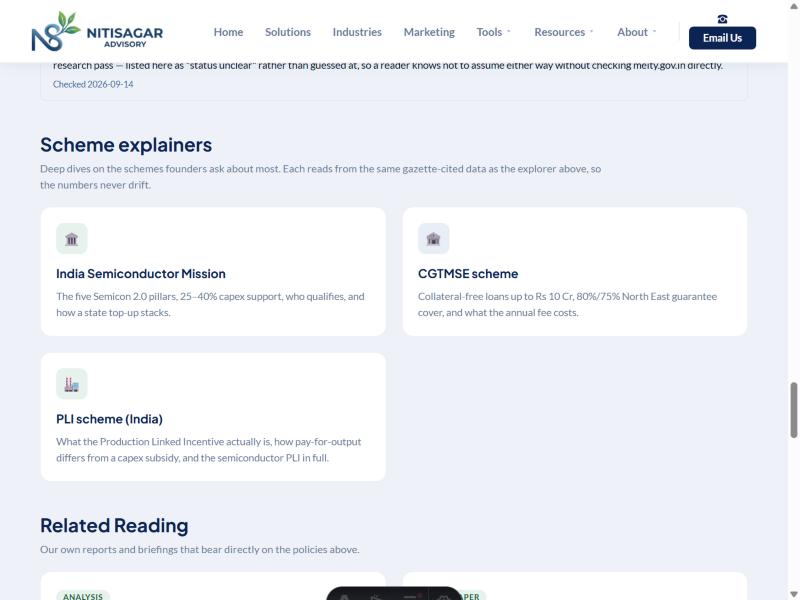
A new explainer: the PLI scheme
While we were there, we added the explainer that section had been missing — the PLI scheme. “PLI” (Production Linked Incentive) is one of the most searched-for incentive terms in India, and also one of the most misunderstood, because the word gets attached to things that are not production-linked at all.
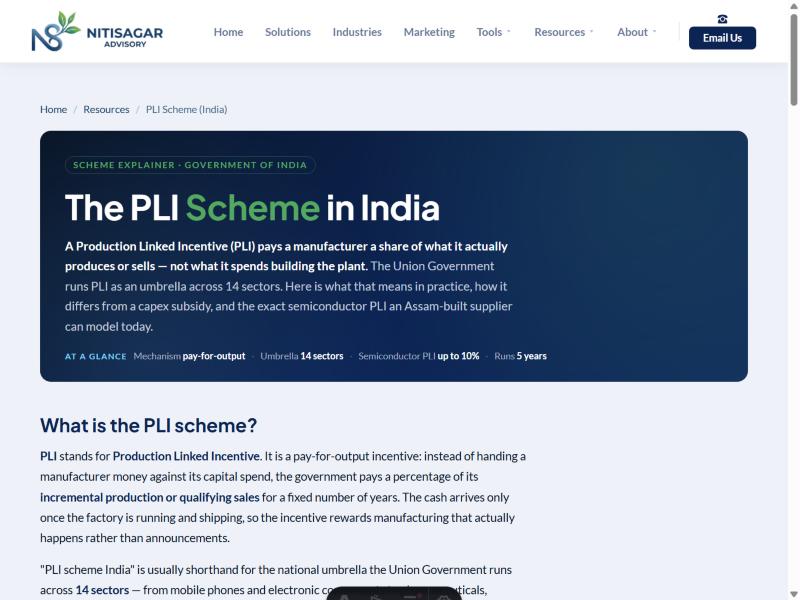
The page does the thing we think is genuinely useful: it separates three mechanisms people routinely conflate. A PLI pays you on what you produce. A DLI (the chip-design incentive) pays you on net sales. A capex subsidy pays you on what you spend building the plant. They land on completely different triggers, and getting them mixed up is the most common modelling error we see.
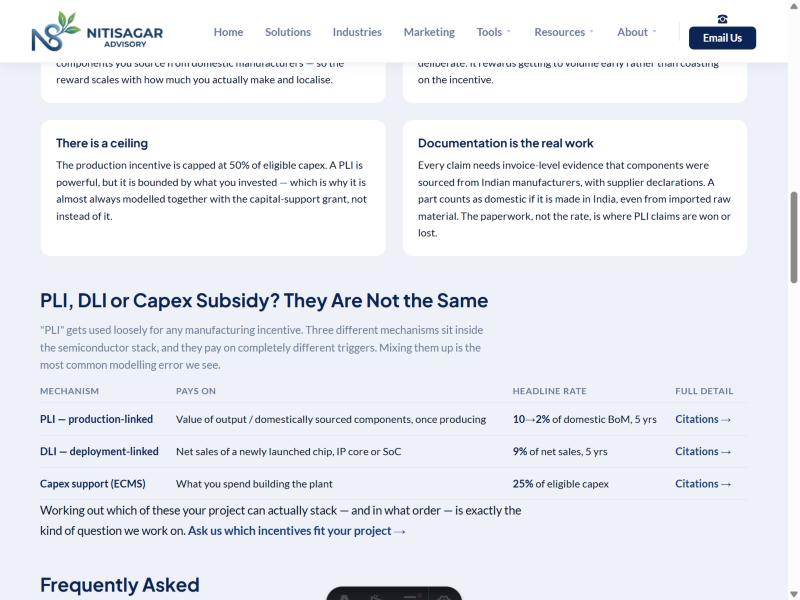
As with every explainer, the hard numbers — the 10→2% semiconductor equipment PLI, the five-year window, the 50%-of-capex ceiling — are read straight from our scheme data, and the national-umbrella figures are attributed to the government’s own releases. We model the electronics and semiconductor pillars; we do not invent figures for the sectors we have not researched, and the page says so.
One way to get in touch
Every explainer used to end differently — some with a mailto link, some with a calculator button, some with nothing. Now each one closes the same way: a single, two-step block that offers to either run the numbers yourself or ask us for a project-fit review.
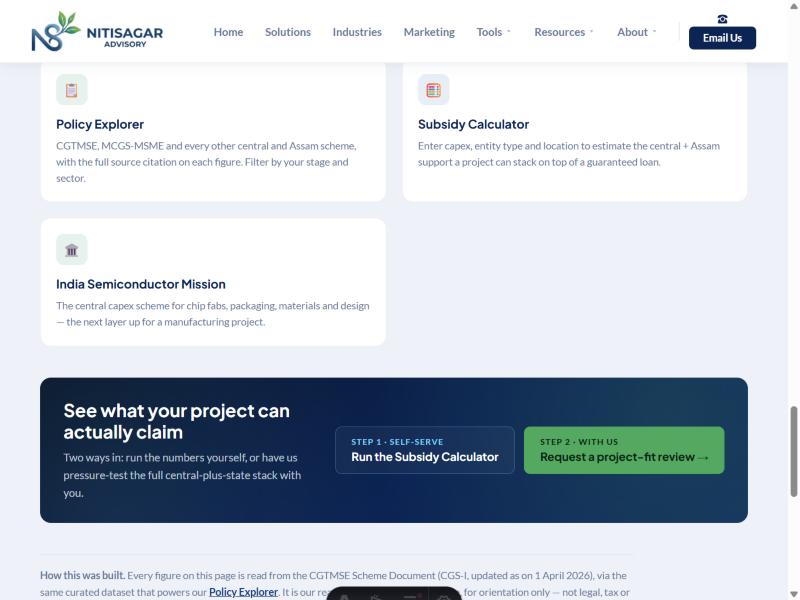
If you have read one of our scheme pages, you now know exactly where the next step is, because it is in the same place every time.
A cleaner menu
Finally, the top menu now follows one rule: Tools are things you operate (Subsidy Calculator, Scheme Eligibility Checker, Policy Explorer), and Resources are things you read (the explainers, the Price Tracker, the Open Data Portal). A couple of pages that had quietly become unreachable from the menu — the eligibility checker and the data portal — are back where you can find them.
What did not change
The policy data, the citations, and the discipline behind them are exactly as they were. This was a navigation and naming pass, not a content rewrite. If a number was right last week, it is the same number this week — it just has a clearer path to it, and one name on the door.
If something still reads two different ways to you, tell us — that is precisely the kind of thing this pass was meant to catch.