
Most MSME owners in Assam know subsidies exist. Very few know what they actually qualify for.
That gap is not really a policy failure. The rates are published and the notifications are online. The scheme logic is derivable, if you are willing to spend a few hours with the PDFs.
What has been missing is something that turns those published parameters into a usable number.
Something a manufacturer with a project in front of them can run, before deciding whether a formal application is worth the time.
That is what the Assam Industrial Incentive Estimator is built to do.
This is a rebuild, not a patch. Here is why.
Why we rebuilt it instead of patching it
The first version of this tool launched in May 2026. It leaned heavily on UNNATI 2024 for its most confident numbers.
UNNATI’s Capital Investment Incentive is a straightforward calculation: a fixed percentage of eligible plant and machinery cost, published in the gazette. No revenue projection required.
That made it easy to hand back a clean rupee figure from six basic inputs.
By August 2026, that foundation was gone.
UNNATI registration is officially extended to 30 September 2026. But the DPIIT portal stopped accepting new applications months ago.
Committed liabilities crossed the scheme’s funding trigger. It may resume if funds free up. It may not.
Either way, a tool that quotes new applicants a UNNATI number today is quoting a number they cannot file for.
Claiming What’s Yours covers the mechanics of that stoppage in full.
UNNATI’s registration window is extended to 30 September 2026 on paper. But the portal notice states applications have “presently been stopped on account of applications exceeding the available funding for the Scheme.” Existing registrants continue to be paid. A new applicant should not plan around it. Verify current status at unnati.dpiit.gov.in.
So this version drops UNNATI and NEIDS from the calculator’s live-scheme logic entirely.
It rebuilds around what is actually open to a new applicant today: IIPA 2019, PMEGP, and CGTMSE.
That swap changed which numbers the tool can honestly compute at all. Not just the numbers themselves.
Why IIPA 2019 does not behave like UNNATI did
UNNATI’s Capital Investment Incentive is a percentage of capex. Multiply plant and machinery cost by the zone rate, and you have a defensible number.
IIPA 2019’s flagship incentive, 100% SGST reimbursement for 15 years, does not work that way.
It tracks SGST you actually pay on your output revenue, through the electronic cash ledger, year by year. Not a fixed share of what you spent building the factory.
That is a real constraint for a calculator that never asks about projected revenue.
A tool that invented a revenue assumption to force out a rupee figure would be manufacturing false precision.
So v2.1.0 does something more honest. For SGST reimbursement, it computes the incentive ceiling, the maximum your enterprise-size tier permits, and labels it clearly: a ceiling, not a receivable estimate.
What the tool does
The tool takes the same six project inputs as before. It runs them against 9 incentive lines.
It returns a number where the calculation is defensible, and flags everything else for review.
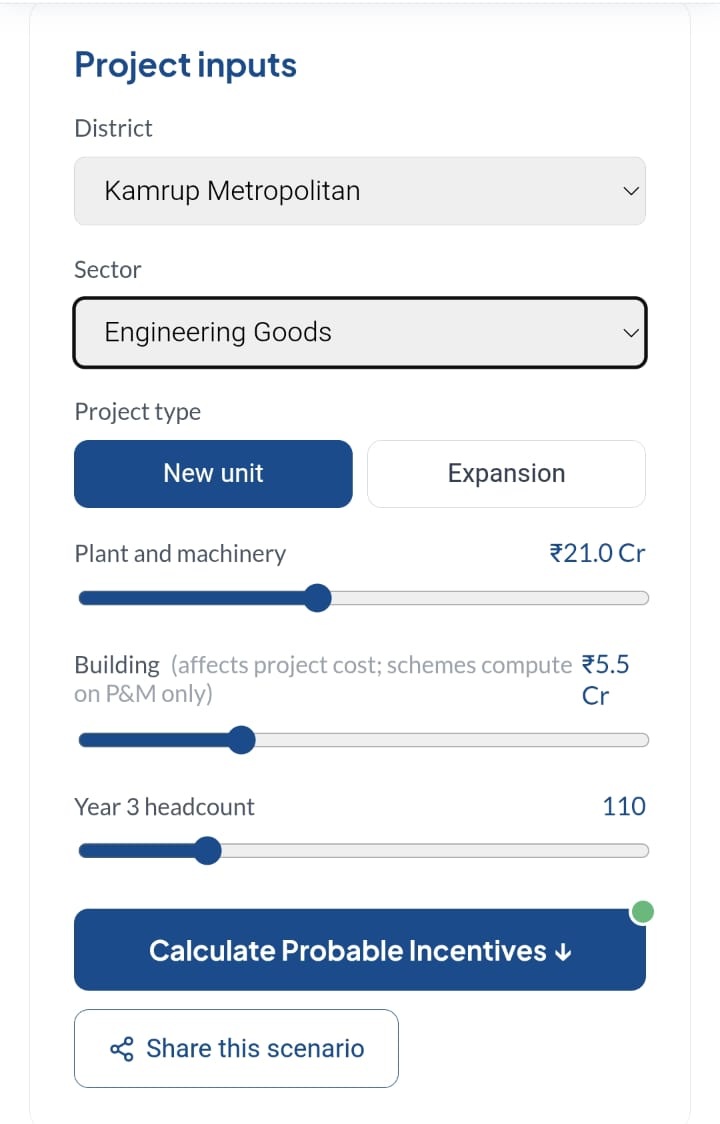
The six inputs, and what they now feed:
- District. No longer determines a UNNATI zone, since IIPA 2019 has no district dimension. It now flags Sixth Schedule provisions, feeds your PMEGP rural/urban rate, and checks whether your plot sits in a Govt-collaborated park, which raises the SGST cap.
- Sector. Flags eligibility for the Assam Electronics/Semiconductor Policy, correctly marked as anchor-investment scale only, not accessible to a typical MSME.
- Project type. New unit or expansion. Some capped IIPA 2019 lines are restricted to new units.
- Plant and machinery cost (₹ Cr). Sets your enterprise-size tier (Micro, Small, Medium, Large, Mega), which determines your SGST cap. Also sets how much of your project is PMEGP-eligible, capped at Rs 50 lakh for manufacturing.
- Building cost (₹ Cr). Included in Fixed Capital Investment for the SGST ceiling, and in the benefit-to-cost ratio.
- Year 3 headcount. Now informational only. IIPA 2019’s employment-linked incentive needs actual filings to compute, so it surfaces as “in review.”
The two numbers the tool computes with confidence
Of the 9 scheme lines the tool assesses, two return an actual figure.
PMEGP margin money. A clean formula: category and location set a rate of 15% to 35%, applied to your project cost up to the Rs 50 lakh (manufacturing) or Rs 20 lakh (service) cap.
For a new general-category unit in Kamrup Metropolitan (urban), the tool returns roughly Rs 7.5 lakh: 15% of the Rs 50 lakh capped base.
Special-category applicants (SC/ST/women/ex-servicemen and others) or a rural location raise this materially. Confirm your category with your DIC before relying on the figure.
IIPA 2019 SGST reimbursement ceiling. For the same illustrative unit, Rs 2 Cr in plant and machinery plus Rs 0.5 Cr in building cost, sized as Micro, outside a Govt-collaborated park, the tool returns a ceiling of roughly Rs 5 Cr over 15 years.
That is not a “you will receive this” figure. It is the outer boundary the policy sets.
What you actually receive tracks the SGST you put through your cash ledger each year. Claiming What’s Yours models that mechanic against real revenue ramps.
An MSME that reads “up to Rs 5 Cr” as “we will receive Rs 5 Cr” is worse off than one that never ran the calculator. It plans hiring and capex around a number the scheme never intended to hand over at once. The ceiling is the policy’s outer limit. Your actual SGST paid is the real number, and six inputs cannot tell us that.
Why the rest show “in review” or “not applicable”
Seven of the nine lines do not return a number, for two different reasons.
In review, because the number depends on your filings. IIPA 2019’s nine capped Other Incentives, power subsidy, generator subsidy, stamp duty, working capital interest, ETP subsidy, quality certification, employment generation, IPO assistance, infrastructure development, are each computed against actual invoices, loan sanctions, or payroll records the tool does not collect. CGTMSE is not a cash subsidy at all. It is a credit guarantee, so it surfaces as a flag rather than a rupee figure.
Not applicable, for a new applicant today. UNNATI’s Capital Investment Incentive, Capital Interest Subvention, and Manufacturing & Services Linked Incentive all require a live registration the DPIIT portal is not presently granting. NEIDS Transport Subsidy has been closed to new registrants since 31 March 2022, with no reopening mechanism in its notification. The Assam Electronics/Semiconductor Policy is anchor-scale only.
The tool marks each of these clearly, not folded into a vague “in review” bucket. The reason they don’t compute is different: there is nothing to file, not merely a missing input.
An MSME that sees one combined figure across all 9 lines, when five aren’t open to a new applicant at all, is not better informed than one that never ran a calculator. They have false confidence in a number nobody can file for. Marking a line “not applicable” instead of guessing applies the same discipline to scheme availability that this tool applies to filing-linked schemes.
How the engine was built
The calculation engine is pure TypeScript, running entirely in the browser. No API calls, no server round-trips.
Scheme parameters come from published notifications:
- IIPA 2019’s operational guidelines for the SGST cap table by enterprise size.
- The UNNATI 2024 DPIIT gazette notification, for the legacy figures shown as reference only.
- Current PMEGP guidelines, for the margin-money slabs.
Enterprise-size classification uses the revised MSME thresholds effective April 2025: Micro up to Rs 2.5 Cr investment, Small up to Rs 25 Cr, Medium up to Rs 125 Cr.
IIPA 2019’s SGST cap is keyed to enterprise size, not district.
If this classification affects your financing plan, cross-check it against the primary source.
The factory setup playbook covers DPR structure and financing. The techno-economic feasibility guide covers how banks read your numbers. For the sourced notification text behind every line this calculator touches, including the seven that don’t return a number, search the Policy Explorer.
The output for the two hard-estimate lines uses a -25%/+15% band around the midpoint.
This reflects documentation and verification timing, not uncertainty about the policy rate. Whether your claim clears first-pass or needs resubmission shifts the real figure.
The benefit-to-cost figure is the sum of the two hard-estimate lines, as a percentage of total project cost (P&M plus building).
It excludes the IIPA 2019 ceiling: that figure spans 15 years and is not comparable to a Year 1 capex ratio. It is a starting point, not a return figure.
What the tool cannot replace
The calculator is a starting point, not a substitute for a proper assessment.
- It does not compute the filing-linked IIPA 2019 incentives. Power subsidy, stamp duty, working capital interest, and the other capped lines are proportional to your actual invoices and loan terms. Without those documents, any number is invented.
- It does not check negative-list eligibility. IIPA 2019’s Annexure-I excludes certain manufacturing categories entirely. If your sector has a negative-list issue, the tool will not catch it.
- It does not account for land status. IIPA 2019 and PMEGP both require verified land tenure. Disputed title, short-term leases, or pending conversion complicate a claim regardless of the machinery on site. The tool assumes clean land.
- It does not resolve legacy stacking questions. If your unit is an existing UNNATI or NEIDS registrant also exploring IIPA 2019 eligibility, Claiming What’s Yours notes this has not been confirmed in every case. Check with your DIC office directly.
- It does not model the 14-approval sequence that has to clear before any incentive pays out. The 14 approvals guide covers how that sequence gates the timeline.
What to do after you run the numbers
If the PMEGP and IIPA 2019 ceiling figures together suggest a project worth pursuing, the next step is a verified assessment. Not another calculator run.
A verified assessment recomputes IIPA 2019’s filing-linked incentives against your actual SGST filings, loan sanction letter, and EPF records.
It checks your sector against the negative list, and produces a document-ready file you can take to the DIC.
That is the difference between a ceiling and a claim.
Run the calculator and reach out for a detailed review once you have a project in front of you.