Two documents this fortnight put a number on India’s semiconductor bet and on the workforce it will need to service that bet. Assam’s Chief Minister spent four hours with the state’s biggest investors, then opened a potato-chip plant. The state cabinet gave the industries department a land parcel it can actually assign. And a year after the Prime Minister inaugurated the world’s first bamboo bio-ethanol plant, the operating company told the market where it actually is.
Story 1: NITI Puts a Ten-Year Number on Semiconductors, MeitY Puts a One-Lakh Number on the People
NITI Aayog’s Frontier Tech Hub released Future of India’s Semiconductor Industry in late May, and I have been meaning to cover it since. It is the first ten-year roadmap the government has produced for the sector, and the target is a $120 to $150 billion value chain by 2035, built on a “More-than-Moore” strategy that concedes leading-edge fabs to Taiwan and Korea and concentrates on mature-node manufacturing, advanced packaging, compound semiconductors, and design. The document was released jointly by Finance Minister Nirmala Sitharaman and MeitY Minister Ashwini Vaishnaw.
The relvant numbers, from the roadmap and its PIB summary:
- $135 to $180 billion of cumulative capital investment over the decade to underwrite it.
- Government to commit at least one third of that outlay to de-risk private capital.
- Five pillars in the strategy: Pioneering, Policy and Investment, Production, People, Partnership.
- A stretch goal of 100-plus advanced semiconductor design IPs owned in India.
- A near-term workforce target of 50,000 trained technicians and engineers by 2028.
The Fortune India edition of the roadmap coverage put the ten-year framing in one line: India is not chasing the wafer, it is chasing the supply chain around the wafer.
The People pillar picked up its first operational number on 31 August, when Vaishnaw notified Semicon 2.0 and said the mission will train another 1,00,000 semiconductor engineers on top of the 85,000 already qualified in the last four years. India’s earlier target was 85,000 in ten years and the mission reached it in four, so the doubling is not rhetorical. It is set against a global chip-industry shortage of roughly one million workers by 2032.
The MSME angle: Assam does not have a fab and will probably not have one this decade. It does have IIT Guwahati, three engineering colleges with VLSI depth, and a rising ITI network that Semicon 2.0’s talent pillar is designed to fund.
Any Northeast training vendor, industrial skilling firm, or campus placement operator that can credibly deliver even fifty chip-qualified engineers a year is now in a market whose central spending line has been raised, not cut. The relevant application track is the ISM talent-development window on the India Semiconductor Mission portal, and the People pillar is where a Rs 2 to 15 crore skilling operator, unlike the anchor project applicants, can actually compete.
Story 2: Raana Semiconductors Wants to Build the Machine that Grows an Indian Solar Wafer
Chennai-based Raana Semiconductors will launch India’s first commercial 12-inch Czochralski ingot machine for solar module makers in the next ten to twelve months, CEO Rajasekar Elavarasan told The Hindu BusinessLine. The company is chasing a roughly 2 GW machine order from a domestic solar manufacturer and wants its machines supporting 10 GW of Indian cell production capacity within three years, from a new 40,000 sq ft facility in Hosur. Raana raised a $3 million seed round in January.
Why this matters, and why it fits the NITI framing above:
- More than 90 per cent of the ingot growth machines Indian solar module makers currently use are imported, mostly from China.
- The Ministry of New and Renewable Energy plans to bring solar ingots and wafers under the Approved List of Models and Manufacturers regime from 1 June 2028, which forces Indian module makers to buy locally grown ingots after that date.
- Raana keeps intellectual property on its semiconductor wafer stack and sells the equipment to solar buyers. That split is unusual for an Indian deep-tech firm and is the exact “equipment and materials” pillar that Semicon 2.0 has just put money behind.
The MSME angle: No Northeast MSME will place a machine order with Raana next year. But I find this story interesting because it signals a deepening of deep-tech ambitions, where private capital is chasing the building blocks of a semiconductor ecosystem. That’s how a country grows resilient and diverse supply chains.
Story 3: Assam CM takes a hand on approach to Ease of Doing BUsiness, and Assam gets an agri procssing anchor
Assam CM Himanta Biswa Sarma spent 4 September through 9 September working through the state’s post-Advantage Assam 2.0 pipeline sector by sector.
His argument is that “a government that remains personally present at every stage of an investor’s journey” beats the standard single-window playbook. He met 39 companies representing about ₹1.5 lakh crore of committed investment, sector by sector: power, cement, and ethanol on 9 September, food and beverage on 10 September, with departmental secretaries in the room to resolve bottlenecks live.
The 9 September session at Lok Sewa Bhawan brought Ambuja Cements, Star Cement, Dalmia Cement, Adani Power, SJVN Green Energy, Hinduja Group, Greenko, NEEPCO and NLC India Renewables to one table.
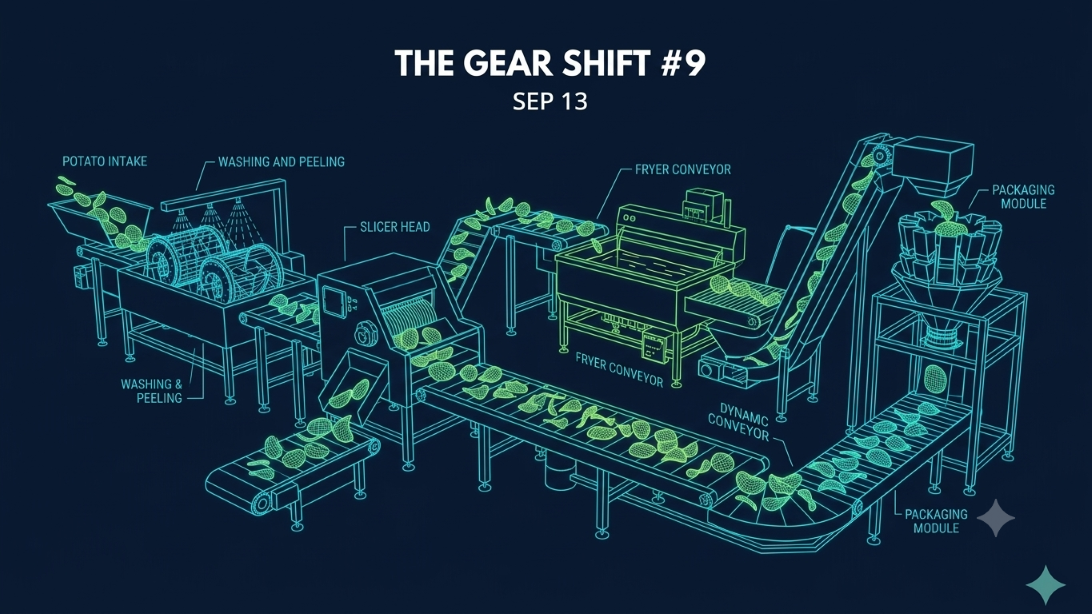
This was followed by PepsiCo India inaugurating its first Northeast food plant and its fifth in India at Nalbari on 11 September, a ₹778 crore investment on 44.2 acres:
- 50,000 tonnes of chip-grade potato to be sourced from within Assam, from roughly 5,000 farmers with technology, seed and machinery support.
- 60,000 tonnes of cold-storage capacity expected to build up around the catchment.
- Roughly 500 direct jobs, with the company saying more than 75 per cent of the workforce is women.
- Part of a wider ₹5,700 crore Indian investment programme through 2030.
At MSME scale, Mission Senehjori, the ₹411 crore Muga silk value-chain programme launched by the Union DoNER Minister and the CM on 2 June, with five modern reeling units at Jorhat, Sivasagar, Sualkuchi, Majuli and Lakhimpur, a spun-silk unit at Dhemaji, and 1,180 Farmer Interest Groups plus 30 FPOs across the value chain by 2028.
The MSME angle: Nalbari’s plant fills the anchor gap that our Assam Premium Agri-Food Export Opportunity report highlighted. A single buyer commits to 50,000 tonnes of a specified potato variety and pays for the cold-chain build the district has never had. Anyone running a cold storage, a chip-potato seed multiplier, a bulk packaging outfit, or farm-to-plant logistics between Nalbari, Barpeta and Kamrup rural can potentially benefit from this. Senehjori is the same shape of opportunity in silk with the FPO registration window open.
Both value chains, unlike the cement and power anchors in the CM’s Lok Sewa Bhawan room, are ones a Rs 2 to 15 crore player can realistically join.
Story 4: Assam Cabinet Frees 1,174 Bighas for Industrial Estates in the Two Districts That Matter Most
The Assam cabinet met on 30 August and, alongside a ₹50,000 crore Viksit Assam: Infra Vision programme, allotted 1,174 bighas across Kamrup (Metro) and Nagaon to the Industries, Commerce and Public Enterprises department for the development of industrial estates and land banks. The two districts pick themselves: Kamrup Metro because it is where the CM’s investor pipeline is located, Nagaon because it lies between Jagiroad and the trunk highway to Upper Assam.
Two smaller decisions from the same meeting are worth flagging:
- The Assam Industrial and Investment Policy, 2019 was amended to add vehicle scrapping facilities as an eligible industry, which opens a subsidy line that a mid-sized scrappage operator can now formally apply for. Track amendments like this as they land in the Policy Explorer.
- The retail licence requirement for the sale of petroleum products under the Assam Trade Articles order was dropped, cutting one compliance step for smaller fuel retailers.
- A ₹600 crore Proton Beam Therapy Centre at GMCH and a 30 MW Goalpara solar project were also cleared.
The MSME angle: 1,174 bighas is roughly 156 hectares, enough for a mid-sized estate in Kamrup Metro with a satellite parcel in Nagaon. The notification does not yet say which AIDC or AIIDC estates the land will feed, or when plot allocation opens. Land assembly is the single longest lead item in our Factory Setup Playbook precisely because state land banks have been thin for years. If Kamrup Metro or Nagaon is on your shortlist, this is the time to get in touch with AIDC and get more details.
Story 5: A Year After Modi’s Ribbon, NRL Explains Where the Bamboo Bio-Ethanol Plant Actually Is
Numaligarh Refinery Limited chairman Ranjit Rath used the company’s 33rd AGM press conference on 11 September to give the most honest one-year-after read on the PM-inaugurated bamboo bio-ethanol plant at Golaghat I have seen from a state-owned oil company in a while.
The plant has produced 2G ethanol and is in stabilisation. Individual units are being run through full-utilisation tests, and derivative products including acetic acid are being brought online in parallel.
What that translates to, and what NRL is prioritising next:
- Commercial production has no date attached yet. Stabilisation must finish first, then transition to commercial scale.
- The ₹200 crore per annum farmer benefit the plant is meant to send back through the bamboo catchment depends on that transition.
- NRL is pushing the refinery expansion from 3 MMTPA to 9 MMTPA, targeted for commissioning by 31 March 2027, followed by a year of stabilisation before it reaches full yield.
- The polypropylene unit whose foundation stone was laid alongside the bio-refinery is now formally behind the expansion in the queue.
The MSME angle: Two takeaways for our clients. First, a first-of-its-kind Indian plant with a PM inauguration, a Finnish JV partner and central-government air cover still spends more than a year in stabilisation before it starts moving a rupee to the growers it promised.
That is the honest yardstick to hold against every Advantage Assam anchor now being pushed to commissioning, and the case our Assam Industrial Flood Risk and Resilience report makes for staggering your project’s dependence on anchor commissioning dates.
Second, if you supply anything the NRL expansion needs, from fabricated pipe supports to civil-works subcontracting to industrial services, the March 2027 commissioning target gives you the timelines to start planning and pitching.
Gear Shift is a fortnightly roundup of India’s manufacturing and industrial policy developments, with a focus on implications for MSMEs in Northeast India. Published by Nitisagar Advisory, Guwahati.
If you found this issue useful, subscribe below to receive the next one in your inbox.