Industrial Ecosystems 2: How Rajkot Built Its Foundry Cluster
One of the few Indian clusters that grew deep without a national champion on top of it. How the state, a water crisis, and 10,000 small foundries did it over forty years, and what Assam can copy.

0 of 12 sections read
Rajkot sits in the middle of Saurashtra, the flat, dusty peninsula that hangs off the western edge of Gujarat.
There are no big rivers. The monsoon is short and unreliable, and for centuries most of Kathiawar’s farmers grew what a shallow open well would let them grow, and then waited. If the rains failed, the district emptied out.
In the 1950s a small machine changed that. A one-cylinder diesel engine, small enough to sit on a bullock cart, cheap enough for a farmers’ cooperative to buy on credit, and strong enough to pull water out of a deep tube well all year.
The engines came in from Britain first, second-hand or new, under trade names like Marshall and Ruston and Lister. When they broke down, and they broke down often, they got taken to the nearest lathe operator in Rajkot, because there was nobody else within a day’s drive who could turn a shaft or true a flywheel.
Those lathe operators started by cleaning and refitting other people’s engines. Then they started copying the easy parts, the bracket, the pulley, the fuel tank. Then the fiddly parts, the injector, the piston, the cylinder head. Within twenty years a Rajkot workshop of six people, with two lathes and a small foundry out back, could build a whole engine that looked, sounded and smelled like a Marshall.
Locals called anything that came out of one of those workshops a “Field Marshal”, after the British brand it copied. The name stuck, and it eventually got trademarked and fought over in court, but the sociological point is what matters. A whole generation of Kathiawari farmers grew their food on machines built by their neighbours, on a floor of small firms that nobody in Delhi had planned.
That was the seed. What grew out of it, over the next forty years, is one of the few Indian engineering clusters deep enough to worry the country of Germany. Around 10,000 small units today in and around Rajkot city, casting foundries feeding pump makers feeding submersible-pump assemblers feeding machine-tool builders feeding auto-component exporters, all inside a radius of about twenty kilometres.
Assam in 2026 is watching a chip-packaging plant rise at Jagiroad, and asking how to build a supplier base around it. The first report in this series went to Japan for the answer, and looked at the vertical keiretsu that carmakers built over fifty years and three near-death moments.
Rajkot answers the same question in a completely different key. There was never an anchor giant. There was never a MITI. There was a water crisis, a lot of small workshops, a very slow state government, and one big policy decision. That mix is worth looking at closely, because it is much closer to Assam’s actual starting conditions than Toyota is.
Where this fits
Second in Nitisagar’s series on industrial ecosystems. The first report covered Japan and the vertical keiretsu. This one goes to Rajkot, the clearest Indian case of a cluster that grew without a national champion at the top. The third will cross the causeway from Singapore to Malaysia’s semiconductor belt.
The shape of the Rajkot cluster is nothing like the Toyota diagram from the Japan report.
There is no anchor firm at the tip. There are, instead, four rough bands of firms that trade with each other across a small city, and with buyers who mostly sit outside Gujarat:
- a large layer of casting foundries, most of them small, pouring iron and non-ferrous parts for whoever will order,
- a layer of machining and finishing shops that grind, drill, thread and polish those castings,
- a layer of assemblers who build the finished thing, historically a diesel engine or a pump, and now increasingly an auto component or a machine tool,
- and a thin, growing layer of design and CNC firms who sit closest to the exporting customer.
Buyers sit at the edges, not the top: Indian pump makers, Indian auto tier-ones, submersible-pump distributors, and, since the 2000s, European foundry buyers who want small-batch iron and steel castings at prices that no European foundry can match.
Figure 1 · The shape of the Rajkot cluster
A horizontal mesh of small specialists, not a pyramid under one anchor. Buyers sit outside the mesh, on all four sides.
Structure adapted from UNIDO cluster mapping (Das and Tewari, ILO/UNIDO Rajkot cluster studies, 1990s to 2000s) and from the Rajkot Engineering Association.
That mesh is what makes the cluster interesting.
Toyota’s supplier network was pulled up by one giant customer that could set the standard, discipline the pace, and, when necessary, lend an engineer. Rajkot has none of that. Its firms are pulled up by whatever buyer is willing to place an order this quarter, and if that buyer walks away, the firm has to find another.
That is a harder, riskier way to build depth. It also means the lessons transfer more cleanly to Assam, which does not yet have any anchor that can play the Toyota role for its own supplier base.
The pre-condition for the Rajkot cluster was not policy. It was a pre-existing base of small artisans who already worked in metal.
Kathiawar in 1947 was a patchwork of more than two hundred princely states, from big ones like Junagadh and Bhavnagar down to tiny estates of a few villages. Each court had its own armoury, its own carriage-makers, its own farriers, and, on the coast, its own boatbuilders. The blacksmith, the tinsmith and the brass caster were as embedded in that landscape as the priest and the moneylender.
After Independence those states were merged, first into the Saurashtra state in 1948, then into the bilingual Bombay state in 1956, and then into the new Gujarat state in 1960. Every merger closed some old workshops and pushed their people into the bigger towns. Rajkot, which had been the political capital of Kathiawar under the British, got a disproportionate share of that movement.
The city inherited three things from that inheritance: a dense population of skilled metal artisans, an entrepreneurial merchant community with the habit of financing small ventures from within the family and the caste, and a set of British-era workshops that had trained locals to work on colonial machinery.
None of this is a policy lever. It is a starting condition. It is worth naming as such, because a lot of what people call the “Rajkot model” is really a description of what happens when a state government does the sensible thing while sitting on top of a pre-existing craft base.
Assam has an analogue at the same layer, but it is a different one. The region has deep craft traditions in bamboo, silk, wood and bell metal, and a genuinely large workforce trained in dexterous small-scale making. What it does not have is a pre-existing metalworking base at anywhere near Rajkot’s density. Any lever this report proposes has to be read against that gap, and not against a fantasy of a Kathiawar-like head start that never existed.
Rajkot’s metalworkers had a base. What they did not have, until the 1960s, was a big enough market to specialise into.
The Indian Green Revolution changed that. From the mid-1960s the central government pushed hybrid seeds, chemical fertiliser and, crucially, irrigation. A farmer growing high-yielding wheat or cotton on rainfed land was throwing money at a coin toss. A farmer with a diesel pump and a shallow tube well was a business.
Gujarat, in particular, was one of the epicentres of this shift. By the late 1970s, Saurashtra had tens of thousands of tube wells, and each one needed an engine and a pump. Cheap diesel engines and, later, cheap electric submersibles became a mass consumer product for the Indian farmer, and Rajkot was the closest cluster with the skills to make them.
The first wave was the diesel engine. Second wave, from the 1980s on, was the pump itself: monoblock pumps, then vertical turbine pumps, then submersibles. Every stage of demand created new specialist firms upstream: the foundries that cast the pump bodies, the machine shops that finished the impellers, the winding shops that made the motors, and the traders and finance houses that moved the money.
This is the demand-side story people often forget. Rajkot did not build itself by decree. It grew because a state-created agricultural revolution created a customer, and because the local supply base could reach that customer more cheaply than anyone else. The state deserves credit for the customer, not for the supply base.
The transferable question, for Assam, is what plays the same role of “large, ongoing, government-adjacent domestic demand” that irrigation played for Rajkot. Semiconductor packaging at Jagiroad is one candidate. Rural electrification and DISCOM equipment is another. State-funded transport and border infrastructure is a third. None of them is a Green Revolution, but a state that wants a supplier base has to be honest about which of its own budgets is going to feed that base for the next twenty years.
If there is one policy decision that carried the Rajkot cluster, it is the creation of the Gujarat Industrial Development Corporation in 1962.
GIDC was set up two years after Gujarat became a state, with a single blunt job: buy up large tracts of land, put in the road, water, drainage and power, plot it into industrial parcels, and sell those plots to small firms at cost or close to it.
That is not a subsidy in the PLI sense. There is no cheque cut to the firm. What GIDC does is take on the two things a small manufacturer cannot handle on its own, namely land acquisition and trunk infrastructure, and hand back a serviced plot that a founder can move onto in a matter of months.
Rajkot got the benefit of this at scale. GIDC estates ring the city: Aji, Bhaktinagar, Metoda, Lodhika, Shapar-Veraval. Metoda GIDC alone hosts several thousand units and is one of the larger continuous industrial estates in western India.
Why serviced land matters more than a tax break
A small firm evaluating a new investment weighs three risks: can I get land, can I get power, and can I get water. A tax holiday changes the answer to a fourth question, “will the returns be worth it”, but only if the first three risks are already solved. GIDC solved them at scale for fifty years. This is the single most-cited lesson from Gujarat industrial policy, and it is the one Assam can copy most directly.
The specific design choices in GIDC that mattered:
- Buy in bulk, sell in units. GIDC acquired large blocks under state powers, then subdivided into parcels a twelve-person firm could afford. The state absorbed the land-title and acquisition risk that no small firm can handle alone.
- Serviced up front, not on request. Roads, drainage, water and power were put in before firms moved on. A founder did not have to negotiate for each utility.
- Rolling capacity, not one-off announcements. New estates were added roughly every five years as older ones filled up, so there was always a next plot available.
- A single landlord, not a scattered permission map. GIDC held the estate as one owner, so a firm dealt with one office for lease, transfer and infrastructure.
Every one of those design choices is a state decision, not a central one. Assam has an industrial infrastructure corporation, AIIDC. Whether AIIDC does the GIDC job at the same scale, on the same rolling basis, is the single most important question in Assam industrial policy that nobody is asking loudly enough.
By the early 1990s Rajkot had a cluster. It had land, it had labour, it had roughly a decade’s momentum in pumps and small engines, and it had a fast-growing captive market inside India.
Then two things happened at once, and either of them could have flattened it.
The first was India’s 1991 liberalisation. Import tariffs on engineering goods came down, foreign competition arrived, and the sheltered Indian buyer of a Rajkot pump could suddenly compare it to a Chinese or Italian one. The margins on the standard diesel engine collapsed. Firms that had grown fat on protected margins found themselves undercut by imports and by cheaper submersibles they did not yet make.
The second was a slow technology shift inside the cluster. Manual lathes and mills could not hold the tolerances that a global tier-one buyer demanded. To sell into a European foundry buyer or an Indian auto tier-one, a Rajkot machine shop had to buy a computerised numerically controlled machine tool, retrain its operator, and rebuild its quality-control setup around statistical process control instead of a caliper and a good eye.
Most small firms had neither the money nor the knowledge to make that jump on their own.
Two responses saved the cluster, and both are worth naming, because both are within reach of a state government.
The first was the Rajkot Engineering Association and its sister bodies. These are voluntary industry associations, formed by cluster firms themselves over the 1970s and 1980s, and by the 1990s they had enough weight to lobby the state, run trade shows, and, crucially, take part in cluster-development projects with international agencies.
The second was the United Nations Industrial Development Organization’s cluster-development programme in India, launched in 1996 in partnership with the central Ministry of MSME and the SIDBI Foundation for Micro Credit. UNIDO, in its own account of the India cluster-development programme, worked in dozens of Indian clusters over the next decade on shared services, technology upgrading and market linkages, and Rajkot was one of the flagship engineering clusters in that portfolio.
Figure 2 · Forty years, and two moments the cluster nearly ossified
Green marks the shocks Rajkot’s small-firm base absorbed and adapted around, rather than the pyramid-style near-bankruptcies that defined the Toyota story.
Dates from GIDC’s corporate history, UNIDO cluster-development programme reports, and academic surveys by Das and Tewari of Indian industrial clusters.
The UNIDO work in Rajkot in the late 1990s and early 2000s built things that no single small firm could have built on its own: shared testing labs, group export-market visits, matchmaking with foreign buyers, and cluster-wide quality-certification drives. That model, of a state-backed cluster development agent working with an industry association, is the one the Indian government eventually turned into the MSE-CDP scheme.
The lesson is not that a UN agency saved Rajkot. It is that when the cluster hit its upgrading wall, a lightweight external body with money, connections and no political stake was able to unblock things the local firms could not unblock on their own.
The Japan report asked what a twelve-person Aichi stamping shop needed to survive and get better. Rajkot’s version of the question, for a twelve-person Metoda foundry, has a slightly different answer.
Picture the shop. Green-sand moulding, one cupola, three moulders, one pattern-maker, five general labourers, and a supervisor who is also the owner. The shop pours iron castings for whoever will pay, mostly pump bodies and machine-tool beds. What does it need in order to stay alive, get better, and eventually be trusted enough to ship a casting to Germany?
Four things, none of them glamorous.
What the small foundry needed
1. Shared infrastructure it could not afford on its own. A twelve-person foundry cannot pay for a heat-treatment furnace, a spectrometer, a coordinate-measuring machine, or a proper pattern-making workshop. But it needs all four to sell to a serious buyer. Rajkot got these as common facility centres, funded by cluster-development schemes, run either by the industry association or a special-purpose vehicle. That is a straight state-level infrastructure lever.
2. A route from the local buyer to the global one. Selling to a Saurashtra pump maker teaches you volume. Selling to a European casting buyer teaches you tolerance, documentation and consistency. Rajkot firms only got the second education because someone, in this case UNIDO and later the state export bodies, organised the introductions, funded the trade-fair booth, and paid for the first quality audit. This is a matchmaking lever, and it is cheap.
3. Community credit and caste-network trust capital. This is the part of the Rajkot story that policy did not build. The Patidar and other Kathiawadi business communities financed each other’s first machines, stood surety for each other’s bank loans, and let a nephew’s first order be paid on ninety-day terms because everyone knew where his uncle lived. Naming this honestly: this is social capital, and no policy can create it, but a state that ignores or actively erodes it is throwing away the compound.
4. Time-limited technical upgrading, with real conditions. The MSE-CDP scheme, when it worked, funded firms to buy their first CNC machine or their first testing lab conditional on shared use, and only for a fixed window. That paired what Japan’s 1963 SME Modernization Law paired: money for getting measurably better, with an end date and a target. When the state loses discipline on the “end date” and “target” parts, the money becomes rent.
Notice what is not on this list.
There is no anchor OEM lending an engineer. There is no house bank sitting inside the group. There is no five-year national industrial policy with Rajkot in the annexure. The Rajkot cluster is what the four things above produce when you also have the earlier pre-conditions: a pre-existing artisan base, a big captive customer, and cheap serviced land.
For Assam, three of those four are within a state government’s direct control. The fourth, community credit, is not, but the design of state-backed credit can either lean on and amplify existing networks or ignore them entirely. Nitisagar’s earlier work on the MSME certification stack for the Northeast is one small piece of the fourth lever, and the 2026 MSME payment amendment is another.
Every cluster has moments when the underlying product changes, and the firms in the cluster either follow the product or die with it.
Rajkot has had two such moments so far.
The submersible inflection, 1980s to early 1990s. As rural electrification reached more of Gujarat and Maharashtra, farmers stopped buying small diesel engines and started buying electric submersible pumps that sat inside the borewell itself. The old diesel-engine assemblers had a choice. Retrain around motor windings, mechanical seals and stainless impellers, or shrink into a service and spares business.
Many did the second and shrank. Enough did the first, or spun out to do it, that Rajkot became a genuine centre of Indian submersible-pump manufacturing. The casting foundries pivoted with them, learning to pour the different alloys and the more demanding tolerances that the submersible body needed. This was a within-cluster upgrade, driven by demand, with almost no policy intervention. It was possible because the cluster was already dense enough that a founder could reshuffle his supplier base within a few kilometres.
The CNC inflection, 2000s. Manual lathes and mills, however skilfully operated, cannot hold the sub-hundred-micron tolerances that a European auto-parts buyer takes for granted. The cluster’s next step up, and it is still going on, is the CNC upgrade: buying a computerised machine, learning to program it, learning to instrument it, learning to run it in a temperature-controlled bay so that the tool does not drift.
This one was harder. A basic CNC turning centre costs several years of a small firm’s profits. Rajkot got through the inflection with a mixture of MSE-CDP grants, SIDBI loans, family capital, and the emergence of a small number of Rajkot-founded machine-tool builders who themselves sold CNCs to their neighbours, most visibly Jyoti CNC Automation, which listed on Indian exchanges in 2024.
| The submersible inflection | The CNC inflection | |
|---|---|---|
| When | 1980s to early 1990s | 2000s, still under way |
| What changed | Rural electrification killed the diesel-engine market. Farmers moved to submersible pumps. | European auto-parts buyers required sub-hundred-micron tolerances that manual machines cannot hold. |
| What firms had to learn | Motor windings, mechanical seals, stainless impellers, higher-tolerance castings | CNC programming, in-process instrumentation, temperature-controlled bays |
| What paid for it | Almost nothing from policy. Founders self-funded and reshuffled suppliers within a few kilometres. | MSE-CDP grants, SIDBI loans, family capital, and Rajkot-founded machine-tool builders like Jyoti CNC selling to neighbours. |
| Who did not make it | Older diesel-engine assemblers who shrank into spares and service. | Firms that could not afford the first CNC or the operators to run it. |
| What it left behind | A submersible-pump manufacturing centre with the casting depth to serve it. | A rising machine-tool cluster and Jyoti CNC’s 2024 IPO. |
Jyoti CNC is worth pausing on, because its recent trajectory is the clearest case of a Rajkot firm graduating from cluster player to national anchor. Karan Kamble, writing in Swarajya in September 2025, listed Jyoti alongside Ace Micromatic and BFW as the “torchbearers expanding India’s capacity to manufacture precision machinery”, and identified Rajkot as the emerging machine-building hub around Jyoti.
In August 2026 the Ministry of Electronics and Information Technology approved a Rs 1,020.65 crore capital investment proposal from Jyoti CNC under the Electronic Components Manufacturing Scheme (ECMS), for a backward-integrated facility at Rajkot to make the electronic devices used inside its own CNC machines, per its stock-exchange filing carried by CNBC-TV18. Backward integration into servo drives and controllers is precisely the missing link that the Swarajya piece identified as the industry’s dependence: imported servo motors and CNC controllers “unavailable domestically”, in the piece’s phrasing.
At a Vibrant Gujarat regional conclave earlier in 2026, Jyoti’s chairman and managing director Parakram Jadeja publicly committed the firm to a five-year investment of more than Rs 10,000 crore across manufacturing, R&D and skilling, of which the MeitY-backed Rs 1,020 crore ECMS facility is the first tranche.
That is the shape of the graduation. A firm that started in the same cluster of small foundries, riding the same GIDC estates and the same MSE-CDP grants, is now writing cheques large enough to appear in central-government electronics-mission press notes.
The reason this matters for Assam is not that Assam is about to face the same two inflections. It is that a cluster, once built, keeps meeting these inflections, and a healthy cluster is one that can absorb them without policy having to save it every single time.
The policy job, seen through Rajkot’s forty years, is to build the ground conditions well enough that when a Chinese import or a European specification turns up unannounced, at least some of the local firms can adapt on their own money, on their own time, in their own way.
The rest of this report reads Rajkot from a distance, through cluster studies and scheme documents. This section reads it from the inside, through voices that landed on Nitisagar’s feed in the last few months: a commentator, a founder, an equipment supplier, a young die-caster, and a machinist. None of them coordinated. They describe the same cluster.
A commentator on the cluster’s temperament. Prakash Dadlani, an investor and manufacturing commentator on X, put out what amounts to the informal manifesto for the current Rajkot moment:
If I had to bet on which city will lead Bharat’s next industrial revolution, it would be Rajkot.
— Prakash Dadlani (@prakdadlani) Original post on X
Rajkotis are forged from a different mud. Risk runs in their veins. They get knocked down, dust themselves off, and come back stronger until they win.
That’s not just spirit, it’s their DNA.
A silent global hub for auto components, bearings, machine tools, castings, and precision engineering. They make everything from basic kitchenware to components for luxury cars and fighter planes.
Forget fancy IIM degrees, if you truly want to understand manufacturing, just plant yourself in Rajkot for a couple of years.
Walk the workshops in Metoda, Shapar, and Aji, where innovation, quality, and relentless hustle are unmatched. Watch, learn, and absorb.
What Rajkot has built deserves to be studied deeply and replicated across Bharat. It’s this grassroots industrial energy, turning raw grit into world-class products, that will power a Viksit Bharat.
Dadlani names the three GIDC estates that this report has kept returning to, Metoda, Shapar and Aji, and he is describing exactly the mesh in Figure 1: no single anchor, but a very deep floor.
A founder in Stuttgart, taking on a prejudice. Maulik Shah is the founder and managing director of Aditya Engimach, a precision forging company he started in Rajkot in 2010, and grew over sixteen years into a supplier of hot-forged, closed-die and ring-rolled components to automotive, aerospace, energy and heavy-machinery customers across continents. In June 2026 he took the company to CastForge in Stuttgart, one of the most demanding forgings and castings trade fairs in the world, and posted a series of reflections on LinkedIn that got picked up by the general Indian press.
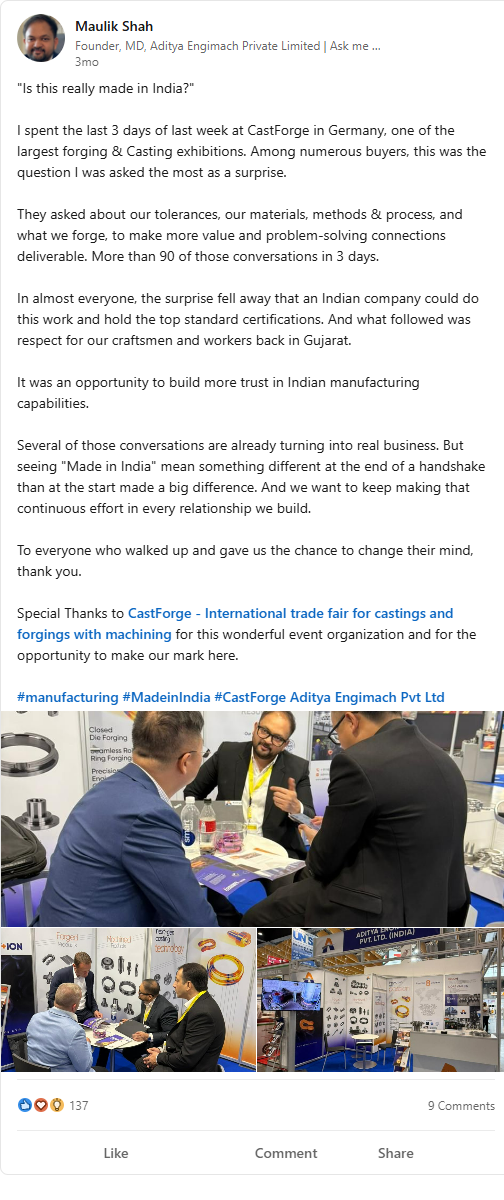
His argument in that thread, reported by ANI in June 2026, is that the bottleneck for a Rajkot exporter is no longer talent or machinery. It is reputation. “For years, the world came to India for one thing, outsourced labour”, he wrote ahead of the show. “This week, we went to the world to show them that we also engineer, build and innovate.” Later in the thread he sharpened the point: “The world does not pay for your clever fix in a crisis. It pays to never have the crisis in the first place.”
That is the voice of a firm that has just discovered the ceiling on jugaad, and the exact discipline the cluster now needs to add.
An equipment supplier on the buying culture. Vishal Tejwani, who makes and sells electronics manufacturing kit and posts as @ivishaltejwani, described a Rajkot buyer:
Got a call few months back and a guy tried to explain how they’re trying to make smart switches and want to make pcbs in house.
— Vishal Tejwani (@ivishaltejwani) Original post on X
Then went on saying he needs to see the machine and will buy on spot.
He came from Rajkot next day saw the machine and paid on spot by now theyve recovered the cost of the machine.
And wanted to add “few more” as it would allow them to even do job work for others and make small pcbs around the block faster.
Wanted to consult how he should do it and introduce few things.
Hes now an openpnp ninja rips through software like he developed it.
Seeing someone use things I built feels so great like water to thirsty.
Two things sit inside that anecdote. First, decision speed: the buyer flies out, inspects, pays the same day. That is the community-credit and cash-in-hand culture from Section 7 in action. Second, the instinct to add “a few more” machines so the shop can do job work for neighbours: that is exactly how the cluster’s next layer keeps growing, one small vendor at a time, each one making capacity available to the block.
A young die-caster on why he started where he started. From the same week, an anonymous voice worth quoting in full:
know a young fellow who took out a loan to start his own die casting operation in rajkot/shapar. Wouldn’t have started it if it was somewhere else. It gives sense of comfort knowing there are folks out there to help out and guide u.
— Reigen_Raju (@Reigen_Raju) Original post on X
The phrase “wouldn’t have started it if it was somewhere else” is the whole cluster-effect thesis in twelve words. A first-time founder does not need government hand-holding if there are enough experienced neighbours who will pick up the phone. That is not a policy lever, but it is exactly what a state can either build the conditions for, or actively erode. Assam does not yet have any comparable density of experienced small-firm founders who know how to help a new die-caster set up.
A machinist inside Jyoti CNC. And, closing the loop back to the anchor firm of Section 8, a shop-floor worker at Jyoti CNC with the one-liner that captures why the cluster now sells to Europe:
I Work in jyoti cnc . 2nd largest cnc manufacturing company .. they churn out 1um finish like nothing happened 😂😂😂
— Nishant (@Nishant74660511) Original post on X
One micron. That is the tolerance a Rajkot-designed CNC now holds as a matter of routine. Three decades earlier, the same cluster’s manual mills could barely hold fifty microns without a skilled operator sweating over the feed. The technical distance from that shop to this one is the entire subject of the report so far.
None of these five people has met, and none of them was asked to make a case. They describe a cluster in the same voice because the cluster genuinely is like that. For Assam, the useful question is not how to hire a Rajkot consultant. It is how to design conditions over the next twenty years so that in 2046 a similar week of unrelated posts, from Guwahati or Silchar or Dibrugarh, sounds like this one.
First, the honest bit.
Rajkot took forty years to go from oil-engine repair sheds to castings-for-Germany. The first ten of those years, the cluster was invisible to anyone outside Kathiawar. The next twenty, it was a domestic supplier to Indian pump and engine buyers. Only in the last ten has it become an international-export cluster of any consequence.
That is a realistic clock, and it matches the Japan timeline from the first report. A state that promises depth in five years is not building depth, it is running a press release.
But method transfers. Six things, all within a state government’s reach.
| # | Lever | What Rajkot actually did | What Assam can do now |
|---|---|---|---|
| 1 | Serviced land at scale | GIDC acquired and developed industrial estates for fifty years and sold plots to small firms at cost. | AIIDC on a rolling GIDC playbook: the next estate always under acquisition before the last one fills up. |
| 2 | Common facility centres | Cluster shared a spectrometer and CMM lab that no twelve-person foundry could afford alone. | Specify Jagiroad’s shared metrology, testing and calibration labs now, before tier-two firms have to bring their own. |
| 3 | Convened industry association | State funded and worked through the Rajkot Engineering Association, and gave it a seat at policy tables. | A state-recognised electronics-and-precision-engineering council with a real budget and a seat at every anchor MoU. |
| 4 | Fund the first buyer visit | Cluster grew exporters because someone paid for the first flight to Frankfurt and the first audit. | Ring-fence part of Assam’s TIES budget for supplier-development visits, matchmaking and first-audit costs. |
| 5 | Upgrade grants with an end date | The best MSE-CDP grants had a clock and a productivity condition attached. | A first CNC grant should require a tolerance improvement and a new customer inside three years, or part of the money returns. |
| 6 | Do not confuse a park with a cluster | State held down land prices, kept utilities honest, and did not let anchor firms strangle supplier cash flow. | Attach TReDS payment terms and supplier-development contributions to every anchor MoU that wants Assam land. |
The rest of this section reads each row.
1. Do GIDC properly, at scale, and keep doing it
The single most-cited lesson from Gujarat is that the state took on land acquisition and trunk infrastructure at scale for fifty years, and sold the resulting plots to small firms at cost. AIIDC has the mandate. The question is whether Assam can commit to the rolling, continuous, decade-after-decade pipeline that GIDC ran, rather than one big park every five years with a ribbon cutting.
2. Build common facility centres before firms ask for them
A twelve-person foundry cannot afford a spectrometer or a coordinate-measuring machine. A cluster of a hundred foundries collectively can, and MSE-CDP will co-fund it. Assam’s Jagiroad ecosystem needs its shared metrology, testing and calibration labs specified now, before the tier-two firms have any of their own to bring.
3. Convene the industry association, and give it real work
The Rajkot Engineering Association is not a policy creation, but the state’s willingness to work with it, fund it and treat it as a legitimate partner is what made it useful. Assam has fragmented industry bodies. A state-recognised electronics-and-precision-engineering council with real budget and a seat at every anchor MoU discussion would do the same work.
4. Fund the first buyer visit, not just the machine
Rajkot firms became exporters because someone paid for the first flight to Frankfurt. Trade Infrastructure for Export Scheme (TIES) grants and state export-council budgets exist for exactly this. Assam’s export push should ring-fence some of that money for supplier-development visits, matchmaking, and first-audit costs, not just for buyer roadshows.
5. Pair every upgrade grant with an end date and a target
The Japanese SME laws and the best MSE-CDP grants had a clock and a condition. A state grant that funds a first CNC machine should require the firm to demonstrate a tolerance improvement and a new customer within three years, or return part of the money. Without that discipline, the grant becomes a subsidy, and the firm does not get better.
6. Do not confuse a park with a cluster
An industrial park is real estate. A cluster is a mesh of specialists who trade with each other. The state can build the first, and it should. It cannot conjure the second, but it can protect the conditions under which it forms, by holding down land prices, by keeping utilities honest, and by not letting anchor firms squeeze their local suppliers’ cash flow.
What does not transfer, and Assam should stop wishing for it: the Patidar and Kathiawadi community-credit networks and the caste-based trust capital that let a Rajkot founder raise his first machine loan from his uncle instead of from a bank.
Nor does the port access. Kandla, Mundra and JNPT are on Gujarat’s doorstep, and every Rajkot exporter benefits from a container-shipping cost that Assam, sitting behind the Siliguri corridor, will never match.
Nor does the power record. Gujarat has been near the top of Indian states on grid reliability for decades, and Rajkot’s foundries and machine shops depend on that reliability in ways that no state-level industrial policy can substitute for.
Nor does the forty-year runway of state governments, of any party, treating industry as a legitimate long-horizon project rather than as an election-cycle announcement.
Next in this series
Industrial Ecosystems 3 goes to Singapore and Malaysia, and reads the whole semiconductor stack across the causeway, from Bayan Lepas’s free-trade-zone origins in 1972 to Singapore’s Jurong-anchored wafer fabs. Then Pune, South Korea, the Netherlands and Germany, before a closing report that turns the whole comparison into an Assam roadmap with dates.
Every lever in the last section maps to an Indian scheme that already exists. The gap, again, is not a missing scheme. It is a state that will pick up the right tool for the right job, and keep picking it up for a decade.
| # | Lever | Indian tool on the shelf | What the state actually has to do | Rough cost |
|---|---|---|---|---|
| 1 | Serviced land | AIIDC’s estate-development mandate | Run a rolling pipeline of GIDC-style estates. The next always under acquisition before the last fills up. | Hundreds of crore per estate, over a decade |
| 2 | Common facility centres | MSE-CDP | Retarget from legacy craft clusters to metrology, testing and calibration labs around Jagiroad. | Rs 10-25 crore per CFC, co-funded up to 70% by DC-MSME |
| 3 | Industry association | State administrative action, no central scheme needed | Recognise a precision-engineering council, co-fund a shared secretariat, give it a seat at every anchor MoU. | Tens of lakhs a year |
| 4 | First buyer visit | TIES, plus state export-council budget | Ring-fence part of the TIES allocation for supplier-development visits and first-audit costs. Not just buyer roadshows. | Rs 2-5 crore a year at cluster scale |
| 5 | Upgrade grants with conditions | SIDBI, CGTMSE, ZED, plus Assam’s 75% certification refund | Bundle into a graduated ladder. Each rung needs measurable productivity gain and each rung has a sunset. | Existing schemes; state’s design task, not fiscal |
| 6 | MoU discipline | The state’s own land-and-power negotiating leverage | Attach local-content paths, TReDS payment terms and a supplier-development contribution to every anchor MoU. | Zero fiscal. This is the Japan lesson from the first report, imported into the Rajkot stack. |
Figure 3 · The Rajkot stack, ported to Assam
Six levers, six Indian tools already on the shelf. None of them is new. The design task is to use them together.
Composite view. Scheme fits drawn from DC-MSME guidelines, MSE-CDP evaluation, UNIDO cluster-development reports, and Nitisagar’s own Assam industrial policy explorer.
The honest promise at the end of this report, restated from the first:
Assam will not become Rajkot. But over a generation, using tools that already sit on the Indian policy shelf, Assam can build a supplier base deep enough that the day the Jagiroad plant needs a bracket, or the day a European buyer wants a small casting run from India, the answer lands in Guwahati instead of in Ahmedabad.
That is what “depth” means, in the state that has none of it yet.
- Gujarat Industrial Development Corporation, GIDC corporate history and estate directory (the 1962 founding, the estate model, the Rajkot estates at Aji, Bhaktinagar, Metoda, Lodhika and Shapar-Veraval).
- UNIDO, Micro, Small and Medium Enterprises Cluster Development Programme in India, 1996 onward (the cluster-development method, and the Rajkot engineering cluster as one of the flagship engagements).
- Keshab Das, Indian Industrial Clusters (Ashgate, 2005), and later work on Rajkot and Saurashtra engineering clusters (Gujarat Institute of Development Research working papers).
- Meenu Tewari’s work on Indian small-firm clusters and upgrading, especially the studies on how Indian engineering clusters entered global value chains in the 2000s.
- Ministry of Micro, Small and Medium Enterprises, MSE-CDP scheme guidelines and evaluation reports on common facility centres.
- Small Industries Development Bank of India, SIDBI technology-upgradation and CGTMSE guarantee programmes.
- Rajkot Engineering Association and the Indian Machine Tool Manufacturers Association directory for the modern cluster profile.
- Jyoti CNC Automation, company filings and IPO prospectus, 2024, for one documented Rajkot-founded machine-tool builder’s growth arc.
- CNBC-TV18, Jyoti CNC gets approval for Rs 1,020.65-crore investment proposal under MeitY scheme, August 2026, on the ECMS-backed backward-integration facility.
- Karan Kamble, Why India’s Machine Makers Could Be The Quiet Heroes Of Its Industrial Comeback, Swarajya, September 2025, on Rajkot’s rise as a machine-building hub.
- DelightERP, Types of Manufacturing Industries Surrounding Rajkot / Saurashtra Region, a practitioner’s tour of the sub-sectors packed into the cluster.
First-person voices quoted in Section 9:
- ANI, Is This Really Made in India? The Rajkot Manufacturer Rewriting the Answer, on Maulik Shah of Aditya Engimach at CastForge Stuttgart.
- Maulik Shah, LinkedIn post on CastForge and the “Made in India” prejudice.
- Prakash Dadlani, “If I had to bet on which city will lead Bharat’s next industrial revolution…”, X.
- Vishal Tejwani, the Rajkot buyer who paid on the spot, X.
- Reigen_Raju, “wouldn’t have started it if it was somewhere else”, X.
- Nishant, inside Jyoti CNC, “1um finish like nothing happened”, X.
Related Nitisagar work:
- Industrial Ecosystems 1: How Japan Built Its Supplier Base.
- The Assam industrial policy explorer for the scheme fits on the state’s own incentive stack.
- The MSME certification stack for the Northeast.
- The 2026 MSME payment amendment and its Assam enforcement questions.
The moves that matter, before they cost you
Reports like this one are how we go deep on the shifts that decide which projects work in Northeast India. Every new report, briefing, and analysis in your inbox — original reporting, no syndicated fluff.
We'll map your project against IIPA 2019 and Assam's incentive stack, complimentary, no commitment.
Get a Free Pre-Assessment