Industrial Ecosystems 1: How Japan Built Its Supplier Base
About 70% of a modern Toyota is not built by Toyota. It is built by a web of small firms held together by an arrangement Japan calls the vertical keiretsu. How Toyota built that base over fifty years, and what Assam can copy.
0 of 11 sections read
At about four in the morning on 1 February 1997, a factory in the Japanese city of Kariya caught fire and burned to the ground.
It made one thing that mattered: a small brake-fluid valve called a P-valve, fitted to nearly every car Toyota built. One plant, and almost the entire supply. Toyota had about two days of valves in stock. After that, the assembly lines would stop, and roughly 14,000 cars a day would stop with them.
But that is not what happened.
Aisin, the company that owned the burned plant, faxed the valve drawings to anyone who would take them, and Toyota sent engineers out on the road.
Across the region, phones started ringing in small workshops that had never made a brake part in their lives:
- a sewing-machine company that owned the right kind of press,
- a firm that normally made welding electrodes,
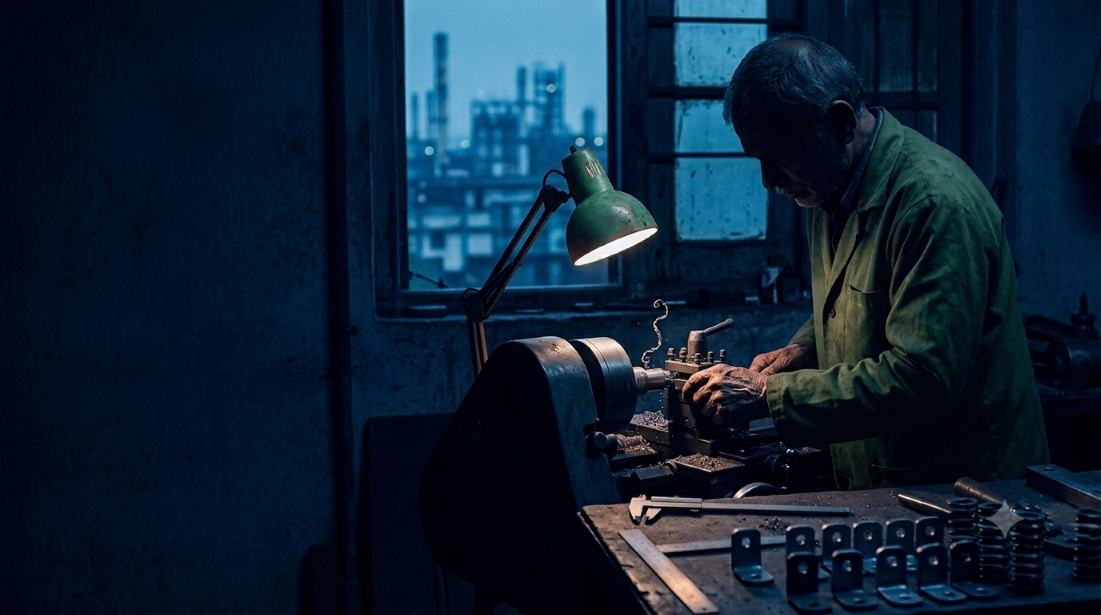
- family shops with a dozen staff, one good lathe, and a great deal of nerve.
By day four, the first replacement valves were on Toyota’s line, and within two weeks Toyota was back to full production.
More than 200 companies had pitched in, most of them small, none of them under any contract to help, and none of them paid up front.
That was not luck, and it was not some special Japanese spirit. It was a machine that Japan had spent fifty years building on purpose.
The Japanese have a name for the arrangement: the vertical keiretsu. It is what the rest of this report is really about, and this series looks at how different countries and regions built their own versions of it.
Japan goes first, because it is the clearest case.
This is a story about small factories
The famous name here is Toyota, along with the founding family and a run of clever ideas about how to run a factory floor.
That part has been told a thousand times, mostly to MBA classes and by business books. But the part that matters for Assam is the layer underneath. Below Toyota sit four layers of firms:
- a few hundred large tier-one suppliers that build whole systems, like a complete braking assembly,
- a few thousand mid-sized tier-two firms that make the pump or the wiring loom that goes into that assembly,
- tens of thousands of tier-three workshops of five to twenty people, each making one bracket or one spring or one moulded clip,
- and a floor of specialist tier-four shops that do a single hardening step or a single coating.
That bottom half is the “depth” everyone talks about and almost nobody explains, and it is the hero of this report.
Figure 1 · The shape of a vertical keiretsu
A large manufacturer is the tip, but the value, the jobs, and the resilience are in the wide part at the bottom.
Orders of magnitude, from studies of the Toyota supply network (Cusumano, 1985; MacDuffie and Helper). The tiers are not exact counts.
Assam, in 2026, has the tip and almost nothing under it. A large chip-packaging plant is being built at Jagiroad, and the state has a fifteen-year incentive policy, cheap land, and a young workforce.
But what it does not have is the wide green band at the bottom of that diagram: the small firms who can make the bracket, hit the tolerance, deliver on Tuesday, and still be in business in ten years.
The question this series asks, country by country, is how you grow that band.
A companion report on Japan
An earlier Nitisagar report, the Japan Industrial Resilience Playbook for Assam, covered how Japanese factories are engineered to survive earthquakes and typhoons through seismic codes, business-continuity rules, and FRP retrofits. This report is about the layer underneath: the supplier web that lets those factories recover in weeks instead of years. Read together, they cover both the building and the people inside it.
Before we get to Toyota, it is worth pausing on this point.
This report isn’t about how to “build another Toyota”. But in Japan, the same small-factory pattern shows up in places that never had a giant anchor at all.
Sabae. A cold, snowbound farming district in Fukui prefecture, with no industry to speak of a century ago. In 1905 a local man brought in craftsmen from Osaka to teach spectacle-frame making as winter work for farmers who had no income for half the year.
A century later, that one district makes about 95% of Japan’s eyeglass frames and produced the world’s first titanium frames. It is a deep cluster of small family firms, and there is no giant at the top of it.
Higashi-Osaka. A single suburb of Osaka with roughly 6,000 factories, around 90% of which employ fewer than 20 people.
Locals say the district makes “everything from toothbrushes to satellites”, and in 2009 a group of these small firms built an actual satellite, the SOHLA Maido-1, to prove the point.
Panasonic and Sharp. The Kansai region grew its own dense web of small moulding, stamping and circuit-assembly shops around the consumer-electronics giants.
The shape was exactly the same as Toyota’s supplier network, but in a completely different sector.
The common thread here is not the anchor. It is a thick layer of small, capable, specialised firms, sometimes clustered under a giant and sometimes just clustered on their own.
But the best-documented example of how such a layer gets built, and gets tough enough to survive a fire, is Toyota’s home region of Aichi. That is where the story takes us.
Sakichi Toyoda was a carpenter’s son from a poor village on the coast near Nagoya. In the 1890s he started tinkering with weaving looms, because his mother and every other woman he knew wove cloth by hand for almost no money.
Over thirty years he built a loom that could spot a single broken thread and stop itself instantly, and one worker could then mind dozens of machines instead of one.
In 1929 the largest textile-machinery firm in the world, Platt Brothers of England, paid one million yen for the rights to that loom.
Sakichi’s son Kiichiro took the money and spent it studying a product Japan could not yet make: the motor car.
There was no plan for a national industry here.
There was a family, a windfall, and a hunch that a country which had just taught itself to build world-class looms could learn to build engines too.
Kiichiro opened a car department inside the family loom company in 1933.
Ford and General Motors already ran assembly plants in Japan, shipping in parts from Detroit and bolting them together with local labour. Every earlier Japanese attempt to build a car from scratch had died on the same problem.
There was nobody to buy parts from. No firm in Japan could supply a pressed-steel car body to a usable standard, or a proper crankshaft bearing, or brake components, or electrical parts, or rubber seals that held.
Kiichiro’s first engine, copied from a Chevrolet, kept cracking because no local foundry could pour the casting cleanly.
So Toyota did what a firm does when the supply base does not exist. It made everything itself: forging, casting, machining, glass, electrical, all in one place, all learned the hard way.
It was slow and expensive, and the cars were mediocre for years.
Assam today is in a milder version of this bind. India has deep supplier bases, but they sit two thousand kilometres away in Gujarat, Tamil Nadu and Maharashtra, and the Northeast has almost none of that capacity locally.
So the Japanese question, ported to Assam, is not “how do you build a supplier base from nothing?” It is a subtler one: how does a region stop importing every part and start making most of them nearby?
That is the question the Jagiroad anchor now puts to the state government.
In 1936 Japan’s government passed a law that would look familiar to anyone who has watched India’s electronics push.
Any large carmaker had to be Japanese-owned and licensed, and Ford and GM were capped and then squeezed out entirely by 1939.
Tariffs on imported parts went up, and Toyota and Nissan got the first two licences.
The military wanted trucks. The industry ministry wanted an industry. Protection was total, and it was pointed at two firms.
This policy wall gave Japan a domestic industry, and it worked because it came after two decades of small, high-cost producers making unremarkable vehicles. What changed things later was not the wall itself, but the four conditions Japan attached to sitting behind it:
- the licensed firms had to compete with each other, not carve up the market,
- they had to chase exports, so a foreign buyer’s judgement kept them honest,
- they had to hit quality numbers a government auditor could actually check,
- and the protection had a clock on it, not a permanent seat.
The wall without those conditions is just a subsidy. The wall with them is an industry.
The transfer test
Assam has no tariff lever, because trade policy is set in Delhi. But what a state government does control is procurement, land allotment, capital subsidy, and the conditions attached to each. Every lever in this report has to survive that translation, or it is just a slogan.
In 1945 Japan lost the second World War, and Toyota lost its market a second time.
In 1949, an American adviser named Joseph Dodge put the Japanese economy through a brutal anti-inflation squeeze. Demand vanished, dealers stopped taking cars, and by mid-1949 Toyota could not pay its bills.
A syndicate of 24 banks bailed the company out on conditions: split off the sales arm, cut costs to the bone, and, over the founder’s objection, cut jobs.
Toyota moved to sack 1,600 workers, and the workforce struck for two months.
When it was over, more than 2,000 people were gone and Kiichiro Toyoda had resigned as president of the company his family had founded.
Toyota was made to spin off its electrical-parts division in 1949 as a separate company called Nippon Denso, now known simply as Denso- one of the largest auto-parts firms on earth today.
Aisin, the company whose factory would later burn down in 1997, was spun out of the group in the same wave. But Aisin, and Toyota and the ecosystem survived and thrived because of keiretsu.
Two kinds of keiretsu
There are two kinds of keiretsu in Japan, and only one is the subject of this report.
| Horizontal keiretsu | Vertical keiretsu | |
|---|---|---|
| Examples | Mitsubishi, Mitsui, Sumitomo, Fuyo | Toyota, Nissan, Honda, Matsushita |
| What holds it together | A single house bank at the centre | A single manufacturing anchor at the top |
| What sits inside it | Firms across unrelated sectors: shipping, banking, chemicals, breweries | Suppliers stacked in tiers, each feeding the tier above |
| Typical size | ~30 large group companies | Tens of thousands of firms, most under 20 people |
| What it built | Post-war Japanese finance and trading | The small-factory manufacturing base |
| Relevance to this report | Background context only | The whole subject |
The horizontal keiretsu matters for Japanese corporate history, but it is not what built the small-factory base. This report is about the vertical keiretsu, built around a single manufacturing anchor like Toyota, and stacking its suppliers in tiers below it, each tier’s fate tied to the tier above.
Toyota sits at the centre. Denso and Aisin are on the ring immediately outside it, as former divisions turned into permanent suppliers. Below them sit a few hundred first-tier firms. Below those, a few thousand tier-two ones, and finally tens of thousands of tier-three workshops on the outermost ring.
They hold shares in each other, borrow from the same house bank, and stay linked for decades. None of them is fully free to walk away, and none of them is fully alone either.
That is the arrangement this report is about, and it is what made 200 strangers rebuild a brake valve in four days.
Toyota drew a hard lesson from nearly going bust: never again carry every cost yourself.
From then on, it deliberately kept itself smaller than it could have been, and pushed work outward to a network of suppliers it could guide, lean on in a boom, and share the pain with in a slump.
But that network did not yet exist.
It had to be built, and it was built slowly over the next fifteen years, through a combination of Toyota’s own pressure and technical help, new laws that we come to in the next section, and banks that were set up specifically to lend to firms no commercial bank would touch.
This is the moment in our story when small factories, the MSMEs, become the main characters.
The economist Michael Smitka, whose book Competitive Ties is the closest study of exactly this, argues that Japan’s supplier system was built as much to spread financial risk as to save cost.
The big firm stays lean and stable, while the smaller suppliers absorb the swings in the market. But in return, those suppliers get long relationships, technical help, and a real shot at growing with the customer. That bargain is what kept small firms willing to take on the risk in the first place.
Figure 2 · Fifty years, and three times close to dead
The Toyota supplier network was not a project with a launch date, but a thing built slowly, through repeated near-failure. Green marks the crises it barely survived.
Dates from Toyota’s own corporate history and the sources listed at the end. The supplier-share and defect-rate comparisons are from Cusumano (1985) and later work by Cusumano and Takeishi.
The romance of this story is all about the big company.
But the useful bit is about a small factory, and about four unglamorous things a state can choose to build or not build, each of which the small factory needed in order to survive.
Picture a twelve-person stamping shop in Aichi in 1956, one that presses a bracket for a Toyota tier-one supplier. What does that shop need in order to stay alive, get better, and eventually be trusted enough to help save the anchor when a fire breaks out forty years later?
Four things, in roughly this order.
What the small factory needed
1. Not to have its cash starved by the customer. The 1956 Subcontract Act made it illegal for a large buyer to stretch out payment or cut an agreed price after the fact. A small-firm base cannot form if the anchors use their size to squeeze their vendors’ cash flow, and this is the first-order law that has to be written before anything else can work.
2. A bank willing to lend it a first machine. Japan set up dedicated finance bodies whose only job was to lend to firms the commercial banks would not touch, on long repayment terms, for equipment. So a twelve-person shop could borrow to buy its first press, and then its second.
3. Time-limited help to upgrade, not permanent protection. The 1956 machinery-industry law paired government technical guidance with cheap loans for parts makers, but it came with targets and an end date. It expired in 1971 and was not renewed, and that discipline is a large part of why the small firms got sharper over time rather than softer.
4. Support tied to getting measurably better. A 1963 law shifted the whole approach from shielding small firms to modernising them. Money and tax relief went to firms that improved their equipment, output and quality, and firms that did not improve gradually lost the support.
Alongside those four things, Toyota ran a suppliers’ association of its own called the kyohokai, which Toyota’s own historians describe as “a voluntary organization of parts suppliers”.
It ran shared training, quality circles and joint problem-solving for decades, among firms that were often rivals in each other’s product lines. Toyota now runs versions of it in a dozen countries.
None of this was fast, however. It took decades of sweat, blood and motor oil.
Now go back to the fire in Kariya in February 1997.
The reason 200 strangers could make a brake valve in four days was not improvisation nor a slick presentation on a business continuity plan, but fifty years of quiet groundwork bearing fruit. Every one of the five things a crisis needs was already in place:
- The standard was known. Those small firms already understood Toyota’s tolerances, because Toyota and its tier-ones had spent decades teaching them on quieter work.
- The trust was built. They took the job on a handshake because a law and a long relationship said they would be paid.
- The language matched. Their engineers already spoke the same production dialect, so drawings could be read without translation.
- The room existed. Many of them already sat in the same suppliers’ association, so a group call on day one could reach dozens of firms at once.
- The blueprints were open. The intellectual-property fights had been settled long ago in favour of keeping the group alive, so Aisin could fax its designs to rivals without a lawyer in the room.
Figure 3 · The recovery clock
What a deep supplier base actually buys you: two weeks instead of two months.
Nishiguchi and Beaudet, The Toyota Group and the Aisin Fire, MIT Sloan Management Review, 1998.
That is what “depth” means in practice: not a long list of registered factories, but a web of relationships thick enough to route around a disaster.
First, the honest bit.
This ecosystem took Japan about fifty years and three brushes with collapse.
Even inside India the clock is long: the engineering cluster in Rajkot, Gujarat, which this series looks at next, took the better part of forty years to go from diesel-engine repair sheds to exporting castings. Nobody built that in five.
So a realistic Assam roadmap is measured in the working lives of the people who start it, which is twenty to thirty years to real depth.
This report is an aspirational map, not a promise. But what does transfer is method. Six things, all of which a state government can actually do.
| # | Lever | What Japan actually did | What Assam can do now |
|---|---|---|---|
| 1 | Anchor discipline | Toyota, Nissan and Honda absorbed a first tier of ~200 suppliers each and pushed knowledge down two more tiers. | Attach a published local-content path, a supplier-development cell and open audits to the Jagiroad MoU. |
| 2 | Payment law with teeth | The 1956 Subcontract Act criminalised late payment and price-shading by prime firms. | Force every state PSU and anchor MoU to route MSME invoices through TReDS, with a public dashboard. |
| 3 | Patient equipment finance | Shoko Chukin and JFC lent to firms of 20 people, on 7-to-10 year terms, for machines. | Stitch NEDFi, SIDBI and CGTMSE into a single pipeline. One door, not three. |
| 4 | Pay to get better, and check | The 1963 SME Modernisation Law funded improvement, audited it, and ended the grant on schedule. | Extend Assam’s 75% quality-certification refund into a graduated ladder tied to ZED, with sunset dates. |
| 5 | A convened suppliers’ association | Toyota’s kyohokai trained rivals together on cost, quality and delivery. | Seed an electronics-and-precision-engineering council for Jagiroad. State money, industry seat. |
| 6 | Exports as the test | Post-1955 support tied the richest incentives to firms whose products left Japan. | Top up RoDTEP for firms exporting from the Northeast, and skew capital subsidies toward the same metric. |
The rest of this section unpacks each row.
1. Build around the anchor, do not scatter the money
Japan’s base formed around a few demanding buyers, but Assam’s incentives are spread thinly by company size with no cluster logic. Attach conditions to the Jagiroad anchor instead: a published local-content path, a funded supplier-development cell, and open capability audits.
2. A subcontractor payment law with teeth
Japan passed one in 1956, because a small-firm base cannot form on strangled cash flow. India’s MSME payment law of 2026 is the seed. Assam can force its own PSUs and every anchor MoU to route payments through TReDS and mean it.
3. Patient equipment finance for the bottom two tiers
Japan built lenders whose only job was the small firm, on long terms, for machines. NEDFi and SIDBI are the nearest Indian tools and are barely used this way.
4. Pay for getting better, and check
The 1963 law funded improvement, not existence. Assam already refunds 75% of quality-certification cost. Extend it: graduated support against audited productivity, ZED levels, and first-tier vendor approvals, tapering over time.
5. A real suppliers' association, convened and part-funded by the state
The kyohokai worked because it did training and problem-solving across rivals. An Assam electronics-and-engineering suppliers’ council, seeded with public money and tied to Jagiroad, is cheap and high-return.
6. Make exports the test
The interventions that worked elsewhere rewarded firms for winning outside markets, not for collecting subsidy. Tie the richest incentives to output that leaves the state.
What does not transfer, and Assam should stop wishing for it: a full-blown vertical keiretsu, with a captive main bank willing to fund the group through decades of losses and cross-shareholdings that lock suppliers in for a generation.
Nor a war economy that forced skills in-house; nor a US-run postwar occupation that could restructure Japanese industry by order; nor a central ministry with the staff and the political cover to run all of this for forty years.
The World Bank’s own study of East Asia warned that these tools misfire without strong institutions behind them, and that warning is the real subject of this series.
The honest promise at the end of it: Assam will not become Aichi. But over a generation, it can build a supplier base deep enough that the day the Jagiroad plant has a bad week, there are two hundred small firms in the Brahmaputra valley who know how to help.
Next in this series
Industrial Ecosystems 2 goes to Rajkot, and how a Gujarat town of engine-repair sheds became a casting exporter. Then Singapore and Malaysia, then Pune, South Korea, the Netherlands and Germany, before a closing report that turns the whole comparison into an Assam roadmap with dates.
Every one of the six levers in the last section already has an Indian scheme sitting on the shelf.
The problem is not a missing scheme. It is that policy conversation in Delhi and Dispur has, for a decade, reached for the same tool for every job: the Production-Linked Incentive, or PLI. PLI pays cash for output above a target, and it has worked well for what it was built for: mobile phones, and a handful of large assembly units.
But it is a hammer, and most of what Assam needs is not a nail.
Why PLI alone will not build a supplier base
PLI has three quiet limits that matter for the tier-three and tier-four layer:
- It rewards the anchor, not the layer below. The cheque goes to the firm that hits the output number, which is almost always a large one. A twelve-person stamping shop rarely qualifies, and rarely sees the money.
- It is time-limited, and outcome-blind. The support ends on a fixed date, whether or not the firm has become better at what it does. There is no upgrade condition attached, only a volume one.
- It is manufacturing-only. Design, IP, tooling, testing, calibration and repair, which are the services that surround a supplier base and often start it, are not eligible.
The lesson from Japan is that a supplier base is built by a stack of instruments, not a single one.
The Indian stack, and what each piece is really for
Here is the honest matching, lever by lever, with the tool that already exists.
| # | Lever | Indian scheme on the shelf | What the state actually has to do |
|---|---|---|---|
| 1 | Anchor | PLI, plus the state’s own land-and-power MoU | Attach local-content, supplier-development and audit conditions to the MoU. PLI alone will not do it. |
| 2 | Cash flow | MSME Act 2006, MSMED Amendment 2026, TReDS | Make TReDS the default route for every state PSU and anchor invoice. Audit the payment cycle publicly. |
| 3 | Patient finance | SIDBI, NEDFi, CGTMSE | Stitch the three into one pipeline. A first-time Jagiroad supplier should get an equipment loan, a guarantee, and a purchase order as a routine, not a favour. |
| 4 | Upgrade | DLI (design), MSE-CDP, ZED, state 75% certification refund | Bundle into a graduated ladder. Each rung requires audited productivity and each rung has an end date. |
| 5 | Suppliers’ association | SFURTI, MSE-CDP | Retarget from craft clusters to an electronics-and-precision-engineering council for Jagiroad. Seed it with state money. |
| 6 | Export discipline | RoDTEP | State top-up on RoDTEP for exports from the Northeast. Reserve the richest capital subsidies for the same firms. |
The rest of this section reads each row.
1. The anchor lever · use PLI, but attach conditions to the MoU
PLI is a good fit for the Jagiroad-scale anchor. But the state’s leverage is the MoU that sits alongside it, not the central cheque. Assam can attach a published local-content path, a funded supplier-development cell, and open capability audits to the state-level land-and-power package, the way Japan attached export and quality conditions to its 1936 licences.
2. The cash-flow lever · MSME Act 2006 plus TReDS, made non-optional
The Micro, Small and Medium Enterprises Development Act of 2006 already mandates payment within 45 days, and the MSME Amendment of 2026 sharpens the tax teeth. TReDS gives a small firm a way to discount an invoice the day it is raised. What is missing is not the law, but the enforcement. Assam can require every anchor MoU and every state PSU to route MSME invoices through TReDS, and audit it.
3. The patient-finance lever · SIDBI, NEDFi, CGTMSE, mostly under-used
Japan built dedicated small-firm lenders. India has three:
- SIDBI, the Small Industries Development Bank of India, for equipment and working capital,
- NEDFi, the North Eastern Development Finance Corporation, the closest thing the region has to a Japanese-style patient lender,
- CGTMSE, the credit-guarantee scheme that lets a bank lend to a small firm without collateral.
The kit is there. The gap is a state-level pipeline that walks a first-time Jagiroad supplier from a NEDFi loan to a CGTMSE guarantee to a tier-one purchase order, as a routine, not a favour.
4. The upgrade lever · DLI over PLI for a services-led route
This is where the Indian toolkit has the most interesting fit. The Design-Linked Incentive scheme, run by MeitY, funds fabless chip-design firms and IP development, not fabrication. It is services-led by design.
Assam has no fab-supplier depth. It does have young engineering graduates and a growing IIT and NIT footprint.
A DLI-shaped path - design services, verification, embedded software, testing IP - reaches the tier-3 layer through people rather than through machines. It is cheaper per rupee, faster to start, and it builds the exact human capital the physical suppliers will need in ten years.
Bolt this to ZED (Zero Defect, Zero Effect) certification refunds, MSE-CDP cluster grants, and the state’s own 75% quality-certification refund, and the “get measurably better” lever is fully assembled.
5. The suppliers' association lever · SFURTI and MSE-CDP, retargeted
Japan’s kyohokai worked because rivals trained together. India already funds cluster bodies through two schemes:
- SFURTI, the Scheme of Fund for Regeneration of Traditional Industries, and
- MSE-CDP, the Micro and Small Enterprises Cluster Development Programme.
Both mostly go to legacy craft and textile clusters. Retargeted at an electronics-and-precision-engineering suppliers’ council seeded with state money and tied to the Jagiroad anchor, they become the direct Indian counterpart to what Toyota built in the 1950s.
6. The export-discipline lever · RoDTEP, MEIS's replacement, plus the state's own top-up
The Remission of Duties and Taxes on Exported Products scheme refunds embedded taxes on export. It is the closest thing in India to Japan’s export-first discipline, because it only pays out when a container leaves the country.
Assam can add a state-level top-up on top of RoDTEP for firms that export from the Northeast, and skew the richest capital subsidies toward that same metric. Make foreign judgement the tiebreaker.
The imagination bit
Put those six together and it starts to look less like a wish list and more like a design brief. A workable Assam stack, in one line each:
- one anchor MoU per major cluster, with published local-content and quality conditions;
- one enforced payment law, routed through TReDS, with public dashboards;
- one small-firm lending pipeline that stitches NEDFi, SIDBI and CGTMSE into a single door;
- one design-linked route for services and IP, alongside PLI for hardware;
- one suppliers’ council per cluster, seeded from SFURTI and MSE-CDP;
- one export top-up on RoDTEP, with the biggest subsidies reserved for firms that ship out of India.
None of these needs a new central scheme. Every one of them needs a state that treats industrial policy as engineering, not as a press release.
That is the real transfer from Japan.
- Toyota Motor Corporation, 75 Years of Toyota (the loom patent sale, the 1936 licensing law, the 1949 to 1950 reconstruction and Kiichiro Toyoda’s resignation, the kyohokai, and the Denso spin-off).
- Michael A. Cusumano, The Japanese Automobile Industry: Technology and Management at Nissan and Toyota, Harvard University Press, 1985. Publisher listing.
- Michael J. Smitka, Competitive Ties: Subcontracting in the Japanese Automotive Industry, Columbia University Press, 1991 (the risk-sharing argument for why the supplier system formed).
- Toshihiro Nishiguchi and Alexandre Beaudet, The Toyota Group and the Aisin Fire, MIT Sloan Management Review, 1998, and the 1997 Aisin fire.
- Chalmers Johnson, MITI and the Japanese Miracle: The Growth of Industrial Policy, 1925 to 1975, Stanford University Press, 1982. Full text at the Internet Archive.
- The World Bank, The East Asian Miracle: Economic Growth and Public Policy, 1993.
- Japan’s Subcontract Act, 1956, and Yoshimura and Kato, The Policy Environment for Promoting SMEs in Japan, PECC, 2007.
- Fukui Prefecture, A Global Eyewear Hub (Sabae), and JETRO, Higashi-Osaka City data.
Related Nitisagar work:
- The Japan Industrial Resilience Playbook for Assam, the sibling report on how Japanese factories are engineered to survive earthquakes and typhoons.
- What the Japan summit means for Assam’s semiconductor cluster.
- The incentive estimator for Assam’s fifteen-year policy.
The moves that matter, before they cost you
Reports like this one are how we go deep on the shifts that decide which projects work in Northeast India. Every new report, briefing, and analysis in your inbox — original reporting, no syndicated fluff.
We'll map your project against IIPA 2019 and Assam's incentive stack, complimentary, no commitment.
Get a Free Pre-Assessment