
Assam finance minister Jayanta Mallabaruah presented the Assam Budget 2026-27 on 10 July. Previous Assam budgets counted bridges built and beneficiaries enrolled. This one names clusters, corridors, and chips.
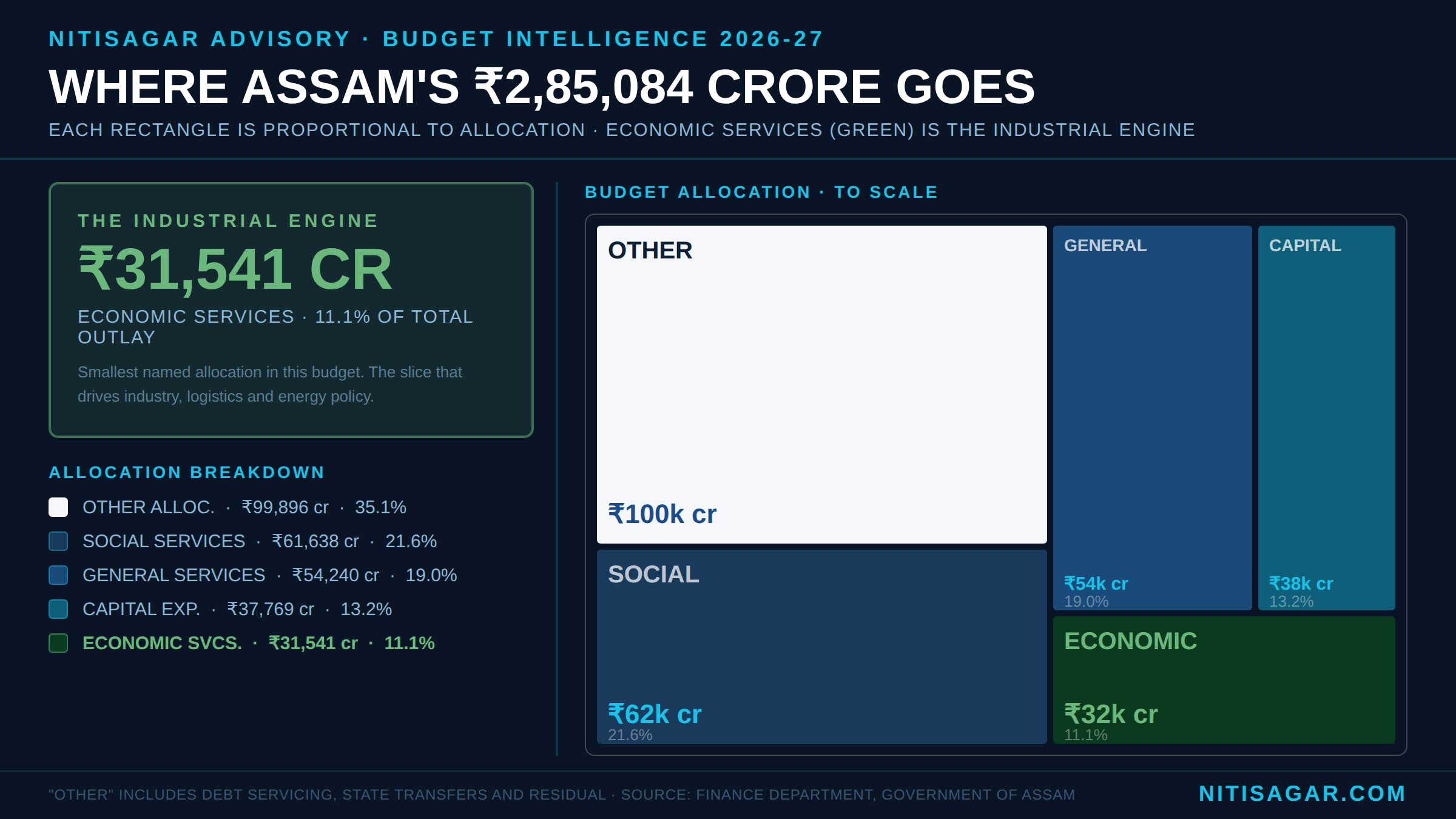
The Rs 2,85,084 crore outlay is the largest in the state’s history, up from Rs 79,296 crore in 2015-16, with capital expenditure now at Rs 37,769 crore and economic services receiving Rs 31,541 crore against Rs 61,638 crore for social services. But that number is not the actual story. What’s different is that for the first time, the industrial sections of the budget read as if the policymakers understood what a modern industrial ecosystem and supply chain requires.
That shift deserves careful tracking, because now it boils down to execution. If Assam manages to translate even 50% of these proposals into actual ground level results the industrial scenario would transform dramatically.
Chief Minister Sarma described the budget as a five-year economic roadmap, not an annual accounts exercise. That framing matters for how to read it.
It is not a delivery document. It is a commitment architecture that only becomes legible when you track each commitment against what it actually requires.
What follows is a scheme-by-scheme, number-by-number analysis of five commitments that bear directly on manufacturing, MSME operations, and logistics in Assam, followed by five structural gaps the budget does not yet address.
The Semiconductor Bet: A-SEMI and What Jagiroad Needs to Deliver It
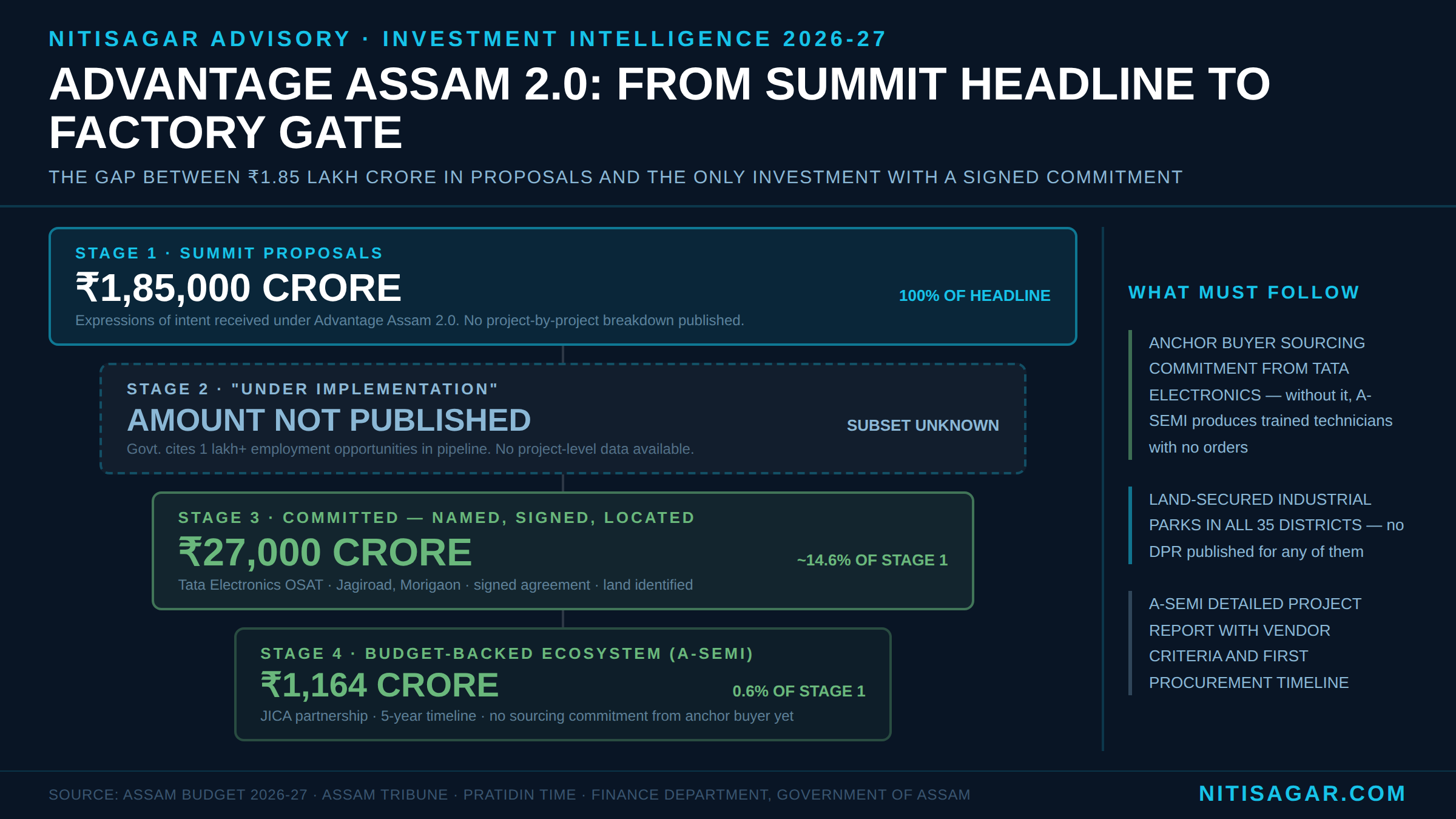
The budget proposes A-SEMI, the Assam Semiconductor Ecosystem on Manufacturing and Innovation programme, at Rs 1,164 crore over five years in partnership with the Japan International Cooperation Agency (JICA). The explicit objective is to build a vendor and skills ecosystem around the Tata Electronics OSAT facility at Jagiroad in Morigaon. Chief Minister Sarma confirmed at the press conference that A-SEMI specifically targets enabling local MSMEs to manufacture components required by the semiconductor industry.
The JICA involvement is not new. As our earlier analysis of the India-Japan summit highlighted, Japan’s interest in the development of Assam’s electronics corridor has been consistent.
The Rs 1,164 crore converts a diplomatic arrangement into a budget line. That conversion matters. It does not, however, resolve the central question for any MSME considering entry into this supply chain.
Electronics manufacturing clusters succeed globally when the anchor buyer commits to local sourcing targets, not simply when a government funds a training and infrastructure programme alongside it. The budget contains no demand-side commitment, no sourcing framework, and no procurement linkage programme from Tata Electronics.
A-SEMI creates the possibility of a vendor ecosystem. It does not create the orders that make that ecosystem commercially viable.
For MSMEs tracking the semiconductor supply chain opportunity, the A-SEMI Detailed Project Report is the document to watch, not the budget line. It will specify which component categories are being targeted, what vendor qualification criteria will look like, and what the timeline to first procurement is. Until that document is public, positioning decisions are ahead of the evidence.
The MSME Bill: The Most Structural Change in This Budget
Alongside the budget, the cabinet introduced the Assam Micro, Small and Medium Enterprises (Facilitation of Establishment and Operations) Bill, 2026. Its core provision: small enterprises may begin operations without prior government permission for the first three years, provided they comply with applicable norms. Industries within notified industrial estates receive all approvals through single-window clearance managed by the Industry Department.
| Aspect | Current situation | After MSME Bill 2026 |
|---|---|---|
| Starting operations | Prior government approval required | No prior permission needed for first 3 years |
| Approvals within industrial estates | Multiple departments, no fixed timeline | Single-window via Industry Department |
| Approvals outside industrial estates | Department-by-department | Unchanged; multiple departments apply |
| Pollution-category industries | Standard approval process | Explicitly excluded from deemed-approval |
| Application filing | Must await government acknowledgement | File and start; application status irrelevant |
This reform addresses the most common cause of MSME formation failure in Assam: the permission queue. If you have been through this process, the Factory Setup Playbook maps the full approval sequence that currently separates a manufacturer from first operations. A unit that can begin operations from the date of filing, rather than from the date of approval, has a fundamentally different cash-flow position.
The Assam Ease of Doing Business (Amendment) Act 2026 runs parallel to the bill and extends the same reform logic across a broader set of business registrations. Together, these two legislative changes represent the most direct reduction in administrative friction for small manufacturers that Assam has enacted in a single session.
Two limits in the provision are worth understanding. The deemed-approval clause does not apply to pollution-generating industries. Also, units located outside a notified industrial estate must still navigate the full departmental approval process.
The reform is meaningfully concentrated inside industrial parks. That creates a strong economic reason for any new manufacturing unit to choose a designated estate over private land.
UNNATI 2024’s registration window is nominally open until 30 September 2026, but new registrations have effectively stopped. The scheme’s own guidelines halt further grants once projected financial liability against approved units reaches 115% of the total outlay, and that threshold has been reached. Treat UNNATI as closed to new applicants.
The MSME Bill’s deemed-approval clause does not reopen that route. What it does is remove the permission delay that used to compound the funding gap for units that missed UNNATI. IIPA 2019, not UNNATI, is the live state incentive scheme for a new Assam MSME today, and a unit sited within a notified industrial estate can now move the clock from the date of filing, not the date of clearance. For the current status of every scheme this budget touches, search the Policy Explorer.
Infrastructure and Logistics: The Three Numbers That Change the Geography
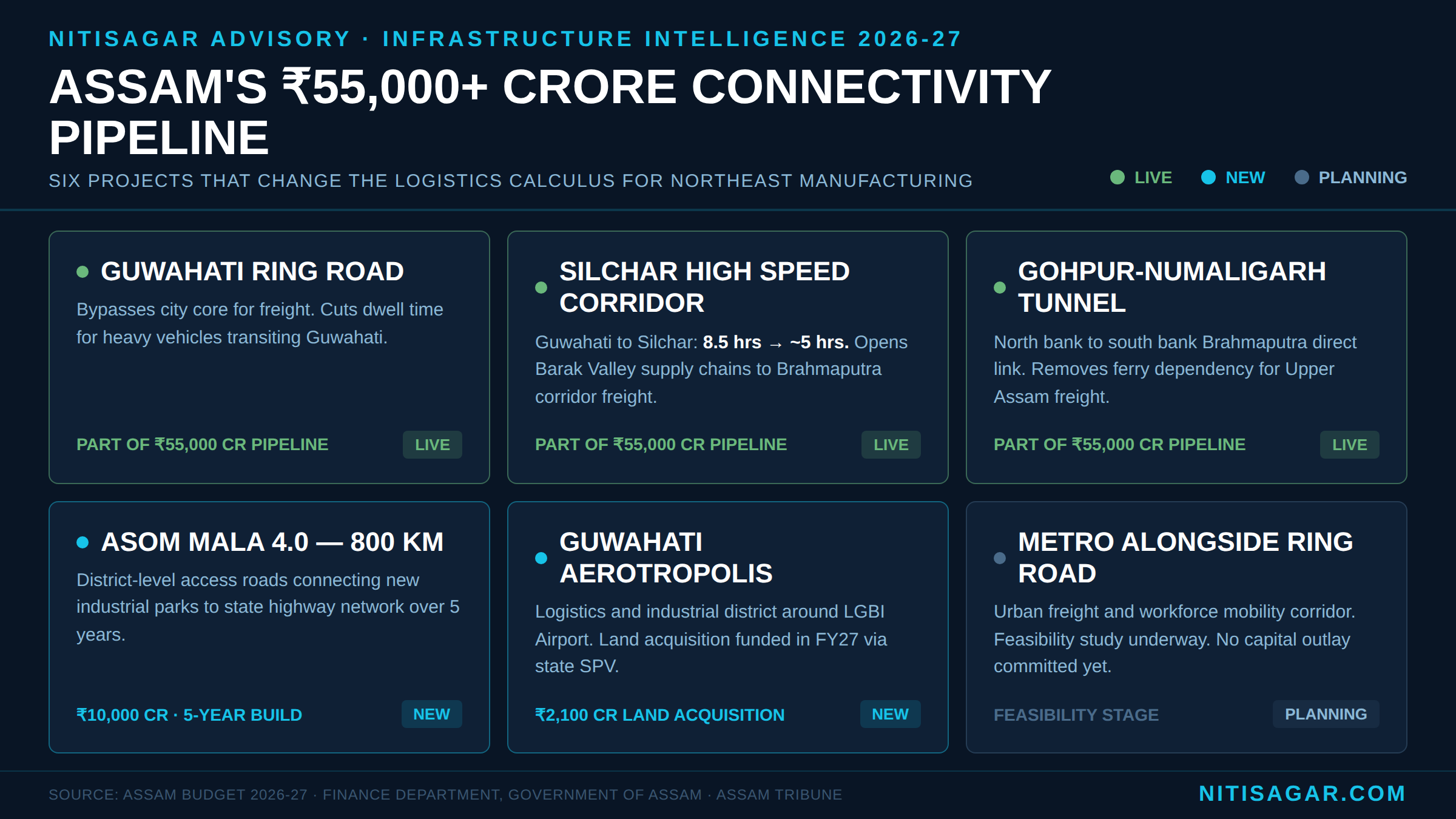
The budget’s infrastructure commitments address the constraint that has historically made Assam a difficult proposition for logistics-intensive manufacturing: time and cost of movement. A Rs 55,000 crore pipeline is currently under implementation, covering the Guwahati Ring Road, Silchar High Speed Corridor, Kaziranga Elevated Corridor, and Gohpur-Numaligarh Brahmaputra Tunnel. Asom Mala 4.0 adds Rs 10,000 crore for 800 km of new roads over five years.
The Silchar High Speed Corridor is the most significant logistics-affecting project in this stack for Barak Valley operations. Reducing Guwahati-to-Silchar travel time from eight and a half hours to approximately five changes the economics of supply chain integration between the two corridors.
Time-sensitive goods that currently move by air or overnight road can shift to standard freight. That is a structural change in logistics costs, not simply an incremental one.
| Project | Investment | Primary logistics impact |
|---|---|---|
| Guwahati Ring Road | Part of Rs 55,000 crore pipeline | Bypasses city core for freight movement |
| Silchar High Speed Corridor | Same pipeline | Guwahati to Silchar: 8.5 hours to ~5 hours |
| Kaziranga Elevated Corridor | Same pipeline | Removes seasonal NH-37 bottleneck |
| Gohpur-Numaligarh Brahmaputra Tunnel | Same pipeline | North bank to south bank direct link |
| Asom Mala 4.0 (800 km) | Rs 10,000 crore over 5 years | District-level access to new industrial parks |
| Aerotropolis (land acquisition) | Rs 2,100 crore in FY27 | Logistics hub at Guwahati airport perimeter |
| Metro alongside Ring Road | Feasibility study stage | Urban freight and commuter access to industrial zone |
The Guwahati Aerotropolis is the most ambitious logistics announcement in the budget. The government has allocated Rs 2,100 crore for land acquisition around Lokpriya Gopinath Bordoloi International Airport and will implement the project through the Guwahati Satellite City Development Authority, a Special Purpose Vehicle wholly owned by the state government. The Finance Minister named logistics companies explicitly among the intended occupants, alongside manufacturing units and commercial establishments.
Land acquisition at this scale is the step that turns an aerotropolis from a concept into a construction project. The budget has funded that step.
What follows (utility connections, plot demarcation, anchor tenant agreements, and the SPV’s regulatory framework) is where airport city projects across India typically stall. This one has no precedent in Northeast India to suggest whether the project will actually take off.
The proposal to establish industrial parks in every district is the piece of this budget that determines whether the MSME Bill’s reforms reach manufacturing outside Guwahati. A park with functional power, water, roads, and single-window clearance can distribute the reform across 35 districts.
A park that exists on paper offers a faster approval for an unviable location. The budget does not contain park-by-park status disclosures or timelines.
Energy: The Heartbeat of Industrial Assam
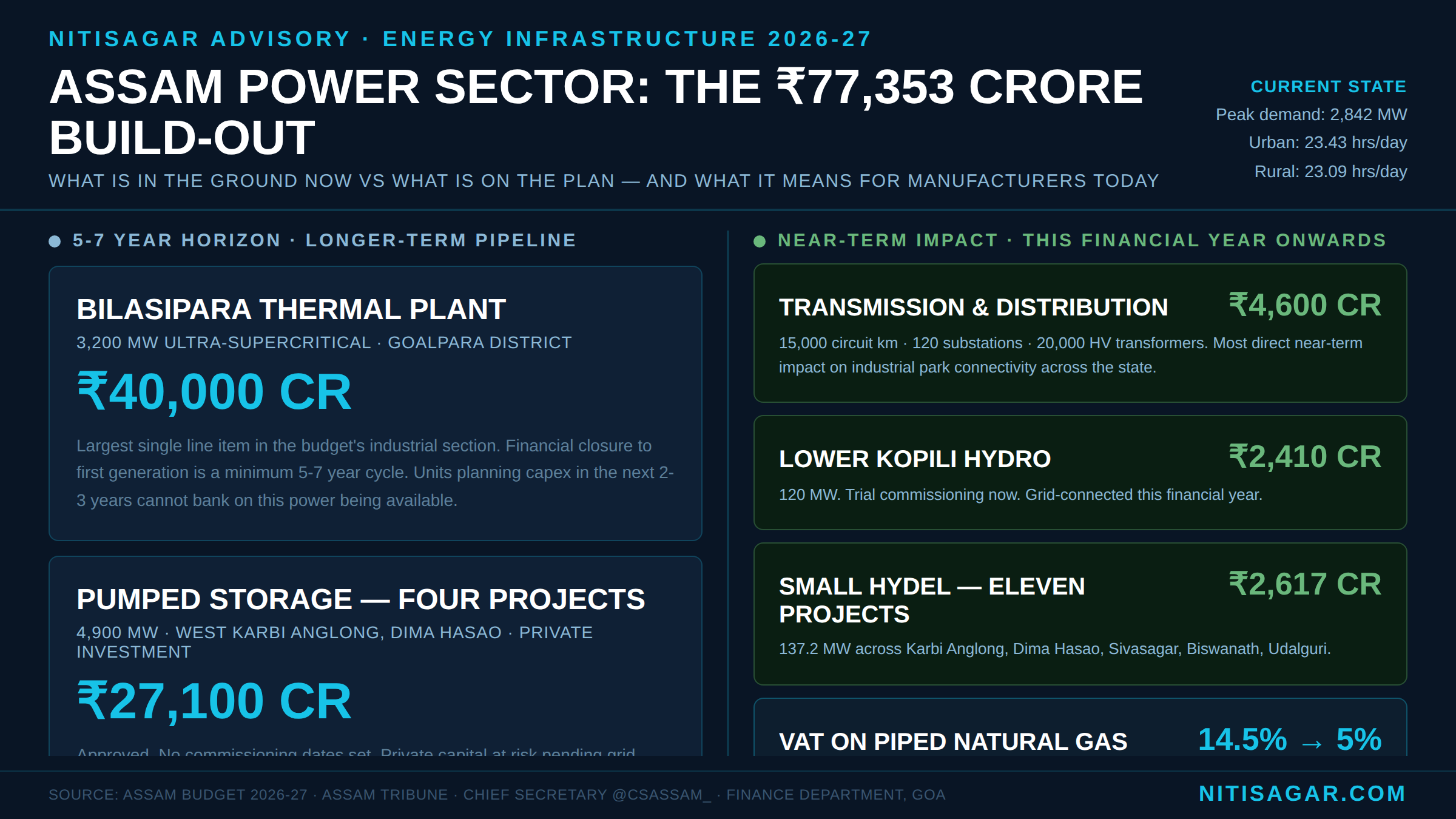
Consistent, affordable power is not a supporting feature of industrial policy. It is the primary input cost that determines whether a manufacturing unit can compete. The Assam Budget acknowledges this with unusual directness, backing the argument with a Rs 77,353 crore investment pipeline across thermal, hydro, solar, pumped storage, battery storage, and transmission. Assam’s peak electricity demand currently stands at approximately 2,842 MW, and average daily power availability is 23.43 hours in urban areas and 23.09 hours in rural areas, above the national average.
| Category | Investment | Capacity / Scale |
|---|---|---|
| Thermal plant at Bilasipara | Rs 40,000 crore | 3,200 MW ultra-supercritical |
| Four pumped storage projects (private investment) | Rs 27,100 crore | 4,900 MW combined |
| Eleven small hydel projects across six districts | Rs 2,617 crore | 137.2 MW combined |
| Lower Kopili Hydroelectric Project | Rs 2,410 crore | 120 MW (trial commissioning now) |
| Solar projects (Sonitpur, Dibrugarh, Karbi Anglong) | Rs 456 crore | Target 3,000-4,000 MW by 2030 |
| Battery energy storage systems | Rs 170 crore | Grid stability |
| Transmission, distribution and substations | Rs 4,600 crore | 15,000 circuit km; 120 substations; 20,000 HV transformers |
| Total | Rs 77,353 crore |
The reduction in VAT on piped natural gas from 14.5% to 5% is the energy measure with immediate effect. PNG is the preferred process fuel for food processing, pharmaceuticals, ceramics, precision machining, and light chemical manufacture. A 9% reduction in fuel tax slashes operating expenditure without requiring any capital investment by the manufacturer.
For units already connected to the piped gas network, this change is effective from the budget date.
The transmission plan covers 15,000 circuit kilometres of new lines, 120 substations, and 20,000 high-voltage distribution transformers over five years. It addresses the last-mile delivery problem that has made reliable industrial power a planning assumption rather than an operational reality for manufacturers outside Guwahati. The Rs 1,200 crore initiative to replace ageing low-tension power lines is the most tangible near-term improvement for existing unit operators.
The Bilasipara 3,200 MW thermal plant carries an estimated cost of Rs 40,000 crore. Projects of that scale and complexity typically require 5-7 years from financial closure to first generation. Industrial units making capital expenditure decisions today will operate in today’s power environment, not the future one.
The 23.43-hour urban supply average is an improvement, but industrial park sites outside major urban centres may have materially different supply profiles. Verify APDCL connection and load availability for your specific site before treating the state-level average as a planning input.
Advantage Assam 2.0 and the Conversion Problem
The government cited Rs 1.85 lakh crore in investment proposals received under Advantage Assam 2.0, with projects under implementation expected to generate over one lakh employment opportunities. The budget publishes neither a project-by-project status register nor a sectoral breakdown of what is under construction versus what is at the MoU stage.
Investment proposals are expressions of intent. The historical conversion rate from expression of intent to commissioned plant, across Indian states, sits consistently below the headline summit number. Assam is not an exception to this pattern.
| Sector named for continued support | What commissioned capacity actually requires |
|---|---|
| Electronics manufacturing | Vendor qualification, bonded logistics, A-SEMI alignment |
| Semiconductor ecosystem | Anchor buyer sourcing commitment, not just government infrastructure |
| Food processing | Cold chain connectivity, agri-supply aggregation, export certification |
| Chemicals and petrochemicals | Environmental clearance sequencing, pipeline connectivity, feedstock logistics |
| Renewable energy | Grid interconnection agreements, land clearance, evacuation infrastructure |
| Logistics and warehousing | Last-mile road and power to park sites, customs bonding arrangements |
The six-sector focus is the right editorial decision in industrial policy terms. Assam cannot build competitive depth across every sector simultaneously. The budget’s industrial logic holds if the six-sector filter concentrates infrastructure, workforce development, and single-window resources rather than distributing them evenly across all comers.
If the six sectors become six separate brochures, the focus will not compound.
Five Gaps This Budget Does Not Address
A budget that names the right problems still has to answer for the problems it leaves unnamed. Five gaps in the Assam Budget 2026-27 are structural, and they will constrain execution regardless of how well the announced programmes are implemented.
The credit gap. The MSME Bill reduces the permission queue but does not reduce the cost of borrowed capital. Research on Assam’s MSME sector consistently identifies credit access as the primary growth constraint, ahead of permissions and infrastructure. The Sentinel Assam editorial noted the same priority inversion. What is absent:
- No MSME working capital facility or interest subvention for manufacturing units
- No state-backed credit guarantee scheme
- The financing side of the problem is left entirely to central government existing schemes
The skills gap. Rs 496 crore for the Skill, Employment and Entrepreneurship Department is spread across all sectors and all geographies. Semiconductor manufacturing demands a specific workforce that Assam has no current programme to produce. What is absent:
- No cleanroom technician training at any of the seven newly funded universities or at Assam Skill University
- No curriculum for process technicians, cleanroom operators, metrology specialists, or quality engineers
- The budget announces Japanese and Korean language training for overseas workers, not the workforce Jagiroad needs
The land bank gap. Mission Basundhara 4.0 addresses residential and agricultural land rights for indigenous communities. Industrial land availability in Morigaon, Kamrup (Metro), and Nagaon districts is a separate and underdiscussed constraint. Our AIDC TEFR analysis covers the land and infrastructure preconditions that determine whether an industrial estate is operationally viable. What is absent:
- No DPR for any of the 35 proposed district industrial parks
- No land acquisition plan or timeline for those parks
- Industrial parks announced without land secured are aspirations, not projects
The flood and climate risk gap. Assam’s average annual flood-related economic losses run to thousands of crore. The Rs 77,353 crore power pipeline includes transmission lines across some of the most flood-exposed districts in India. What is absent:
- No elevated platform specifications for new industrial parks
- No drainage standards for industrial estates
- No flood-risk disclosure requirement for the Aerotropolis site selection process
The accountability gap. The budget is explicitly framed as a five-year plan. A five-year plan without a public performance register is indistinguishable from a five-year wish list. What is absent:
- No project-by-project status disclosure for the Advantage Assam 2.0 pipeline
- No commissioning schedule for the industrial parks commitment
- No procurement linkage target for A-SEMI
- No shared standard against which to measure whether this year’s commitments held when the 2027-28 budget arrives
What Comes Next
The Sentinel Assam editorial on the budget said what needed saying: industrial ecosystems are rarely built by investment alone, and manufacturing competitiveness depends equally on skilled labour, efficient transport, uninterrupted electricity, reliable urban infrastructure, and regulatory certainty. That is not pessimism. That is the specification.
The Assam Budget 2026-27 looks like the first Assam budget in recent memory that reads as if it was written by people who understand supply chains. A-SEMI addresses vendor development, not just anchor investment. The MSME Bill addresses the permission bottleneck, not just the credit bottleneck.
The Aerotropolis addresses logistics infrastructure, not just urban development.
These are the right problems. The budget’s industrial logic holds if:
- The six-sector focus concentrates infrastructure, workforce development, and single-window resources rather than spreading them equally across all comers
- The A-SEMI DPR arrives with a sourcing commitment from the anchor buyer, not just a government training programme alongside it
- Industrial parks in every district get land, power, and roads before the parks get brochures
- The government publishes a public performance register before the next budget session
Budget utilisation has improved from 58% to 85% over the past decade. That 15% gap still represents Rs 5,600 crore of uncommitted capital in any given year at current scale. Execution quality, not announcement ambition, is the variable that will determine whether this budget becomes a turning point or a well-intentioned speech.
Nitisagar Advisory publishes industrial policy intelligence and MSME facilitation analysis for Northeast India. For subsidy eligibility modelling under IIPA 2019 and the current scheme stack, try the Assam Industrial Subsidy Calculator. For factory approval and compliance guidance, see the Factory Setup Playbook. Sector-specific policy coverage runs fortnightly in the Gear Shift newsletter.