Japan’s Prime Minister Sanae Takaichi’s three-day tour to India is over, and she stayed put in Delhi. Guwahati, which was reportedly going to be the venue of this India-Japan summit, got a mention in her arrival essay and a paragraph in the joint statement. That is as close as Assam came to the Prime Minister herself.
Our earlier piece on the venue shift argued the cancellation would not close the door on Assam, because the deals are part of a bilateral framework that never needed a Guwahati backdrop to happen. The summit is done now, and India and Japan have signed 120 memoranda of understanding since August 2025, worth close to Rs 1 lakh crore, spread across six states. This piece covers what Assam got out of that map, what the semiconductor ecosystem got, and where the real opening still sits.
The Delegation Stayed The Same Size. The Audience Became Bigger.
Takaichi travelled with roughly the same 50-executive delegation that had been planned for a Guwahati leg, including Suzuki Motor’s president and senior figures from Itochu and Toyota Tsusho. What changed was who showed up to meet them. Speaking before her departure, Takaichi said the Business Forum in Delhi would draw more than 150 people from Japan’s business community, three times the size of her own travelling delegation.
That is the first number worth considering. Delhi did not just take over a meeting Assam was going to host, it pulled in a business crowd a Guwahati leg was unlikely to draw on its own, simply because Delhi already has that pull for anyone flying into the country. Missing the room got more expensive the moment the room got three times bigger.
Assam’s Two Named Deals: A Chip Research Tie-Up And A Biogas Plant
Look past the summit-level language and at the actual company-by-company investment map, and Assam shows up twice by name.
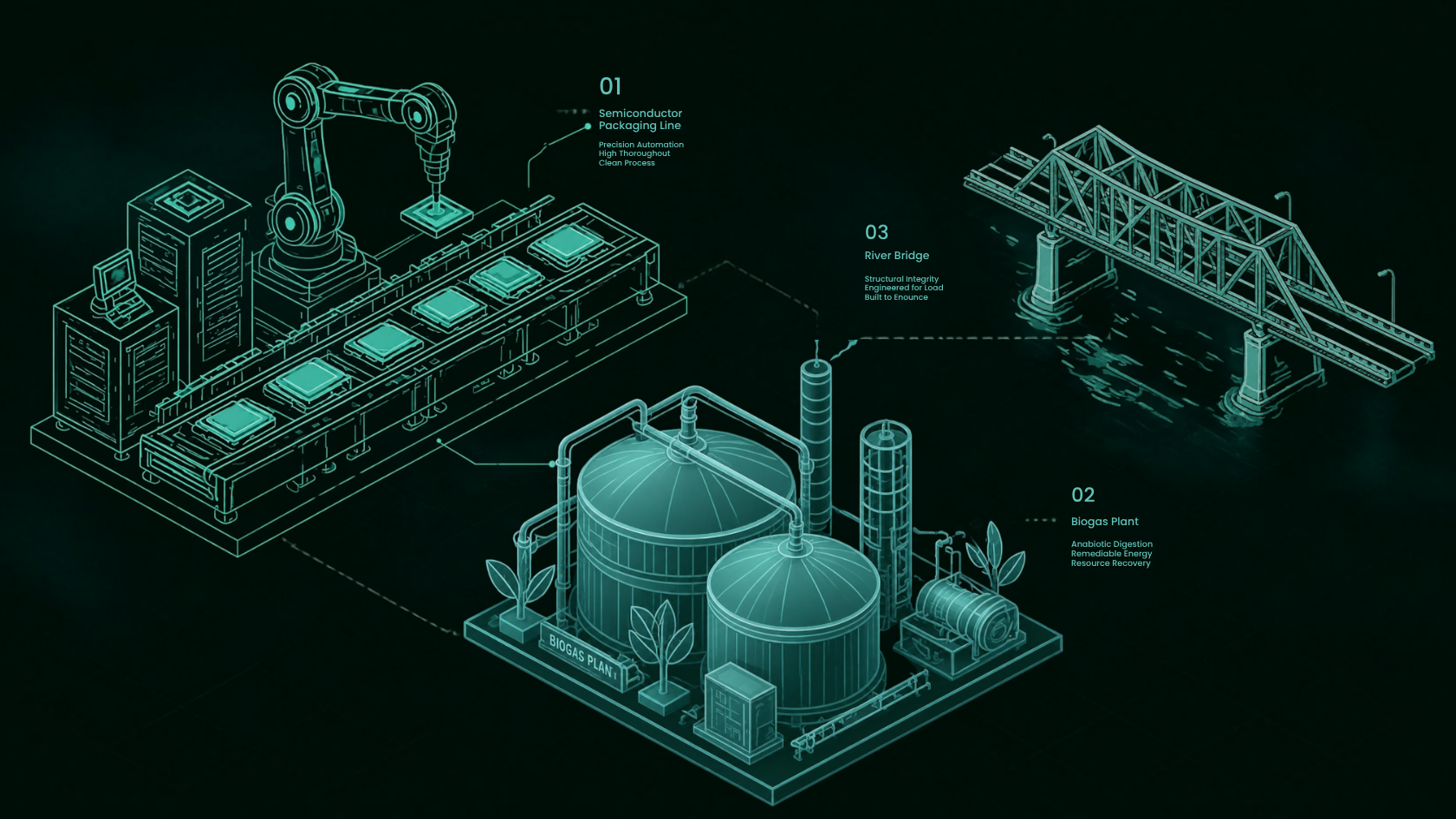
The first is a semiconductor deal, and it is a genuinely good one to have. Toho Koki, a Japanese manufacturer that builds polishing and inspection equipment for CMP pads used in wafer processing, is partnering with IIT Guwahati to build out a semiconductor research and manufacturing ecosystem in the Northeast.
Toho Koki’s own materials describe wanting to help India’s semiconductor industry “take off,” and this is the closest thing to a Japanese semiconductor company putting its name specifically on an Assam institution rather than on Tata Electronics nationally.
The second is a biogas plant. Suzuki’s India R&D arm, working through NDDB’s biogas subsidiary, is building a compressed biogas plant in Assam, the same model Suzuki has already run in Gujarat with Banas Dairy. It converts cow dung into fuel for CNG vehicles, with the residue sold as organic fertiliser, the same dairy-to-energy logic Nitisagar covered from the export side in our agri-food intelligence brief.
Neither of these is a fab, nor are they Jagiroad-scale. But both are real, named, and specific to Assam in a way that most of the semiconductor headline language from this summit is not.
The Big Semiconductor Money Went To Gujarat
Three company deals explain where the large-scale Japanese semiconductor money is actually going, and it’s mostly Gujarat.
Tokyo Electron’s original memorandum with Tata Electronics, signed in September 2024, already covers equipment for both the Rs 91,000 crore Dholera fab and the Rs 27,000 crore Jagiroad plant in Assam.
What’s new from this visit is Tokyo Electron expanding that relationship and opening a dedicated office, at Dholera, not at Jagiroad. ROHM’s arrangement with Tata Electronics, formalised on 22 December 2025, covers backend packaging, assembly and testing of power semiconductors for electric vehicles, a description that matches the ATMP plant coming up in Jagiroad.
But no source names Jagiroad as the delivery site for either deal.
Nippon Express is the clear exception on the logistics side, and this one is well documented. The company’s own statement at SEMICON India 2025 named plans to build dedicated semiconductor warehouses in Gujarat and Assam by 2027, part of a push to triple its India revenue to $400 million. That is a company putting Assam on paper, in writing, with a date attached.
Fujifilm’s new semiconductor materials facility, meanwhile, is going up in Dholera, with production starting in 2028. The pattern across this summit is consistent: the large, headline-scale Japanese semiconductor commitments are landing in Gujarat, while Assam picks up equipment and packaging relationships that exist by function rather than by name. Our own OSAT cluster benchmarking against Penang and Sanand flagged this exact gap months before this summit confirmed it.
Jagiroad Itself Is Still Not Running
None of this changes the fact that Tata Electronics’ own Jagiroad plant, the anchor plant everything above depends on, has not started commercial production yet.
We aim to start production from this plant within this financial year.
Ashwini Vaishnaw, Union Minister for Electronics and Information Technology, on X
Vaishnaw made that statement on 30 May 2026 after meeting Assam Chief Minister Himanta Biswa Sarma, which puts commercial production sometime before March 2027. The Rs 27,000 crore plant is in its final construction phase, and Tata Electronics has already signed Qualcomm as an anchor customer for automotive semiconductor modules made there. The plant is real and close, but it is not yet the reference customer Japanese suppliers can point to when they want to prove Assam works.
Nagarbera Is Still Empty
The 13th Japanese Industrial Township, planned for Nagarbera in Kamrup Rural district, has sat without a single Japanese tenant since it was designated in 2020. Assam government officials have said on record that Japanese companies simply are not interested in the land on offer. Nothing in this summit’s outcomes points to that changing.
Jagiroad reaching commercial production is the more realistic route to filling Nagarbera than any language in a joint statement, because a plant that is actually running generates supplier demand that a vacant industrial estate does not.
Assam Is Part Of A Bigger Story: Critical Minerals
One thread from this summit has nothing to do with Assam by name, but it should. China expanded its export blacklist on Japanese firms to 80 entities by late June, cutting off dysprosium, terbium and other rare earth flows in response to Takaichi’s remarks on Taiwan.
That squeeze is likely the real backstory behind why the summit joint statement focuses so much on critical minerals cooperation.
On 2 July, at the ICC’s India Minerals & Metals Forum, NITI Aayog’s Anupam Lahiri confirmed that a technical committee is drafting a framework to recover critical minerals from mine overburden, tailings and other waste, with consultations already held with Coal India, Singareni Collieries, Jindal Steel and Adani. He pointed to Neyveli Lignite Corporation’s success pulling rare earth elements out of fly ash as proof the approach works.
None of the companies named so far operate in Assam, but Assam has its own coal and hydrocarbon waste streams going back to Digboi, and the state has a case to make for inclusion once this framework moves from committee to policy.
The bigger point is that Assam does not need to wait for that inclusion to matter, because the Geological Survey of India has already put it on the map. GSI’s own assessment found 28.6 million tonnes of rare earth deposits at Assam’s Jashora alkaline complex in Karbi Anglong district, alongside more than 1,400 million tonnes of limestone concentrated in Dima Hasao. Seven exploration blocks covering limestone, iron ore and silica sand have already been handed over in Assam specifically.
The Hindu’s 8 June op-ed on this shift, summarised by policy analysts as reframing Northeast India from a security-focused borderland into a strategic resource frontier, argues the reframing has to come with inclusive development and local trust or it repeats old tensions between national resource ambitions and indigenous rights. That caution applies directly to Assam and its neighbours as this policy moves from geological survey to actual mining leases.
The Bridge To Meghalaya Is Already Being Built
While the summit language argued for connecting the Northeast to the Bay of Bengal, one physical piece of that connection is already under construction and funded by Japan. The Dhubri-Phulbari bridge over the Brahmaputra, financed through a JICA loan worth roughly Rs 4,997 crore, will connect Assam’s Dhubri to Meghalaya’s Phulbari once complete, cutting a journey that currently takes six to eight hours down to about 20 minutes.
Meghalaya’s own Chief Minister has already called this bridge a future economic corridor linking Northeast India with Bangladesh, speaking at an India-Japan conclave in Guwahati. Our East-NE Logistics Roadmap flagged exactly this kind of cross-border corridor infrastructure as underweighted in most industrial planning for the region, and the earlier piece on this summit’s cancellation flagged the $408 million JBIC-funded bamboo ethanol refinery in Golaghat as sitting 80 km from the Morigaon semiconductor cluster with no one connecting the two.
The Dhubri-Phulbari bridge is the same pattern at a larger scale: a serious piece of Japanese-funded infrastructure, doing exactly the connective work the summit keeps describing, and it barely gets mentioned when officials talk about the Japan relationship.
Modi Called Her His Little Sister. Japan Is Actually The Older One.
Modi’s press remarks after the summit included a personal moment that made headlines on its own. He referred to Takaichi as his “little sister,” and the reason traces back to a private conversation about the late Shinzo Abe, who Takaichi described as an elder brother figure to her and who shared an unusually close personal bond with Modi himself.
It is a warm story, and it is also a useful lens read the other way round.
Japan has spent decades building the precision manufacturing discipline that Tata Electronics is now importing wholesale into Jagiroad, from the 5S floor discipline Japanese engineers are training Indian technicians on, to the equipment relationships with Tokyo Electron and ROHM that only work because Japanese firms trust their own quality systems enough to license them abroad.
In the industrial relationship, if not the personal one, Japan is the older sibling with decades of manufacturing experience worth learning from, and Assam’s own workforce is the direct beneficiary every time a Japanese engineer trains someone at Jagiroad rather than simply shipping a finished machine.
What Assam Can Still Get
The clearest forward-looking opportunity in this entire summit has almost nothing to do with semiconductors directly, and everything to do with a commitment India and Japan already made a year ago.
In August 2025, the two governments signed an Action Plan for Human Resource Exchange targeting the movement of 500,000 people in both directions over five years, including 50,000 skilled Indian workers moving to Japan specifically under its Specified Skilled Worker system. That Action Plan explicitly commits both governments to establishing new SSW testing centres covering the North, East, South, West and Northeast regions of India. A Northeast testing centre is already an official commitment, not something Assam has to lobby for from scratch.
Assam’s own government made the specific ask during the Chief Minister’s December 2025 Tokyo visit, covered in our earlier piece: a Specified Skilled Worker testing centre in the state, giving Assamese youth a structured pathway to Japanese manufacturing jobs. It has not been established yet.
Pairing that ask with the NIELIT training centre Vaishnaw has already confirmed is progressing well, plus a state government-backed Japanese language school network, would let Assam do two things at once: capture a real share of the 50,000-worker corridor Japan has already committed to, and build the long-term skilled workforce Jagiroad needs regardless of who else invests in it.
Jagiroad’s supply chain window is open now, before commercial production starts, not after. Suppliers positioning for packaging materials, logistics subcontracts and facilities services should be building qualification cases against Nippon Express’s 2027 Assam warehouse plans and Tata Electronics’ current build phase, not waiting for a fresh Japanese fab announcement that this summit did not produce and is unlikely to produce soon. Our Factory Setup Playbook and our breakdown of Assam’s 14-clearance approval sequence cover the practical steps for getting a supporting unit licensed and running in that window.
None of the individual pieces here, the biogas plant, the Toho Koki tie-up, the Nippon Express warehouse plan, the JICA bridge, are large on their own. Taken together with an already-committed Northeast SSW testing centre and a Geological Survey that has already found Assam’s rare earth deposits, they describe a state with more live threads running through this relationship than the venue snub suggested. The task now is connecting them, not waiting for Tokyo to do it first.
Nitisagar Advisory tracks India’s semiconductor and industrial policy with a Northeast India lens. Our subsidy calculator covers 15 live Assam incentive schemes at nitisagar.com/tools/incentive-estimator, and our Claiming What’s Yours report covers the NEIDS and transport subsidy mechanics referenced above in full.