
Every MSME founder in Northeast India asks a version of the same question.
- What certifications do I actually need?
- Why did the buyer reject our quote?
- Why does my competitor have a BIS mark and I don’t?
It is always the same question in disguise. Nobody has handed them the full stack in one place.
That gap costs real money. A founder either over-invests early, paying for ISO 9001 before any buyer asks for it. Or they under-invest and get disqualified from a tender because a certificate nobody warned them about was missing.
Both mistakes are avoidable. Neither is rare.
This maps the certification landscape the way our TSAT component supply chain report mapped the semiconductor ancillary ecosystem. By what actually gates commercial activity, not by what sounds impressive on a pitch deck.
Every certification in this report, organised as a tickable checklist you can work through tier by tier. Free to download and share. Get the MSME Certification Checklist on Google Docs.
This is oriented to manufacturing MSMEs in Assam and the wider Northeast, since that is the base most of our readers operate from. The tier logic (foundation, quality management, product-specific, buyer-specific) holds nationally. State-level approvals like pollution consent and factory licensing vary by state.
Tier 1: The Foundation Layer
These four are not optional. Every manufacturing unit in India needs all of them before it can legally operate.
| Approval | Issuing authority | What it unlocks | Typical timeline |
|---|---|---|---|
| Udyam Registration | Ministry of MSME | MSME status. The gateway to every scheme, subsidy, and reservation that follows | Same day, self-declared |
| GST Registration | GST Council | Legal invoicing above the threshold. Input tax credit | 7-15 days |
| Factory Licence | State Labour Department | Legal permission to operate premises as a manufacturing unit | 30-60 days. Faster inside notified industrial estates |
| Consent to Establish (CTE) and Consent to Operate (CTO) | Assam Pollution Control Board | Environmental clearance to construct, then to run production | CTE before construction, CTO before operation. Timeline scales with pollution category |
Udyam registration is the least understood step. It is free. It takes minutes online.
But it is the credential every other certification, subsidy, and buyer qualification checks first.
A unit operating without it is invisible to the entire incentive architecture we mapped in the Assam Budget 2026-27 analysis, and searchable in the Policy Explorer.
Pollution consent is where most first-time founders lose the most calendar time. The Assam Pollution Control Board categorises industries by pollution potential: orange, red, or green.
- A red-category unit’s CTE and CTO timeline can run several months
- A green-category light assembly operation can clear it in weeks
- Founders sizing their setup timeline off a peer in a different category consistently get this wrong
The MSME Bill 2026’s deemed-approval provision, covered in our budget analysis, lets units inside notified industrial estates begin operations without waiting for approval for the first three years. Pollution-generating industries are explicitly excluded. If your unit falls into the orange or red category, CTE and CTO remain full-timeline gates regardless of location.
For the full approval sequence end to end, see the Factory Setup Playbook.
Tier 2: Quality Management Systems
Once the foundation is in place, the next tier is not mandated by law. It is mandated by whoever buys from you.
ISO 9001 (Quality Management Systems)
This is the baseline almost every serious industrial buyer expects before reviewing a technical quote.
It certifies that a unit has a documented, auditable quality process. Not that a specific product meets a specific spec, but that the system producing it is controlled and repeatable.
For a first-time manufacturing MSME, this is usually the first paid certification worth pursuing. It is a prerequisite baked into nearly every certification above it. Details and accredited certification bodies are listed on the Bureau of Indian Standards and Quality Council of India sites.
IATF 16949 (Automotive Quality Management)
Built on top of ISO 9001, with automotive-specific requirements layered in.
- Defect prevention tooling (Core Tools: APQP, PPAP, FMEA, MSA, SPC)
- Customer-specific requirements published by individual OEMs
- Mandatory annual surveillance audits
- Certification valid for three years, renewable
Tata Motors’ own Supplier Quality Assurance manual states it directly. First-tier suppliers of parts for OE and spare parts requirements are expected to hold IATF 16949:2016 certification. Second and third-tier suppliers are expected to hold at minimum ISO 9001:2015, working toward IATF 16949.
This is not a certificate to pursue speculatively. Most Tier 1 automotive buyers will not shortlist a supplier without it on file.
ISO 14001 (Environmental Management) and ISO 45001 (Occupational Health and Safety)
Increasingly bundled into RFPs for units supplying larger industrial groups or export markets, particularly where the buyer has its own ESG disclosure obligations upstream.
A unit with IATF 16949 already holds ISO 9001-equivalent certification, since IATF is built on the ISO 9001 base. The reverse is not true. Get ISO 9001 in place first if IATF is on your roadmap, rather than restarting from zero when the automotive customer arrives.
Tier 3: ZED, India’s Own Certification Built for This Exact Gap
The Ministry of MSME’s Zero Defect Zero Effect (ZED) certification is built for the situation an Assam MSME is actually in.
It does not assume an existing quality system. It assesses one into being, across three progressive levels: Bronze, Silver, Gold.
And it is structurally subsidised toward Northeast India uptake.
What it costs before subsidy
- Bronze: ₹10,000
- Silver: ₹40,000
- Gold: ₹90,000
What actually reduces that cost
| Component | Detail |
|---|---|
| Joining reward | ₹10,000 on taking the ZED Pledge. Enough to make Bronze free if availed against the certification fee |
| Base subsidy | 80% for micro enterprises, 60% for small, 50% for medium |
| NER additional subsidy | A further 10% for MSMEs in the North Eastern Region, alongside women, SC/ST-owned, Himalayan, and aspirational-district units |
| Cluster additional subsidy | A further 5% for units under SFURTI or the Micro & Small Enterprises Cluster Development Programme |
| Testing and certification support | Up to 75%, capped at ₹50,000, beyond the base fee |
| Technology upgradation support | Up to ₹3 lakh for upgradation, plus up to ₹2 lakh for handholding and consultancy |
| Lending benefit | 0.5% interest rate concession on loans, plus 50% concession on processing fees, for ZED-rated MSMEs |
All manufacturing MSMEs registered on the Udyam portal are eligible. The scheme is implemented by the Quality Council of India.
This is the direct link back to Tier 1. Udyam registration is not just a formality. It is the eligibility gate for the certification that follows.
The assessment itself is broad by design. It scores productivity, quality, pollution mitigation, energy efficiency, financial status, human resources, and technological depth including design and IPR.
That breadth is exactly why ZED works well as a starting point. It surfaces the gaps that ISO 9001, IATF 16949, or an export certification will later demand in narrower, deeper form.
Stack the joining reward against the Bronze fee, add the 10% NER top-up, and Bronze-level ZED is achievable at close to zero out-of-pocket cost for a Northeast India micro enterprise. There is very little reason for an Udyam-registered MSME in Assam not to at least take the ZED Pledge.
Tier 4: Product-Specific Mandatory Marks
This tier does not depend on your buyer. It depends entirely on what you make.
If your product sits on the Bureau of Indian Standards notified list, certification stops being a competitive choice. It becomes a legal precondition to sell in India at all.
BIS CRS (Compulsory Registration Scheme) governs electronics and IT products.
- Covers laptops, mobile phones, adapters, TVs, power banks, LED lighting, and more
- 79+ product categories currently, expanding with each notification
- Mandatory whether the applicant is an Indian manufacturer, a foreign factory, or a brand sourcing from an OEM
- No small-quantity or online-only exception
CRS operates on self-declaration. Lab testing, self-declaration, and an assigned registration number. No factory inspection. Typically 20-45 working days.
The older ISI mark route requires a factory inspection and typically takes around three months. Electronics generally go the CRS route. A separate set of household and commercial electrical appliances not on the CRS list falls under the newer Quality Control Order (QCO) / ISI route instead.
Registration is valid for two years and renewable.
Without it, products are blocked at customs. They cannot be listed by marketplaces or retailers.
For an Assam MSME producing leadframes, test sockets, or any finished electronic sub-assembly bound for domestic sale, BIS applicability is a design-stage question. Not something to discover after the first production run. Check applicability directly on the BIS CRS portal.
Two MSMEs making superficially similar components can land on opposite sides of the CRS line depending on exact product classification. A borderline product deserves a formal applicability check before committing capital. Treating “we’re in electronics” as sufficient due diligence is the most common way founders discover a BIS gap after tooling is already bought.
Tier 5: What the Anchor Fabs and OSATs Actually Require
The certifications above are generic. This section is not.
The anchor factories in India’s semiconductor build-out are fabs and OSATs first. Their published supplier standards, and the end markets they are actually building for, tell you exactly what to build toward.
TSAT Morigaon is not a single-sector customer.
Tata’s own announcements name the segments the Jagiroad facility is built to serve.
- Automotive, especially electric vehicles
- Mobile devices and telecom
- Communications and network infrastructure
- AI, industrial, and consumer electronics
- Medical equipment
Tata Electronics has also confirmed a partnership with Qualcomm specifically to manufacture automotive semiconductor modules at Jagiroad. That gives the facility a named automotive anchor from day one, alongside its broader mandate.
Micron’s Sanand ATMP facility targets a different mix.
Sanand transforms wafers into BGA packages, memory modules, and solid-state drives, aimed at data centres, AI applications, and mobile devices. Less automotive-weighted than TSAT, more compute and storage-weighted.
The takeaway for an Assam MSME: which OSAT you are supplying into changes which certification ceiling actually applies. A component destined for TSAT’s automotive line faces a different bar than the same component destined for a data-centre memory module line.
Global semiconductor manufacturers publish their supplier standard openly.
- Micron requires ISO 9001 and IATF 16949 certified quality management systems across its manufacturing sites worldwide, including its India operations
- GlobalFoundries states plainly that it requires suppliers to maintain ISO 9001 or IATF 16949 certified quality systems, monitored through qualification audits and ongoing performance reviews
- Texas Instruments has held ISO 9001 and ISO 14001 certification since 1996, and is also IATF 16949 certified
- NXP Semiconductors certifies its manufacturing operations to IATF 16949 and ISO 21434, the automotive cybersecurity standard, alongside ISO 14001 and ISO 45001
Electronics assembly also requires ESD control.
Semiconductor and electronics assembly work involves static-sensitive components. Buyers commonly require facility certification against ANSI/ESD S20.20 or IEC 61340-5-1, the two industry standards for electrostatic discharge control programmes.
Automotive OEMs add a second layer on top, for anything that flows further downstream.
Tata Motors’ Supplier Quality Assurance manual states it directly. First-tier suppliers of OE parts are expected to hold IATF 16949:2016. Second and third-tier suppliers are expected to hold at minimum ISO 9001:2015, working toward IATF 16949.
Maruti Suzuki, Hyundai India, and Mahindra apply the same baseline expectation. Relevant if your component eventually reaches an automotive Tier 1, not just the OSAT.
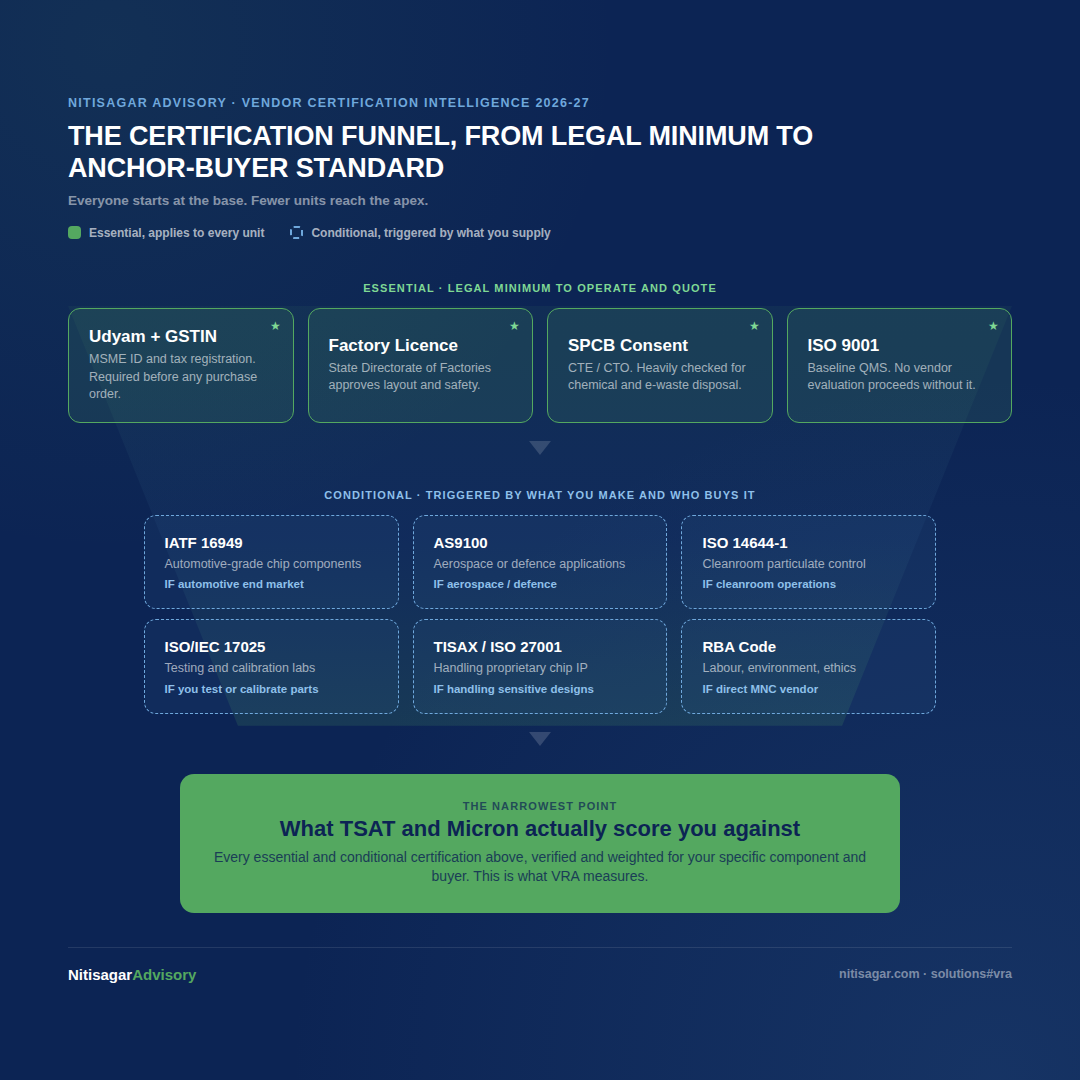
Four more certifications are conditional, not universal. Each triggers off a specific fact about what you supply or who buys it.
- AS9100, only if your output feeds aerospace or defence-grade applications. It shares roughly three-quarters of its content with ISO 9001, then adds counterfeit-parts detection, configuration traceability, and risk management specific to flight-critical supply chains. Not theoretical for a semiconductor supplier: Polar Semiconductor, a US foundry, holds AS9100D alongside IATF 16949 specifically to serve aerospace, defence, and automotive customers from one facility.
- ISO 14644-1, only if you supply into or operate a cleanroom. This standard classifies airborne particulate cleanliness, ISO Class 1 through Class 9. Wafer fabrication typically demands Class 1 to Class 3. Packaging and test areas, closer to what TSAT runs, typically sit at Class 5 to Class 7. Relevant to materials or sub-assemblies entering a controlled zone, not to a tool-room shop working outside one.
- ISO/IEC 17025, only if your unit tests, measures, or calibrates precision tools used on the fab or OSAT floor. This is lab accreditation, not a manufacturing quality standard. Test-socket fabricators and calibration-service providers are the MSME categories most likely to need it.
- ISO 27001, and separately, TISAX if the buyer is automotive. These get conflated often and are not the same certificate. ISO 27001 is a general information security standard, relevant if you handle a buyer’s proprietary chip designs or production data. TISAX is narrower: an automotive-specific security framework built on the VDA ISA questionnaire, required by German OEMs (Volkswagen, BMW, Mercedes-Benz) and passed down through their supply chains regardless of company size. A semiconductor OSAT supplier generally needs ISO 27001 if IP exposure is real. TISAX only becomes relevant if that OSAT’s own output specifically serves a German or European automotive customer.
- RBA Code of Conduct, only if you become a direct vendor to a multinational electronics brand rather than supplying through an intermediate. The Responsible Business Alliance code covers labour, environmental, and ethical sourcing standards that several large electronics buyers require as a condition of direct vendor status.
What this means for an Assam MSME entering the TSAT ancillary corridor
Our semiconductor cluster comparison of Penang, Sanand, and Morigaon found that mature clusters like Penang built their supplier certification depth over five decades. Sanand is compressing that into five years.
Morigaon does not get to skip the certification requirement just because the cluster is new. The buyer’s standard is the buyer’s standard everywhere.
- If TSAT’s automotive-grade packaging lines are the customer, IATF 16949 is the entry ticket, not ISO 9001 alone
- If the component touches static-sensitive assembly, expect an ESD control audit alongside the quality management review
- If the end product ships to network infrastructure or medical equipment customers, expect sector-specific reliability testing layered on top of the base standard
Our Vendor Readiness Audit maps exactly this gap. Which certification tier a given MSME genuinely needs, scored against the specific component and the specific anchor buyer. Not generic advice to “get ISO certified” that treats every vendor’s ceiling as identical. See how it works at nitisagar.com/solutions#vra.
Tier 6: Export and Traceability
For MSMEs targeting export markets, agro-processing units bound for ASEAN, bamboo and specialty rice processors, any unit in the Bio-Action Plan corridor, the question shifts.
It is no longer “what does Indian law require.” It is “what does the importing country’s buyer require to accept the shipment at all.”
- Phyto-sanitary certification
- Traceability documentation
- Quality marks recognised outside India
This is where ZED’s export dimension does real work. A Gold-level ZED rating, backed by genuine traceability records, is a credibility signal international buyers can verify independently.
It does not replace a destination-market-specific certification requirement. But it shortens the trust-building conversation that precedes one.
Export certification requirements are buyer and destination specific in a way domestic certifications are not. There is no one “export certificate.” There is a stack that depends on product category and destination market, built against the specific buyer relationship.
Mapping the Stack Onto TSAT’s Ancillary Corridor
Our TSAT packaging process component map identified six components as realistic, fundable MSME opportunities.
- Leadframes
- Die-attach adhesives
- Flip-chip underfill formulation
- Plating and surface-finish chemicals
- Precision engineering and tool-room services
- Test-socket fabrication
The certification stack for each is not identical. Conflating them is a real cost.
| Component | Foundation tier | Realistic certification ceiling |
|---|---|---|
| Leadframes | Udyam, GST, factory licence, pollution consent (orange, metal stamping and etching) | ISO 9001 baseline. IATF 16949 required for automotive-grade formats |
| Die-attach adhesives | Udyam, GST, factory licence, pollution consent (chemical handling) | ISO 9001. ZED Silver/Gold strengthens export and lending position |
| Flip-chip underfill formulation | Udyam, GST, factory licence, pollution consent | ISO 9001. Automotive customers push toward IATF 16949 given thermal-cycling reliability needs |
| Plating and surface-finish chemicals | Udyam, GST, factory licence, pollution consent (effluent-heavy, longer CTO timeline) | ISO 9001. ZED given the effluent and energy-efficiency parameters it already scores |
| Precision engineering / tool-room | Udyam, GST, factory licence, pollution consent (typically green category) | ISO 9001 is the realistic ceiling for most shops here. IATF only if directly supplying automotive-grade tooling |
| Test-socket fabrication | Udyam, GST, factory licence, pollution consent | ISO 9001 baseline. Deeper qualification runs against TSAT’s own test programmes, not a public certification body |
The pattern that falls out matches what our component report argued. Certification tier should track the realistic MSME ceiling for that specific component. Not an aspirational maximum.
A leadframe manufacturer targeting automotive-grade TSAT lines genuinely needs the IATF 16949 investment.
A precision engineering shop doing tool-room maintenance does not. ISO 9001 and a track record win that business. IATF-tier spending there is capital misallocated against a ceiling that component was never going to reach.
The Sequencing Mistake That Costs the Most
Two errors show up repeatedly across the MSMEs we assess.
Certifying before there is a buyer to certify for.
ISO 9001 and IATF 16949 require ongoing documentation discipline and annual audits. Not a one-time fee. A maintained system.
A unit that certifies speculatively, without a specific anchor customer’s requirement driving the decision, carries that maintenance cost against no confirmed revenue.
ZED’s low-cost entry point exists partly to solve this. It builds genuine quality-system discipline at near-zero cost before committing to heavier, buyer-specific certifications.
Discovering a mandatory certification after tooling is bought.
This is the BIS applicability trap. And its pollution-consent equivalent.
A founder sizes CTE/CTO timelines off a peer in a different pollution category. Or assumes a product sits outside CRS scope without a formal check. Months are lost mid-construction reconciling the gap.
The highest-leverage move in this entire stack is sequencing it correctly before capital is committed. Foundation tier and BIS applicability should be resolved at the project-planning stage. ZED should follow once Udyam registration is live. ISO 9001, IATF 16949, and export-specific certifications should be pursued against a named buyer’s stated requirement.
What This Means in Practice
The certification stack is not a ladder everyone climbs in the same order.
It branches:
- Four foundation approvals every manufacturing MSME needs, regardless of sector
- A quality-management tier gated by who is buying
- A product-specific mandatory tier gated by what is being made
- An anchor-buyer tier gated by the specific customer’s published standard
- An export tier gated by where the product is going
The founders who get this right treat certification as a sequencing problem tied to a specific commercial milestone. A named buyer. A specific product classification. An actual export order.
The founders who get it wrong either spend early on certifications no current buyer is asking for, or discover a mandatory one only after the capital for tooling is already committed.
That failure rate is not a verdict on the vendors. It is a measure of how rarely this stack gets mapped before capital is spent, rather than after a rejected quote forces the question.
Download the full MSME Certification Checklist, every tier from this report as tickable items with source links.No sign-up required. Get the checklist on Google Docs, free to copy and share with your team.
Nitisagar Advisory publishes industrial policy intelligence and MSME facilitation analysis for Northeast India. See the VRA vendor readiness audit at nitisagar.com/solutions#vra. For the component-level certification ceiling inside the TSAT corridor, see the TSAT Packaging Process Component Map. For cluster context, see the Penang, Sanand, and Morigaon comparison. For the full approvals sequence, see the Factory Setup Playbook and the East-NE Logistics Roadmap. Sector-specific coverage runs fortnightly in the Gear Shift newsletter.