
Pawan Kumar Chandana joined ISRO out of IIT Kharagpur. He worked there for six years as a rocket engineer. At Vikram Sarabhai Space Centre in Thiruvananthapuram, he met Naga Bharath Daka, an IIT Bombay avionics engineer working on the same launch vehicle programme.
In 2018, they left. There was no market for private rockets in India then. There was no policy either.
They founded Skyroot Aerospace on 12 June 2018 with a team of ten and $1.5 million in seed capital from Mukesh Bansal, the Myntra founder Chandana pitched in a single 45-minute conversation. Eight years later, Skyroot employs over 1,000 people. In May 2026, it became India’s first space-tech unicorn at a $1.1 billion valuation.
Today, at 11:35 AM IST, their rocket cleared the First Launch Pad at Sriharikota.
Mission Aagaman
Vikram-1 injected six payloads into a 450 km low-Earth orbit fifteen minutes after liftoff. India became the third country after the United States and China to achieve orbital launch through a private company.
The rocket is 23 metres tall and built with a carbon-composite structure, 3D-printed engines, and all-electric avionics. Its four-stage architecture uses three solid stages and a liquid Orbital Adjustment Module for precise satellite delivery.
Prime Minister Modi called Chandana and Daka within the hour. The video of that call circulated by the afternoon.
Every state government in India watched the same launch this morning. Every one of them is now working out what it means for their industrial pipeline.
Karnataka, Tamil Nadu, and Andhra Pradesh already have done the ground work. But Assam is lagging behind in this sunrise sector of the economy.
The $44 Billion Question
The FICCI-EY report released at the Bharat Space Conclave 2025 forecasts India’s space economy to grow from $8.4 billion in 2022 to $44 billion by 2033. IN-SPACe Chairman Pawan Goenka has confirmed the same target in his Decadal Vision.
India today holds around 2% of the global space market. The 2033 target is 8%, including $11 billion in exports. Reaching that requires $22 billion in private investment over the next decade.
The global market is projected at $1.8 trillion by 2035. The composition matters as much as the total.
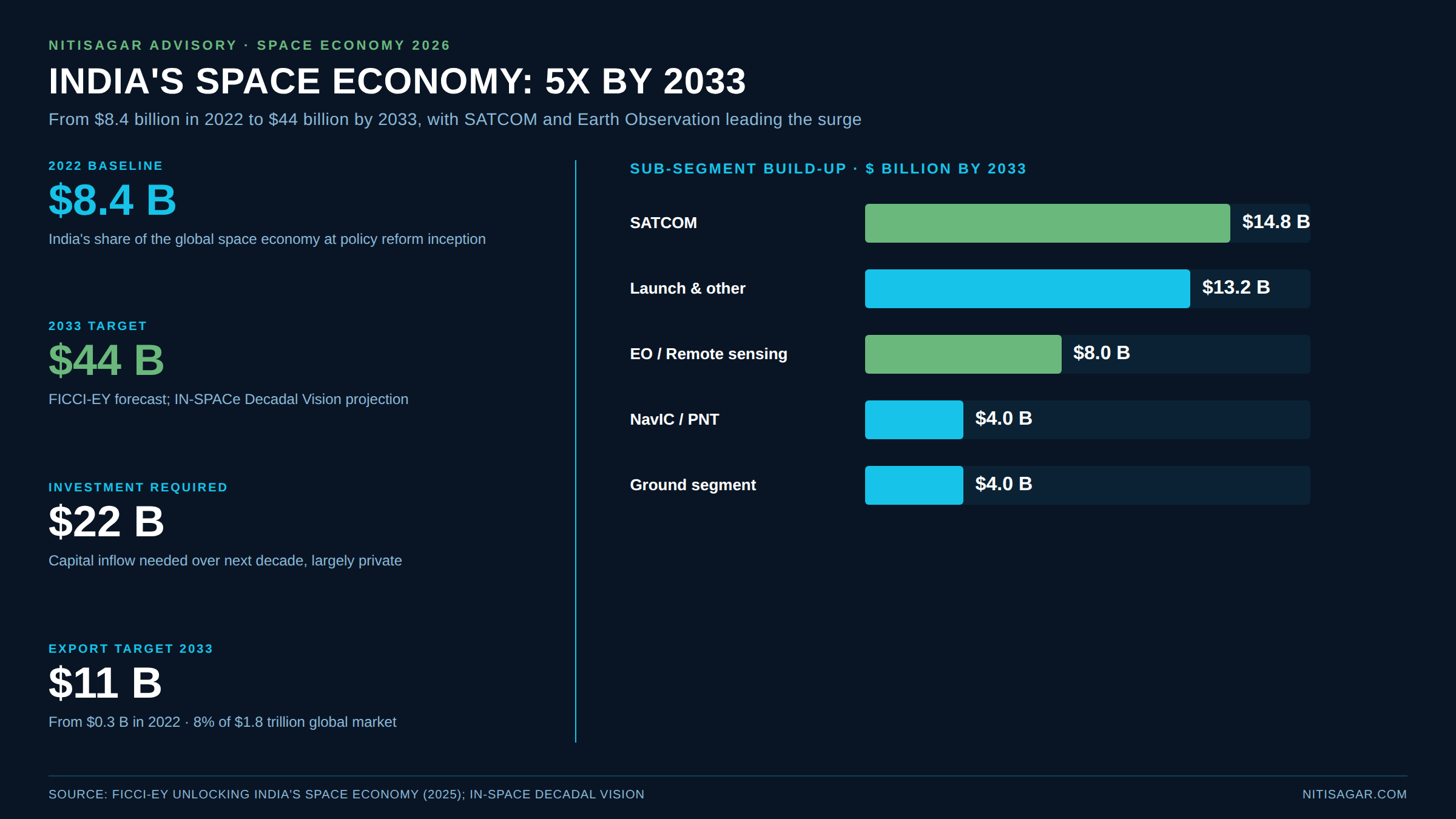
Satellite communication is projected at $14.8 billion by 2033. Earth observation and remote sensing at $8 billion. These are the two segments where state government demand meets private supply most cleanly.
India already has over 400 registered space startups, up from one in 2014. IN-SPACe has received over 658 applications from private entities across satellite development and launch services.
The private sector is expected to absorb most of the $22 billion investment. Which means the location decisions those companies make over the next 24 months will shape state-level industrial geography for the following decade.
Where the Other States Already Are
Karnataka published a draft Space Technology Policy 2024-29 targeting $3 billion in fresh investment. Its explicit goal is to capture half of India’s projected $44 billion space economy. Bengaluru already hosts ten ISRO centres, HAL, BEL, DRDO labs, the Indian Institute of Science, and 2,500+ MSMEs qualified as ISRO vendors.
Tamil Nadu approved its State Space Sector Policy 2024 with a ₹4,000 crore investment target and 10,000 jobs. The state’s advantage is geography: Kulasekarapattinam in Thoothukudi district lets SSLV-class rockets fly directly south over the Indian Ocean without landmass overflight, which improves payload economics on every launch. Construction on the ₹986 crore facility began in March 2025.
Andhra Pradesh is finalising Space Policy 4.0 with a ₹25,000 crore investment target, 5,000 direct and 30,000 indirect jobs, and dedicated Space Cities at Lepakshi and Tirupati. Capital subsidies range from 25% to 45% by category.
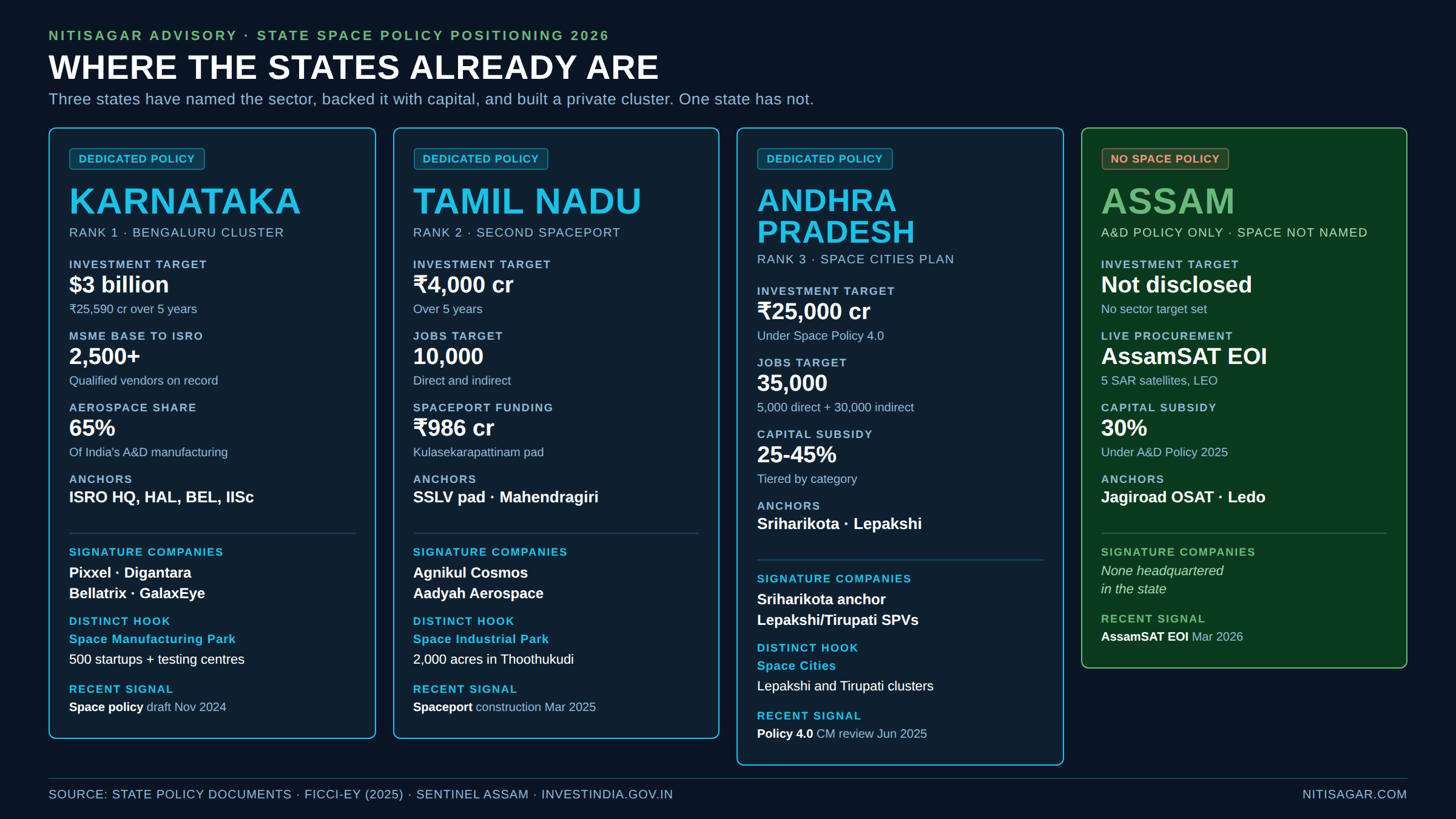
The three southern states have named the sector. They have written targets, allocated incentives, and identified physical clusters. Investors and founders reading site-selection material find their names in the top of the funnel.
Assam is not mentioned in these conversations because Assam has not written itself into it yet.
What Assam Actually Has On Paper
Five instruments in Assam overlap with the space value chain, most of them not designed for it. Reading them together tells a story the state has not yet articulated clearly.
The Assam Aerospace and Defence Manufacturing Policy 2025. Notified on 23 February 2025 for a five-year term. Target categories include aerospace systems, avionics and electronic systems, and unmanned aerial vehicles. The word “space” does not appear in the document. The fiscal package for qualifying units:
- 30% capital subsidy on plant and machinery, disbursed over three years
- 100% SGST reimbursement up to 150% of fixed capital investment over ten years
- 50% land discount for defence industries
- 50% outward transport subsidy on raw materials and finished goods
- 5% production-linked subsidy on annual revenue for five years
- 2% export revenue subsidy for five years
- Seed grant of up to ₹25 lakh and go-to-market support of up to ₹2.5 crore for startups
- Assam Defence and Electronics Startup Growth Fund with a ₹50 crore initial corpus
The Tata Electronics OSAT facility at Jagiroad. A ₹27,000 crore greenfield project, approved in February 2024 with 48 million semiconductor chips per day at full capacity. The packaging technology stack covers Wire Bond, Flip Chip, and Integrated Systems Packaging. First production is targeted for late 2026.
This is a chip packaging facility built for automotive and industrial customers. Space electronics uses the same tolerance categories. That overlap is currently unspoken, and our analysis of the Assam Budget 2026-27 covers the A-SEMI programme designed to build vendor depth around Jagiroad.
The AssamSAT tender. The Assam Science Technology and Environment Council issued an Expression of Interest on 16 March 2026 inviting private aerospace firms to design, build, launch, operate, and eventually transfer at least five earth-observation satellites in low-Earth orbit. Because Assam is cloud-covered for roughly six months of the year, the tender requires Synthetic Aperture Radar payloads.
Assam is the first Indian state to float such a tender. The intended applications include Brahmaputra flood monitoring, Siliguri Corridor surveillance, drug-trafficking route detection, and Kaziranga anti-poaching.
Update: The tender has now moved towards the “final and critical stage of partner selection” as per an update from CM of Assam on X on Aug 23, 2026. We will update this post once the partner has been selected.
The Chief Minister has since framed AssamSAT as one half of a two-part bet, with a proposed Centre for Space Entrepreneurship in Guwahati as the other. The pitch is that space tech becomes a force multiplier for the state, from mapping resources to monitoring disasters and improving planning, and that a dedicated centre gives young innovators a base to build space-based solutions for Assam and beyond.
The centre traces back to a two-day Northeast India Space Workshop that SIA-India ran in Guwahati in August with the North Eastern Space Applications Centre, its first national industry dialogue held outside Delhi. The proposal that came out of it: build the centre with the Software Technology Parks of India and the state government. Beyond the usual mentorship and market-access remit, it is meant to open a working channel to the Centre of Excellence in Space Technology in Bengaluru.
That Bengaluru channel matters more than the Guwahati address. Every Indian satellite prime and space electronics manufacturer sits in Bengaluru or Hyderabad. A Northeast founder does not need Assam to build its own satellite prime. They need a real route into that cluster’s testing labs and supplier lists, while building for problems the region actually has, floods, landslides, agriculture, forests, border management, the exact demand the workshop flagged as under-served.
The centre is still a proposal, not a funded institution. But it answers something concrete: Assam has procurement through AssamSAT and infrastructure through Jagiroad and Ledo, and no pipeline of founders or engineers to build around either one.
The ISTRAC Advanced Radar Research Facility at Chandrapur. On 21 September 2026, ISRO performed the Bhoomi Pujan for a new radar facility on the site of a former thermal power station at Chandrapur, on the edge of Guwahati. The state government handed over close to 70 acres of that land free of cost, of which the radar installation itself will occupy around 6.61 acres. ISRO Chairman V. Narayanan attended alongside the Chief Minister, who thanked the Prime Minister for sanctioning the project.
The facility sits inside Project NETRA, ISRO’s space-situational-awareness programme, which catalogues orbital debris and issues collision warnings for India’s satellite fleet. Before Chandrapur, NETRA’s sensor network was a short, geography-driven list: the Multi-Object Tracking Radar at Sriharikota, optical telescopes at Ponmudi, Mount Abu and Leh, sited for clear high-altitude skies rather than industrial policy, and the control hub that fuses their data at ISTRAC’s Bengaluru campus. Chandrapur is the network’s first dedicated debris-tracking radar outside that original belt of Andhra Pradesh, Kerala, Rajasthan and Ladakh.
The Chief Minister leaned into that distinction, telling ISRO the state would back “whatever help you need for expansion” without limit, and predicting the site would “get the same place as ISRO in Bengaluru” within a few years. That is a large claim for a debris-tracking radar to carry on its own. What Chandrapur concretely delivers is narrower and still useful: Assam’s first operating ISRO facility, a milestone Karnataka, Kerala, Rajasthan and Ladakh already have through NETRA, and Andhra Pradesh has through Sriharikota itself. It does not bring a satellite prime, a launch pad, or a component supply chain with it. It gives the state a fact it did not have in July: ISRO is already building here.
The regional talent pipeline. Assam Don Bosco University’s LACHIT-1 CubeSat flew on PSLV-C62 on 12 January 2026. The launch failed at the third stage, but the 50+ students and faculty from Assam, Meghalaya, Nagaland, Arunachal Pradesh, and Manipur retained the ground station and a workflow that ISRO has already validated. Separately, ISRO is building a ₹81.82 crore satellite earth station near Ledo in Tinsukia.
Where Assam Cannot Compete, and Should Not Try
Four segments of the space value chain are effectively closed to any Northeast Indian entrant over the next decade, and Chandrapur’s radar, welcome as it is, does not reopen any of them. Naming the four lets Assam concentrate elsewhere.
Launch vehicle manufacturing. Skyroot’s Infinity Campus in Hyderabad has 2 lakh sq ft of workspace, built to produce one orbital rocket every month. Agnikul Cosmos operates from IIT Madras. Both cluster around cities with deep composites supply chains and ISRO adjacency.
Satellite prime contracting. The active Indian satellite primes today, including Ananth Technologies, Centum Electronics, Alpha Design Technologies, Tata Advanced Systems, and Dhruva Space, are all headquartered in Bengaluru or Hyderabad. Their supplier relationships and testing infrastructure are locked in those clusters.
Space electronics primes. Data Patterns, an ISRO-approved space-grade manufacturing facility founded in 1985, is in Chennai. Apollo Micro Systems, which supplies aerospace-grade avionics to ISRO and DRDO, is in Hyderabad. Kaynes Technology is in Mysuru. Each carries a 20+ year certification base that a greenfield Assam entrant would need to match before winning a first order.
Launch operations. Sriharikota is in Andhra Pradesh. Kulasekarapattinam is being built in Tamil Nadu. Assam’s latitude and monsoon geography make it unsuitable for orbital launches from state territory.
The first-tier space manufacturing race is already decided. Karnataka, Andhra Pradesh, Tamil Nadu, and Telangana have won it. Assam is not competing at that tier and no policy incentive changes that.
Four Niches Where Assam Can Play
The value chain, however, is broader than manufacturing satellites and rockets. Four segments align with what Assam already has or is building.
Anchor customer for earth observation. AssamSAT is a live procurement, not a policy aspiration. Its SAR specification for flood monitoring, border surveillance, and wildlife protection maps directly onto the earth observation segment projected at $8 billion by 2033. Being the reference customer at this stage of market development is often more valuable than being the manufacturer.
Ground station infrastructure. The Ledo earth station de-risks the cost of a regional ground presence for private operators. As small-satellite constellations scale, demand for South Asian ground segment capacity will grow. Northeast India’s latitude becomes an asset for polar-orbit constellations. This is a segment where Assam is providing infrastructure that a private operator would otherwise take five years to build. Chandrapur doesn’t extend that private-facing case directly, since ISRO isn’t leasing radar time to Skyroot, but it gives Assam a second live example of ISRO choosing to build physical infrastructure in the state, the same argument made twice.
Component packaging adjacency. Space avionics requires chip packaging at automotive-grade tolerances or better. Tata Electronics’ Jagiroad facility covers exactly those packaging categories. The commercial case for an avionics electronics manufacturer to co-locate near Jagiroad, under the 30% capital subsidy and 100% SGST reimbursement in the A&D policy, is a legible board-level argument.
Downstream applications and analytics. The largest employment segment in the space economy over the next decade is not upstream manufacturing. It is downstream data services: flood modelling, agricultural monitoring, insurance underwriting, disaster response coordination, forestry analytics.
Assam has native demand for each one of these services, and the North-Eastern Space Applications Centre at Umiam has been building analytics capacity in the region since 2000.
| Niche | Assam’s asset | Practical next step |
|---|---|---|
| Anchor EO customer | AssamSAT in partner-selection stage (Aug 2026) | Announce the signed award |
| Ground segment | ISRO Ledo earth station (₹81.82 cr) + ISTRAC Chandrapur radar (Project NETRA) | Position for private operator co-location |
| Component packaging | Jagiroad + A&D Policy | Name space in policy amendment |
| Downstream analytics | NESAC proximity, demand density | Fund a Guwahati downstream cluster |
The logistics side of any of these requires the corridor build-out we covered in the East-NE Logistics Roadmap. Component packaging without export-grade transport connectivity is a partial answer.
Five Gaps Assam Needs To Close, And What To Do About Each
The framing question is not whether a Skyroot or a Pixxel will move to Assam. Neither will. The question is what a state government can do to appear in the site-selection frameworks that determine where their suppliers, downstream partners, and second-tier operations go. Five gaps separate Assam’s current position from that list. Three can close within a budget cycle. Two take years regardless of intent.
The policy naming gap. The A&D Policy 2025 covers aerospace generally, but the word “space” does not appear in it. The single most consequential change Assam can make in this cycle is to amend the policy to explicitly include space manufacturing as a qualifying activity. A one-line notification makes the existing 30% capital subsidy, 100% SGST reimbursement, and 50% land discount available to any space electronics or ground segment supplier. Without it, every application requires case-by-case interpretation.
The demonstrated procurement gap. AssamSAT reached what the Chief Minister called the “final and critical stage of partner selection” by August 2026, but Assam has not announced a signed contract. Private space companies read state government procurement conversion rates, and Indian state EOIs historically convert to signed contracts below 50%. The gap does not close until a name is on the award. The longer “final stage” runs without one, the more it reads like the March headline all over again.
The visibility gap. No private space company today identifies Assam as a location it is evaluating. Karnataka’s advantage began with location, and its cluster deepened through a standing presence at Bengaluru Tech Summit, Bengaluru Space Expo, and Aero India. Assam has no visible delegation at any of these forums. A multi-year presence, plus factory visits by senior state officials to Skyroot’s Infinity Campus, Pixxel’s Bengaluru facility, and Dhruva Space’s Hyderabad operations, changes what these companies say when their internal site-selection meetings mention the Northeast. No state government has run that kind of sustained outreach for the space sector out of the Northeast yet. Chandrapur wins Assam a line in ISRO’s own announcements. It does not win a line in any private company’s site-selection deck, and those are the decks that matter here.
The vendor pool gap. Karnataka has 2,500+ MSMEs qualified as ISRO vendors. Assam has essentially none. Building a vendor pool takes 5-7 years even with aggressive skilling, and the A-SEMI programme announced in the recent budget targets semiconductors, not space, though the overlap in chip-packaging tolerances means it is not starting from zero.
The skills gap. Space electronics requires radiation-hardened design, thermal-vacuum testing, and vibration and shock qualification skills. No Assam institution currently offers curriculum in these areas. The upcoming Dassault Systèmes hub at Assam Engineering College in Guwahati is a starting point but does not cover this specialisation. The proposed Centre for Space Entrepreneurship would need to fold in exactly this curriculum to be more than a branding exercise.
The Claiming What’s Yours report covers the pattern by which states that show up win investment they were not initially expected to attract. Assam has not yet shown up on space.
What Comes Next
Vikram-1 reached orbit today. The next Vikram launch is targeted before the end of 2026. Skyroot has stated its intent to reach monthly launch cadence once the demonstration flights are complete.
Each launch feeds demand for avionics suppliers, ground segment operators, downstream analytics companies, and eventually satellite customers. The states that capture that demand will be the states already named in company site-selection material.
Assam has an assembly of assets that were built for adjacent purposes and that overlap usefully with the space value chain. The state has not yet written a policy that acknowledges that overlap or a communication strategy that puts it in front of the companies that would use it. Both are within reach in this budget cycle.
Chandana and Daka started Skyroot in 2018 in a country that had no market for what they were building. The gap between what a state government intends and what a private company reads is smaller than it looks. It is a policy amendment, a signed AssamSAT award, and a delegation programme.
Nitisagar Advisory publishes industrial policy intelligence and MSME facilitation analysis for Northeast India. For our earlier reading of the state’s industrial trajectory, see the Assam Budget 2026-27 analysis. For subsidy positioning under existing schemes, see the Claiming What’s Yours report. Sector-specific policy coverage runs fortnightly in the Gear Shift newsletter.