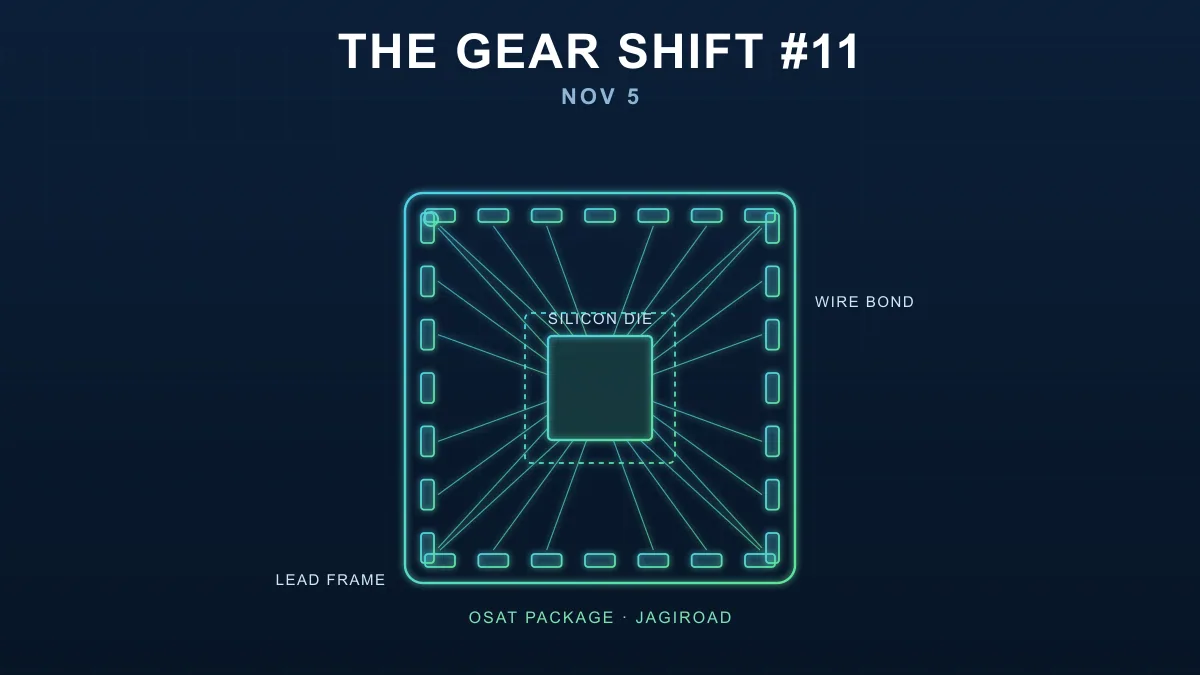
A busy fortnight in Assam. A defence park cleared on 4 November, a bullet-train corridor extended to Guwahati on 1 November, a semiconductor packaging centre signed at IIT Guwahati on 30 October, and cement, plastics and building-block plants cleared or opened across three districts in the same ten days. Five stories, and what each one means for a ₹2 to 15 crore founder.
Story 1: Jagiroad Makes Its First Pilot Chips, and the Plant Enters Its Final Stage
In Issue #10 I reported that one production line had moved to Jagiroad and packaging was underway. On 3 October the Chief Minister said the plant has produced “pilot chips” and that its first clean room is ready, and by the end of the month he was describing the ₹27,000 crore project as being in its final stage. That is the milestone the wire coverage had been waiting for: not a line relocating, but silicon coming off it.
The specifics, for the Tata Semiconductor Assembly and Test facility:
- Packaging technologies on site: Wire Bond, Flip Chip, and Integrated Systems Packaging.
- Full designed capacity: up to 48 million semiconductor units per day, the largest OSAT planned in India.
- Two named customers now: Qualcomm automotive modules (announced February) and a September partnership with Nexperia for discrete semiconductor assembly and testing.
- The formal inauguration by the Prime Minister is expected in December 2026 or January 2027.
Pilot chips are not commercial volume, and the earlier Phase 1 target of April has already slipped once. The honest read is a plant moving through qualification, not one at full tilt.
The MSME angle: The Nexperia name is the one to watch. A second anchor customer means a second set of qualification standards in Morigaon district, and discrete-device assembly has a different consumables and services footprint from Qualcomm’s automotive modules. The vendor-qualification window does not open at the ribbon-cutting, it is open now, while the plant runs pilots and decides which local suppliers it trusts. The semiconductor supply-chain map and the OSAT component breakdown show where those first orders go.
Story 2: IIT Guwahati and Tata Electronics Sign the Packaging School the Ecosystem Needed
The anchor plant has customers. What it has lacked is a local pipeline of people who can run packaging lines, and on 30 October IIT Guwahati and Tata Electronics signed an MoU to build exactly that. The agreement sets up a Centre of Excellence on the IIT Guwahati campus for semiconductor Assembly, Testing, Marking and Packaging, the discipline the industry calls ATMP.
What the collaboration covers, from the institute’s release:
- IIT Guwahati leads the development of diploma-level training and B.Tech engineering programmes in ATMP, with hands-on practical work built into the curriculum.
- Partner engineering colleges, universities and polytechnics will be identified, and their faculty trained to teach the subject.
- Students from partner institutions get hands-on training, with research opportunities in packaging, assembly and testing.
- The stated aim is to strengthen the semiconductor talent ecosystem in Assam and the Northeast.
The MoU was signed by Prof. Rohit Sinha, Dean of R&D at IIT Guwahati, and Ranjan Bandyopadhyay, Chief Human Resources Officer at Tata Electronics. The release does not put a number on students or funding, so treat it as a framework, not a budget.
The MSME angle: I argued in Issue #9 that training is an MSME opportunity, not just an MSME need, and this is the clause that proves it. The Centre of Excellence will train faculty at partner colleges and polytechnics, which means the state’s ITI and polytechnic network becomes the delivery layer, not just IIT Guwahati. A Northeast skilling firm, placement operator or polytechnic that can get itself onto the partner list sits in front of the talent pipeline the OSAT down the road in Jagiroad will hire from. The track to watch is the partner-institution identification, where a ₹2 to 15 crore training vendor can compete, and the semiconductor careers portal maps the roles that pipeline feeds.
Story 3: Assam Clears a 6,000-Bigha Defence Park, and the MRO Question Behind It
On 4 November the cabinet approved a 6,000-bigha defence park near Nellie in Nagaon, the state’s first site set aside for defence manufacturing. No investor, budget or timeline came with it. What makes the decision worth reading is not the park on its own, but the policy stack it finally gives a physical address.
Assam has held the policy for this since early 2025, without a site to put it on:
- The Assam Aerospace and Defence Manufacturing Policy 2025 courts aircraft components, avionics, defence equipment, simulation, and MRO, with negotiated incentives for investors above ₹500 crore.
- The Assam MRO Policy 2025, cleared by the cabinet in January, targets at least three operational maintenance, repair and overhaul facilities by 2030 on cumulative investment above ₹1,500 crore.
- Budget 2026 put ₹100 crore behind aerospace components and MRO infrastructure, and the industries minister has pitched the state’s border location as a defence-logistics advantage.
Read together, the likeliest first use of a park this size is not a weapons line but an MRO depot, a maintenance, repair and overhaul base for civil and defence aviation, which is what the state has been signalling it wants. MRO is the realistic entry point because it runs on engineering capacity, not a defence production licence.
The MSME angle: An MRO depot is a precision-engineering ecosystem before it is anything else. It needs machine shops, tooling and jigs, metrology and calibration, surface treatment, heat treatment and fabrication, the base layer I wrote about in the Rajkot castings and machine-tools report. The certification bar is high, AS9100 and defence vendor registration, and the procurement cycle is slow, so treat this as a two to three year readiness play, not a 2027 order book. The move now is to get the quality system in place and track the park’s notification and the two aerospace policies in the Policy Explorer.
Story 4: The Bullet Train Reaches Guwahati, at Least on the Map
On 1 November the Chief Minister announced that the Centre has extended the Northern high-speed rail corridor to Guwahati. The corridor, which links Delhi with Agra, Kanpur, Lucknow, Ayodhya, Varanasi and Patna, was originally planned to end at Siliguri, and the state had pitched for the Guwahati extension in July. The Chief Minister’s headline claim is Guwahati to Delhi in under eight hours.
Two things to hold in view:
- No construction timeline, route alignment or commissioning date has been given. This is a corridor approved in principle, not a project under way.
- The engineering problem is real. The line has to cross the Siliguri Corridor, the “Chicken’s Neck,” and the Chief Minister has said it may need to go underground there, which is slow and expensive.
The MSME angle: A high-speed line takes a decade or more to build, so no founder should plan a business around a Guwahati bullet train. The reason it still matters is connectivity, which is the single biggest reason the Northeast falls off national supply-chain maps and the constraint our East and Northeast logistics roadmap was written to address. A corridor approval tells an anchor’s procurement team that the friction is being worked on, and if the line breaks ground the construction phase is itself the near-term opportunity, in aggregates, steel fabrication, precast and logistics. Judge it on the freight and road upgrades that tend to follow a corridor commitment, not on the train.
Story 5: The Industrial Base Fills In, Across Cement, Plastics and Building Blocks
The marquee stories take the headlines, but the quieter signal is the spread of ordinary manufacturing into districts that have had little of it. Three plants in ten days, none of them a chip or a defence contract:
- Cement, Dima Hasao. On 30 October the Chief Minister laid the foundation for JK Lakshmi Cement’s integrated plant at Umrangso: a ₹1,800 crore first phase expected to create 1,000 jobs, part of a total commitment of around ₹11,000 crore, with 2.5 million tonnes of annual cement capacity targeted for FY2029. The Chief Minister said Ambuja, Dalmia, Star Cement and Jindal are also set to build in Dima Hasao, and that the state will route 60 per cent of limestone royalty to the Dima Hasao Autonomous Council.
- Plastics, Rangia. The cabinet on 23 October cleared a ₹303.69 crore plant by Weetek Plastic, the Welspun Group company that runs the Sintex brand, at Rangia in Kamrup, expected to employ around 300 people. This is the water-tank and piping business, a classic building-materials anchor on the north bank.
- Building blocks, Tinsukia. On 29 October the Chief Minister inaugurated a ₹55 crore green AAC block plant by Lightbricks, a KD Group company, at Hapjan, with capacity of 2 lakh cubic metres a year and around 80 direct jobs, called the largest private manufacturing investment in Tinsukia district in fifteen years.
The common thread is speed. The Chief Minister said the Dima Hasao cement project went from an Advantage Assam 2.0 MoU to a foundation stone in twenty months, and both the Rangia and Tinsukia plants trace to the same summit pipeline.
The MSME angle: This is the layer a ₹2 to 15 crore firm actually supplies. Cement pulls in limestone haulage, packaging, fly-ash supply, bagging, and plant services, and a four-company cluster in Dima Hasao makes that a durable catchment, not a single buyer. Plastics and AAC blocks feed straight into the state’s own construction demand, which the defence park and the cement plants will only raise. The pattern across all three is MoU to ground in under two years, so the catchment windows are opening district by district, and land assembly remains the longest lead item to plan around, as our Factory Setup Playbook sets out. Run your own numbers against the Subsidy Calculator and track each notification in the Policy Explorer.
Gear Shift is a fortnightly roundup of India’s manufacturing and industrial policy developments, with a focus on implications for MSMEs in Northeast India. Published by Nitisagar Advisory, Guwahati.
If you found this issue useful, subscribe below to receive the next one in your inbox.